

cooling is significant, 10
C or so, it is quite possible for little further nucleation to
occur and for the growth process to be dominated by the originally created suite of
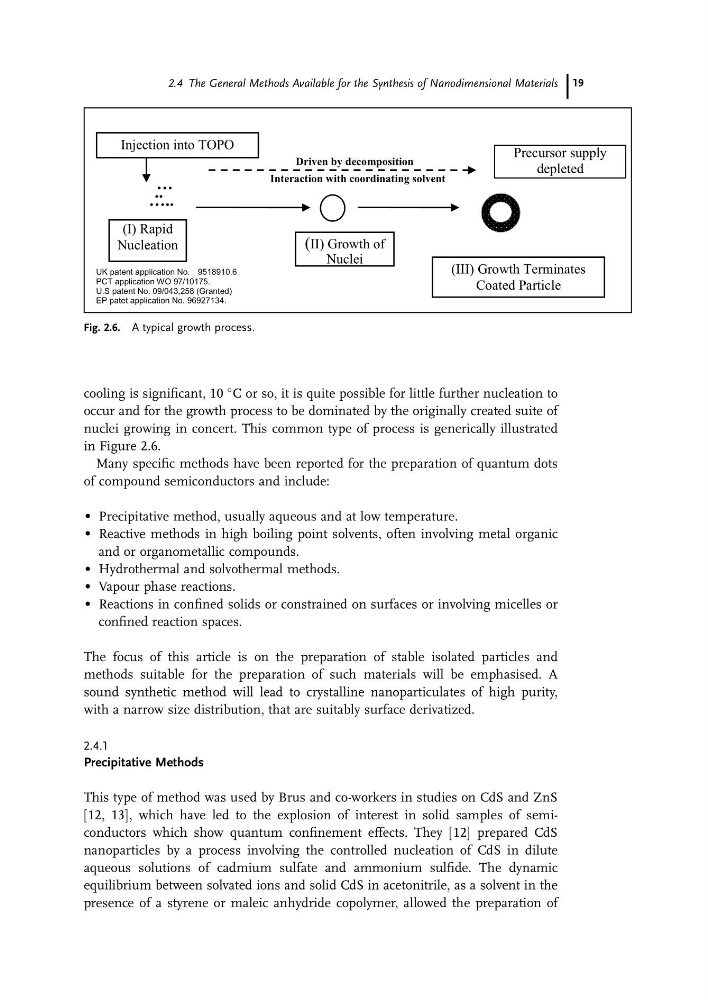
nuclei growing in concert. This common type of process is generically illustrated
in Figure 2.6.
Many specific methods have been reported for the preparation of quantum dots
of compound semiconductors and include:
. Precipitative method, usually aqueous and at low temperature.
. Reactive methods in high boiling point solvents, often involving metal organic
and or organometallic compounds.
. Hydrothermal and solvothermal methods.
. Vapour phase reactions.
. Reactions in confined solids or constrained on surfaces or involving micelles or
confined reaction spaces.
The focus of this article is on the preparation of stable isolated particles and
methods suitable for the preparation of such materials will be emphasised. A
sound synthetic method will lead to crystalline nanoparticulates of high purity,
with a narrow size distribution, that are suitably surface derivatized.
2.4.1
Precipitative Methods
This type of method was used by Brus and co-workers in studies on CdS and ZnS
[12, 13], which have led to the explosion of interest in solid samples of semiconductors which show quantum confinement effects. They [12] prepared CdS
nanoparticles by a process involving the controlled nucleation of CdS in dilute
aqueous solutions of cadmium sulfate and ammonium sulfide. The dynamic
equilibrium between solvated ions and solid CdS in acetonitrile, as a solvent in the
presence of a styrene or maleic anhydride copolymer, allowed the preparation of
UK patent application No. 9518910.6
PCT application WO 97/10175.
U.S patent No. 09/043,258 (Granted)
EP patet application No. 96927134.
Driven by decomposition
Interaction with coordinating solvent
Injection into TOPO
(I) Rapid
Nucleation
(II) Growth of
Nuclei
(III) Growth Terminates
Coated Particle
Precursor supply
depleted
…
..
…..
Fig. 2.6. A typical growth process.
2.4 The General Methods Available for the Synthesis of Nanodimensional Materials 19
C or so, it is quite possible for little further nucleation to
occur and for the growth process to be dominated by the originally created suite of
nuclei growing in concert. This common type of process is generically illustrated
in Figure 2.6.
Many specific methods have been reported for the preparation of quantum dots
of compound semiconductors and include:
. Precipitative method, usually aqueous and at low temperature.
. Reactive methods in high boiling point solvents, often involving metal organic
and or organometallic compounds.
. Hydrothermal and solvothermal methods.
. Vapour phase reactions.
. Reactions in confined solids or constrained on surfaces or involving micelles or
confined reaction spaces.
The focus of this article is on the preparation of stable isolated particles and
methods suitable for the preparation of such materials will be emphasised. A
sound synthetic method will lead to crystalline nanoparticulates of high purity,
with a narrow size distribution, that are suitably surface derivatized.
2.4.1
Precipitative Methods
This type of method was used by Brus and co-workers in studies on CdS and ZnS
[12, 13], which have led to the explosion of interest in solid samples of semiconductors which show quantum confinement effects. They [12] prepared CdS
nanoparticles by a process involving the controlled nucleation of CdS in dilute
aqueous solutions of cadmium sulfate and ammonium sulfide. The dynamic
equilibrium between solvated ions and solid CdS in acetonitrile, as a solvent in the
presence of a styrene or maleic anhydride copolymer, allowed the preparation of
UK patent application No. 9518910.6
PCT application WO 97/10175.
U.S patent No. 09/043,258 (Granted)
EP patet application No. 96927134.
Driven by decomposition
Interaction with coordinating solvent
Injection into TOPO
(I) Rapid
Nucleation
(II) Growth of
Nuclei
(III) Growth Terminates
Coated Particle
Precursor supply
depleted
…
..
…..
Fig. 2.6. A typical growth process.
2.4 The General Methods Available for the Synthesis of Nanodimensional Materials 19