

collections of clusters is that each particle is, in principle, a mesoscopic object with
its properties determined by its own nature, i.e. its precise morphology and the
number of atomic units from which it is built. It inherently lacks the anonymous
nature of a molecule in an assembly.
However there is much that can be learned from colloid chemistry when designing the synthesis of such materials, and it seems colloid chemistry is gaining a
new lease of life from a better understanding of the assembly of nanoparticulates.
Much of the understanding of crystallization is based on the ideas associated with
supersaturation. In a typical system undergoing a crystallization process nuclei or
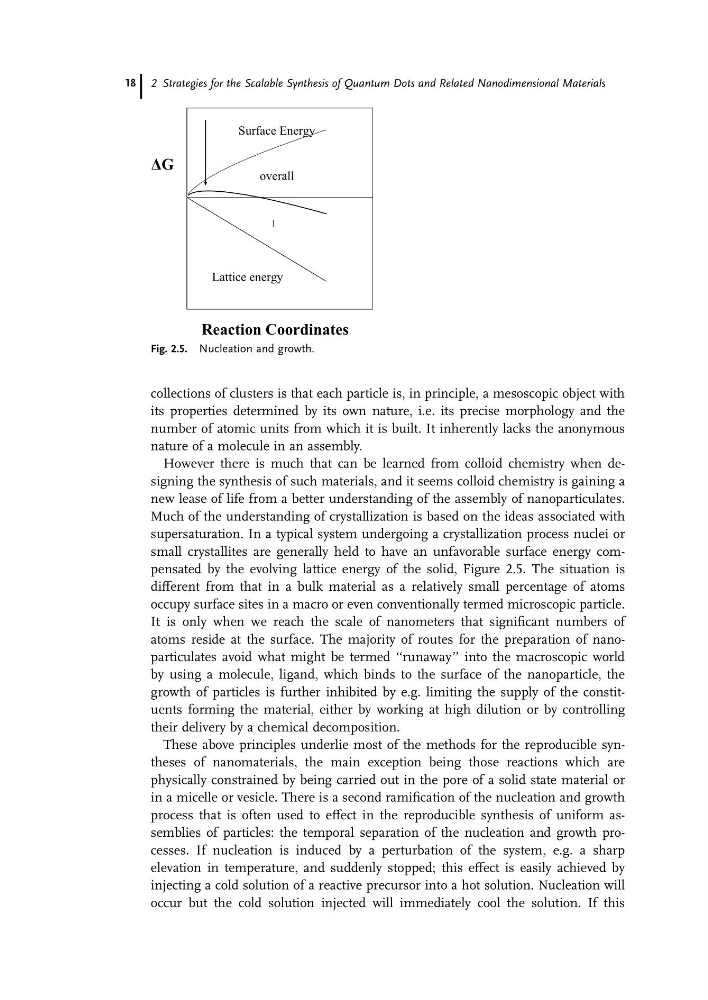
small crystallites are generally held to have an unfavorable surface energy compensated by the evolving lattice energy of the solid, Figure 2.5. The situation is
different from that in a bulk material as a relatively small percentage of atoms
occupy surface sites in a macro or even conventionally termed microscopic particle.
It is only when we reach the scale of nanometers that significant numbers of
atoms reside at the surface. The majority of routes for the preparation of nanoparticulates avoid what might be termed ‘‘runaway’’ into the macroscopic world
by using a molecule, ligand, which binds to the surface of the nanoparticle, the
growth of particles is further inhibited by e.g. limiting the supply of the constituents forming the material, either by working at high dilution or by controlling
their delivery by a chemical decomposition.
These above principles underlie most of the methods for the reproducible syntheses of nanomaterials, the main exception being those reactions which are
physically constrained by being carried out in the pore of a solid state material or
in a micelle or vesicle. There is a second ramification of the nucleation and growth
process that is often used to effect in the reproducible synthesis of uniform assemblies of particles: the temporal separation of the nucleation and growth processes. If nucleation is induced by a perturbation of the system, e.g. a sharp
elevation in temperature, and suddenly stopped; this effect is easily achieved by
injecting a cold solution of a reactive precursor into a hot solution. Nucleation will
occur but the cold solution injected will immediately cool the solution. If this
|
Reaction Coordinates
DG
Lattice energy
Surface Energy
overall
Fig. 2.5. Nucleation and growth.
2 Strategies for the Scalable Synthesis of Quantum Dots and Related Nanodimensional Materials
18
its properties determined by its own nature, i.e. its precise morphology and the
number of atomic units from which it is built. It inherently lacks the anonymous
nature of a molecule in an assembly.
However there is much that can be learned from colloid chemistry when designing the synthesis of such materials, and it seems colloid chemistry is gaining a
new lease of life from a better understanding of the assembly of nanoparticulates.
Much of the understanding of crystallization is based on the ideas associated with
supersaturation. In a typical system undergoing a crystallization process nuclei or
small crystallites are generally held to have an unfavorable surface energy compensated by the evolving lattice energy of the solid, Figure 2.5. The situation is
different from that in a bulk material as a relatively small percentage of atoms
occupy surface sites in a macro or even conventionally termed microscopic particle.
It is only when we reach the scale of nanometers that significant numbers of
atoms reside at the surface. The majority of routes for the preparation of nanoparticulates avoid what might be termed ‘‘runaway’’ into the macroscopic world
by using a molecule, ligand, which binds to the surface of the nanoparticle, the
growth of particles is further inhibited by e.g. limiting the supply of the constituents forming the material, either by working at high dilution or by controlling
their delivery by a chemical decomposition.
These above principles underlie most of the methods for the reproducible syntheses of nanomaterials, the main exception being those reactions which are
physically constrained by being carried out in the pore of a solid state material or
in a micelle or vesicle. There is a second ramification of the nucleation and growth
process that is often used to effect in the reproducible synthesis of uniform assemblies of particles: the temporal separation of the nucleation and growth processes. If nucleation is induced by a perturbation of the system, e.g. a sharp
elevation in temperature, and suddenly stopped; this effect is easily achieved by
injecting a cold solution of a reactive precursor into a hot solution. Nucleation will
occur but the cold solution injected will immediately cool the solution. If this
|
Reaction Coordinates
DG
Lattice energy
Surface Energy
overall
Fig. 2.5. Nucleation and growth.
2 Strategies for the Scalable Synthesis of Quantum Dots and Related Nanodimensional Materials
18