

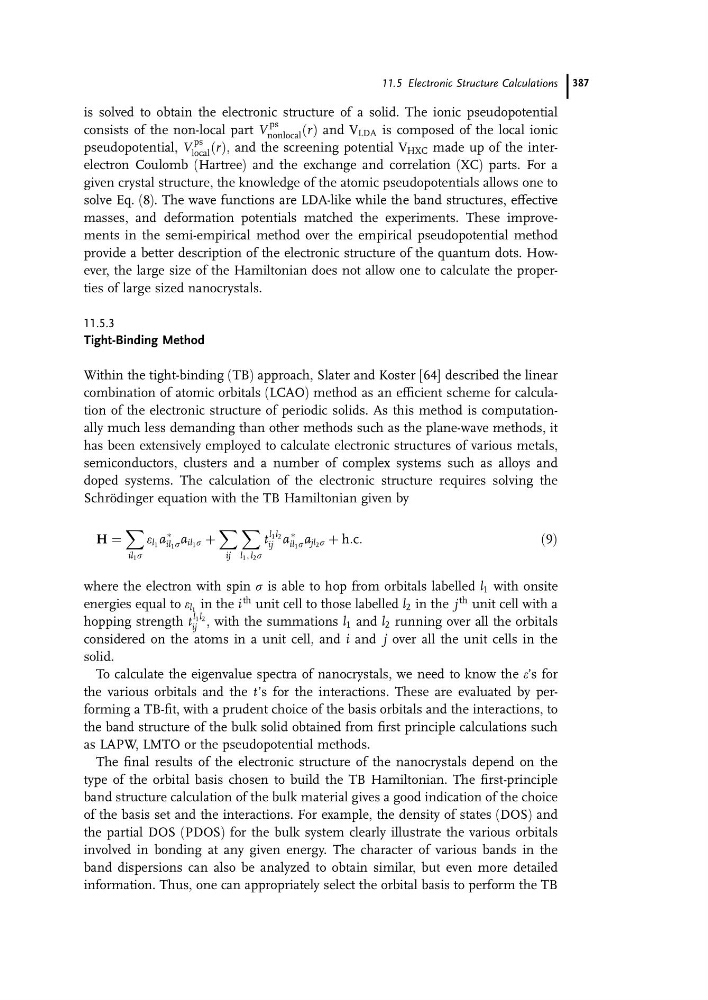
is solved to obtain the electronic structure of a solid. The ionic pseudopotential
consists of the non-local part V
ps
nonlocal ðrÞ and V LDA is composed of the local ionic
pseudopotential, V
ps
local ðrÞ, and the screening potential V HXC made up of the interelectron Coulomb (Hartree) and the exchange and correlation (XC) parts. For a
given crystal structure, the knowledge of the atomic pseudopotentials allows one to
solve Eq. (8). The wave functions are LDA-like while the band structures, effective
masses, and deformation potentials matched the experiments. These improvements in the semi-empirical method over the empirical pseudopotential method
provide a better description of the electronic structure of the quantum dots. However, the large size of the Hamiltonian does not allow one to calculate the properties of large sized nanocrystals.
11.5.3
Tight-Binding Method
Within the tight-binding (TB) approach, Slater and Koster [64] described the linear
combination of atomic orbitals (LCAO) method as an efficient scheme for calculation of the electronic structure of periodic solids. As this method is computationally much less demanding than other methods such as the plane-wave methods, it
has been extensively employed to calculate electronic structures of various metals,
semiconductors, clusters and a number of complex systems such as alloys and
doped systems. The calculation of the electronic structure requires solving the
Schro ¨dinger equation with the TB Hamiltonian given by
H ¼
X
il1s
e l1 a
Ã
il1s a il1s þ
X
ij
X
l1; l2s
t
l1l2
ij a
Ã
il1s a jl2s þ h:c:
ð9Þ
where the electron with spin s is able to hop from orbitals labelled l 1 with onsite
energies equal to e l1 in the i
th unit cell to those labelled l 2 in the j
th unit cell with a
hopping strength t
l1l2
ij , with the summations l 1 and l 2 running over all the orbitals
considered on the atoms in a unit cell, and i and j over all the unit cells in the
solid.
To calculate the eigenvalue spectra of nanocrystals, we need to know the e’s for
the various orbitals and the t’s for the interactions. These are evaluated by performing a TB-fit, with a prudent choice of the basis orbitals and the interactions, to
the band structure of the bulk solid obtained from first principle calculations such
as LAPW, LMTO or the pseudopotential methods.
The final results of the electronic structure of the nanocrystals depend on the
type of the orbital basis chosen to build the TB Hamiltonian. The first-principle
band structure calculation of the bulk material gives a good indication of the choice
of the basis set and the interactions. For example, the density of states (DOS) and
the partial DOS (PDOS) for the bulk system clearly illustrate the various orbitals
involved in bonding at any given energy. The character of various bands in the
band dispersions can also be analyzed to obtain similar, but even more detailed
information. Thus, one can appropriately select the orbital basis to perform the TB
11.5 Electronic Structure Calculations 387
consists of the non-local part V
ps
nonlocal ðrÞ and V LDA is composed of the local ionic
pseudopotential, V
ps
local ðrÞ, and the screening potential V HXC made up of the interelectron Coulomb (Hartree) and the exchange and correlation (XC) parts. For a
given crystal structure, the knowledge of the atomic pseudopotentials allows one to
solve Eq. (8). The wave functions are LDA-like while the band structures, effective
masses, and deformation potentials matched the experiments. These improvements in the semi-empirical method over the empirical pseudopotential method
provide a better description of the electronic structure of the quantum dots. However, the large size of the Hamiltonian does not allow one to calculate the properties of large sized nanocrystals.
11.5.3
Tight-Binding Method
Within the tight-binding (TB) approach, Slater and Koster [64] described the linear
combination of atomic orbitals (LCAO) method as an efficient scheme for calculation of the electronic structure of periodic solids. As this method is computationally much less demanding than other methods such as the plane-wave methods, it
has been extensively employed to calculate electronic structures of various metals,
semiconductors, clusters and a number of complex systems such as alloys and
doped systems. The calculation of the electronic structure requires solving the
Schro ¨dinger equation with the TB Hamiltonian given by
H ¼
X
il1s
e l1 a
Ã
il1s a il1s þ
X
ij
X
l1; l2s
t
l1l2
ij a
Ã
il1s a jl2s þ h:c:
ð9Þ
where the electron with spin s is able to hop from orbitals labelled l 1 with onsite
energies equal to e l1 in the i
th unit cell to those labelled l 2 in the j
th unit cell with a
hopping strength t
l1l2
ij , with the summations l 1 and l 2 running over all the orbitals
considered on the atoms in a unit cell, and i and j over all the unit cells in the
solid.
To calculate the eigenvalue spectra of nanocrystals, we need to know the e’s for
the various orbitals and the t’s for the interactions. These are evaluated by performing a TB-fit, with a prudent choice of the basis orbitals and the interactions, to
the band structure of the bulk solid obtained from first principle calculations such
as LAPW, LMTO or the pseudopotential methods.
The final results of the electronic structure of the nanocrystals depend on the
type of the orbital basis chosen to build the TB Hamiltonian. The first-principle
band structure calculation of the bulk material gives a good indication of the choice
of the basis set and the interactions. For example, the density of states (DOS) and
the partial DOS (PDOS) for the bulk system clearly illustrate the various orbitals
involved in bonding at any given energy. The character of various bands in the
band dispersions can also be analyzed to obtain similar, but even more detailed
information. Thus, one can appropriately select the orbital basis to perform the TB
11.5 Electronic Structure Calculations 387