

11.5.1
Effective Mass Approximation
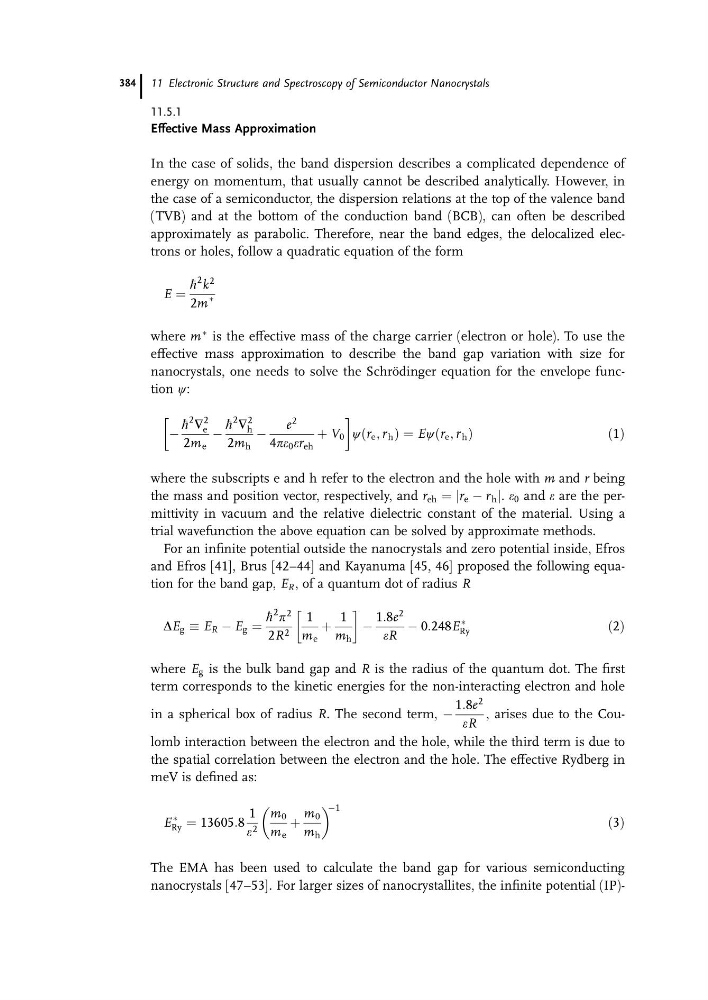
In the case of solids, the band dispersion describes a complicated dependence of
energy on momentum, that usually cannot be described analytically. However, in
the case of a semiconductor, the dispersion relations at the top of the valence band
(TVB) and at the bottom of the conduction band (BCB), can often be described
approximately as parabolic. Therefore, near the band edges, the delocalized electrons or holes, follow a quadratic equation of the form
E ¼
p
2 k
2
2m
Ã
where m
à is the effective mass of the charge carrier (electron or hole). To use the
effective mass approximation to describe the band gap variation with size for
nanocrystals, one needs to solve the Schro ¨dinger equation for the envelope function c:
À
p
2 ‘
2
e
2m e
À
p
2 ‘
2
h
2m h
À
e
2
4pe 0 er eh
þ V 0
!
cðr e ; r h Þ ¼ Ecðr e ; r h Þ
ð 1Þ
where the subscripts e and h refer to the electron and the hole with m and r being
the mass and position vector, respectively, and r eh ¼ jr e À r h j. e 0 and e are the permittivity in vacuum and the relative dielectric constant of the material. Using a
trial wavefunction the above equation can be solved by approximate methods.
For an infinite potential outside the nanocrystals and zero potential inside, Efros
and Efros [41], Brus [42–44] and Kayanuma [45, 46] proposed the following equation for the band gap, E R , of a quantum dot of radius R
DE g 1 E R À E g ¼
p
2 p
2
2R 2
1
m e
þ
1
m h
!
À
1:8e
2
eR
À 0:248E
Ã
Ry
ð2Þ
where E g is the bulk band gap and R is the radius of the quantum dot. The first
term corresponds to the kinetic energies for the non-interacting electron and hole
in a spherical box of radius R. The second term, À
1:8e
2
eR
, arises due to the Coulomb interaction between the electron and the hole, while the third term is due to
the spatial correlation between the electron and the hole. The effective Rydberg in
meV is defined as:
E
Ã
Ry ¼ 13605:8
1
e 2
m 0
m e
þ
m 0
m h
À1
ð3Þ
The EMA has been used to calculate the band gap for various semiconducting
nanocrystals [47–53]. For larger sizes of nanocrystallites, the infinite potential (IP)11 Electronic Structure and Spectroscopy of Semiconductor Nanocrystals
384
Effective Mass Approximation
In the case of solids, the band dispersion describes a complicated dependence of
energy on momentum, that usually cannot be described analytically. However, in
the case of a semiconductor, the dispersion relations at the top of the valence band
(TVB) and at the bottom of the conduction band (BCB), can often be described
approximately as parabolic. Therefore, near the band edges, the delocalized electrons or holes, follow a quadratic equation of the form
E ¼
p
2 k
2
2m
Ã
where m
à is the effective mass of the charge carrier (electron or hole). To use the
effective mass approximation to describe the band gap variation with size for
nanocrystals, one needs to solve the Schro ¨dinger equation for the envelope function c:
À
p
2 ‘
2
e
2m e
À
p
2 ‘
2
h
2m h
À
e
2
4pe 0 er eh
þ V 0
!
cðr e ; r h Þ ¼ Ecðr e ; r h Þ
ð 1Þ
where the subscripts e and h refer to the electron and the hole with m and r being
the mass and position vector, respectively, and r eh ¼ jr e À r h j. e 0 and e are the permittivity in vacuum and the relative dielectric constant of the material. Using a
trial wavefunction the above equation can be solved by approximate methods.
For an infinite potential outside the nanocrystals and zero potential inside, Efros
and Efros [41], Brus [42–44] and Kayanuma [45, 46] proposed the following equation for the band gap, E R , of a quantum dot of radius R
DE g 1 E R À E g ¼
p
2 p
2
2R 2
1
m e
þ
1
m h
!
À
1:8e
2
eR
À 0:248E
Ã
Ry
ð2Þ
where E g is the bulk band gap and R is the radius of the quantum dot. The first
term corresponds to the kinetic energies for the non-interacting electron and hole
in a spherical box of radius R. The second term, À
1:8e
2
eR
, arises due to the Coulomb interaction between the electron and the hole, while the third term is due to
the spatial correlation between the electron and the hole. The effective Rydberg in
meV is defined as:
E
Ã
Ry ¼ 13605:8
1
e 2
m 0
m e
þ
m 0
m h
À1
ð3Þ
The EMA has been used to calculate the band gap for various semiconducting
nanocrystals [47–53]. For larger sizes of nanocrystallites, the infinite potential (IP)11 Electronic Structure and Spectroscopy of Semiconductor Nanocrystals
384