

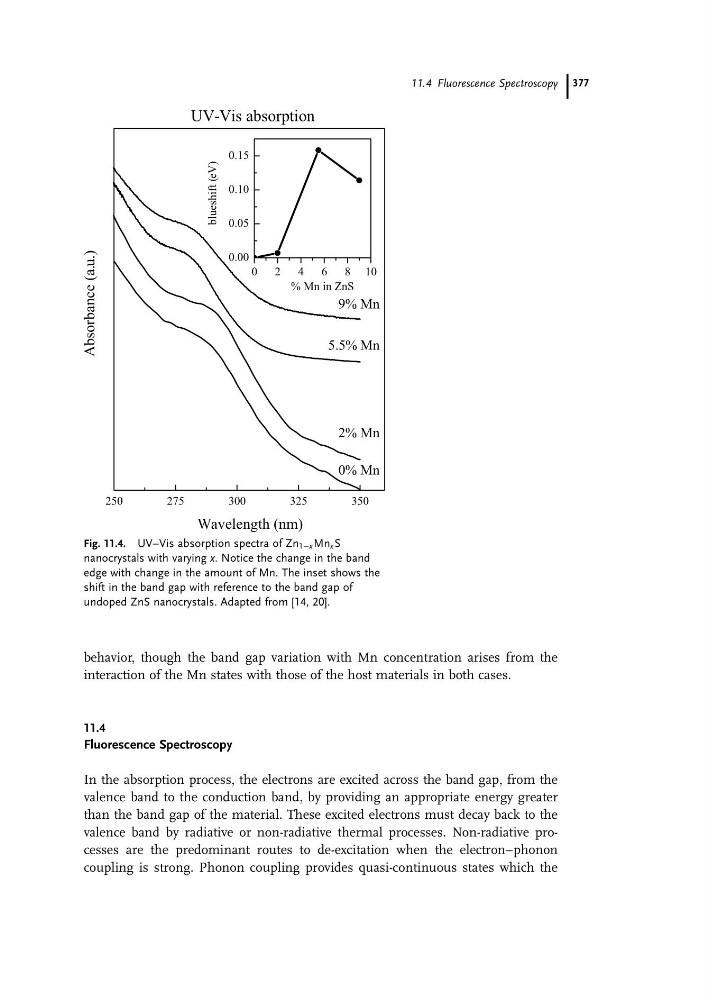
behavior, though the band gap variation with Mn concentration arises from the
interaction of the Mn states with those of the host materials in both cases.
11.4
Fluorescence Spectroscopy
In the absorption process, the electrons are excited across the band gap, from the
valence band to the conduction band, by providing an appropriate energy greater
than the band gap of the material. These excited electrons must decay back to the
valence band by radiative or non-radiative thermal processes. Non-radiative processes are the predominant routes to de-excitation when the electron–phonon
coupling is strong. Phonon coupling provides quasi-continuous states which the
250
275
300
325
350
0
2
4
6
8 10
0.00
0.05
0.10
0.15
9% Mn
5.5% Mn
2% Mn
0% Mn
Absorbance (a.u.)
Wavelength (nm)
UV-Vis absorption
blueshift (eV)
% Mn in ZnS
Fig. 11.4. UV–Vis absorption spectra of Zn 1Àx Mn x S
nanocrystals with varying x. Notice the change in the band
edge with change in the amount of Mn. The inset shows the
shift in the band gap with reference to the band gap of
undoped ZnS nanocrystals. Adapted from [14, 20].
11.4 Fluorescence Spectroscopy 377
interaction of the Mn states with those of the host materials in both cases.
11.4
Fluorescence Spectroscopy
In the absorption process, the electrons are excited across the band gap, from the
valence band to the conduction band, by providing an appropriate energy greater
than the band gap of the material. These excited electrons must decay back to the
valence band by radiative or non-radiative thermal processes. Non-radiative processes are the predominant routes to de-excitation when the electron–phonon
coupling is strong. Phonon coupling provides quasi-continuous states which the
250
275
300
325
350
0
2
4
6
8 10
0.00
0.05
0.10
0.15
9% Mn
5.5% Mn
2% Mn
0% Mn
Absorbance (a.u.)
Wavelength (nm)
UV-Vis absorption
blueshift (eV)
% Mn in ZnS
Fig. 11.4. UV–Vis absorption spectra of Zn 1Àx Mn x S
nanocrystals with varying x. Notice the change in the band
edge with change in the amount of Mn. The inset shows the
shift in the band gap with reference to the band gap of
undoped ZnS nanocrystals. Adapted from [14, 20].
11.4 Fluorescence Spectroscopy 377