

dral phases such as the rock salt structure. It is easy to imagine the conversion
from tetrahedral coordination to octahedral coordination. Applying pressure to the
tetrahedron it can be flattened out to give a square planar structure. Two atoms
from the top and bottom can come closer to form an octahedron. Although C
and Si, which are highly covalent, would be unstable in octahedral coordination
and prefer tetrahedral coordination owing to their sp
3 hybridized orbitals, II–VI
and III–V semiconductors, that have some degree of ionicity, can be transformed
to the octahedrally coordinated structure by application of pressure. It has been
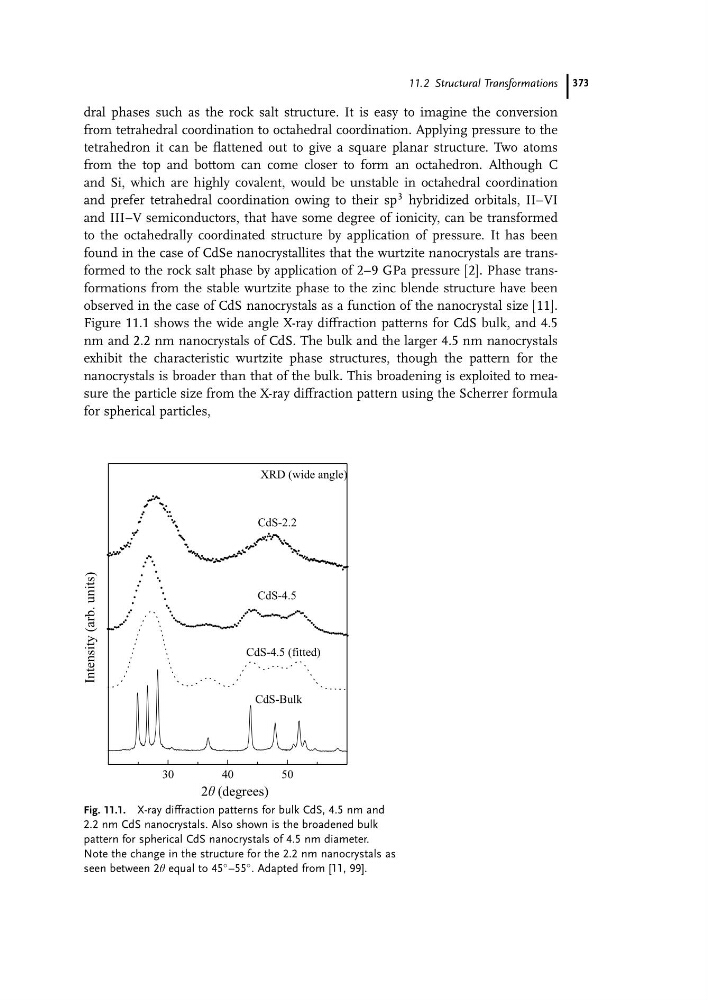
found in the case of CdSe nanocrystallites that the wurtzite nanocrystals are transformed to the rock salt phase by application of 2–9 GPa pressure [2]. Phase transformations from the stable wurtzite phase to the zinc blende structure have been
observed in the case of CdS nanocrystals as a function of the nanocrystal size [11].
Figure 11.1 shows the wide angle X-ray diffraction patterns for CdS bulk, and 4.5
nm and 2.2 nm nanocrystals of CdS. The bulk and the larger 4.5 nm nanocrystals
exhibit the characteristic wurtzite phase structures, though the pattern for the
nanocrystals is broader than that of the bulk. This broadening is exploited to measure the particle size from the X-ray diffraction pattern using the Scherrer formula
for spherical particles,
30
40
50
CdS-4.5 (fitted)
XRD (wide angle)
CdS-Bulk
CdS-4.5
CdS-2.2
Intensity (arb. units)
2q (degrees)
Fig. 11.1. X-ray diffraction patterns for bulk CdS, 4.5 nm and
2.2 nm CdS nanocrystals. Also shown is the broadened bulk
pattern for spherical CdS nanocrystals of 4.5 nm diameter.
Note the change in the structure for the 2.2 nm nanocrystals as
seen between 2y equal to 45
–55
. Adapted from [11, 99].
11.2 Structural Transformations 373
from tetrahedral coordination to octahedral coordination. Applying pressure to the
tetrahedron it can be flattened out to give a square planar structure. Two atoms
from the top and bottom can come closer to form an octahedron. Although C
and Si, which are highly covalent, would be unstable in octahedral coordination
and prefer tetrahedral coordination owing to their sp
3 hybridized orbitals, II–VI
and III–V semiconductors, that have some degree of ionicity, can be transformed
to the octahedrally coordinated structure by application of pressure. It has been
found in the case of CdSe nanocrystallites that the wurtzite nanocrystals are transformed to the rock salt phase by application of 2–9 GPa pressure [2]. Phase transformations from the stable wurtzite phase to the zinc blende structure have been
observed in the case of CdS nanocrystals as a function of the nanocrystal size [11].
Figure 11.1 shows the wide angle X-ray diffraction patterns for CdS bulk, and 4.5
nm and 2.2 nm nanocrystals of CdS. The bulk and the larger 4.5 nm nanocrystals
exhibit the characteristic wurtzite phase structures, though the pattern for the
nanocrystals is broader than that of the bulk. This broadening is exploited to measure the particle size from the X-ray diffraction pattern using the Scherrer formula
for spherical particles,
30
40
50
CdS-4.5 (fitted)
XRD (wide angle)
CdS-Bulk
CdS-4.5
CdS-2.2
Intensity (arb. units)
2q (degrees)
Fig. 11.1. X-ray diffraction patterns for bulk CdS, 4.5 nm and
2.2 nm CdS nanocrystals. Also shown is the broadened bulk
pattern for spherical CdS nanocrystals of 4.5 nm diameter.
Note the change in the structure for the 2.2 nm nanocrystals as
seen between 2y equal to 45
–55
. Adapted from [11, 99].
11.2 Structural Transformations 373