

10.8.3
Thermal and Chemical Stabilities of Hydrogenated Silicon Nanostructures
As reviewed in Section 10.6, the SiNWs could be etched using HF solution so that
the surface oxide sheath is removed and the exposed silicon surface is saturated
with hydrogen. The stability of the oxide-removed H-terminated Si wafer surfaces
has been investigated and many techniques were invented to suppress its reoxidation upon exposure to humidity. For the case of nanostructured hydrogenated
silicon, its chemical stability would be different from the case of the wafer, as has
been demonstrated in our recent computational works. One of our predictions,
that the hydrogenated SiNWs possess better stability than that of a silicon wafer,
could find a number of supportive evidences from our experiments as described
above.
10.8.3.1 Structural Properties of Hydrogenated Silicon Nanocrystals and
Nanoclusters
The structures of hydrogenated Si nanocrystals and nanoclusters were studied
using the empirical tight-binding optimizations and molecular dynamics simulations [88]. It was shown that the structural properties of the hydrogen-saturated Si
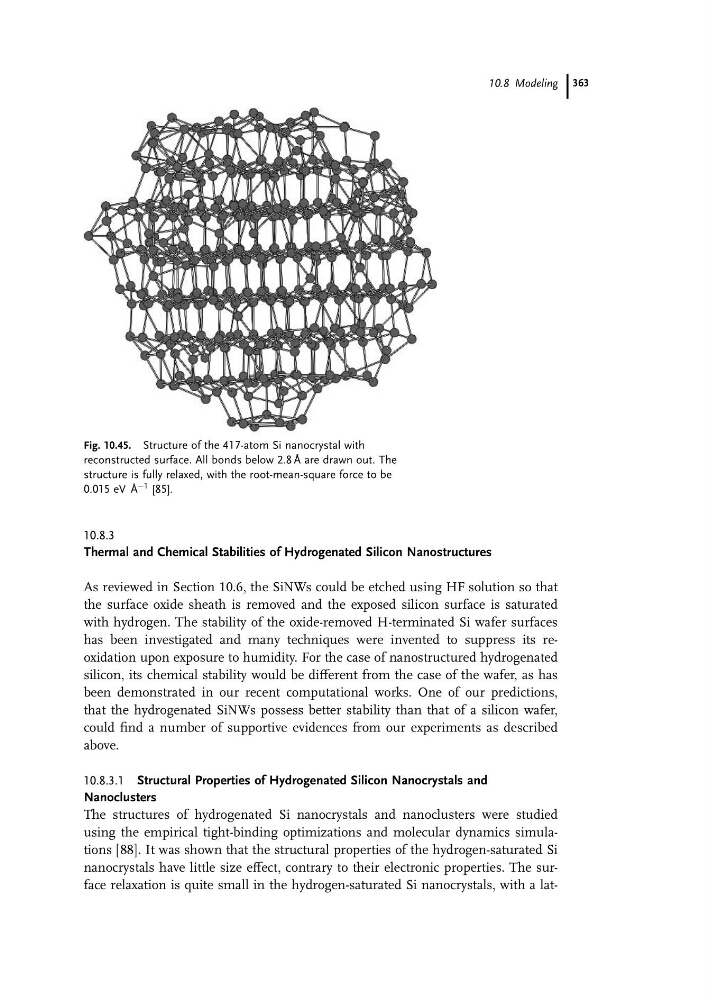
nanocrystals have little size effect, contrary to their electronic properties. The surface relaxation is quite small in the hydrogen-saturated Si nanocrystals, with a latFig. 10.45. Structure of the 417-atom Si nanocrystal with
reconstructed surface. All bonds below 2.8 A ˚ are drawn out. The
structure is fully relaxed, with the root-mean-square force to be
0.015 eV A ˚ À1 [85].
10.8 Modeling 363
Thermal and Chemical Stabilities of Hydrogenated Silicon Nanostructures
As reviewed in Section 10.6, the SiNWs could be etched using HF solution so that
the surface oxide sheath is removed and the exposed silicon surface is saturated
with hydrogen. The stability of the oxide-removed H-terminated Si wafer surfaces
has been investigated and many techniques were invented to suppress its reoxidation upon exposure to humidity. For the case of nanostructured hydrogenated
silicon, its chemical stability would be different from the case of the wafer, as has
been demonstrated in our recent computational works. One of our predictions,
that the hydrogenated SiNWs possess better stability than that of a silicon wafer,
could find a number of supportive evidences from our experiments as described
above.
10.8.3.1 Structural Properties of Hydrogenated Silicon Nanocrystals and
Nanoclusters
The structures of hydrogenated Si nanocrystals and nanoclusters were studied
using the empirical tight-binding optimizations and molecular dynamics simulations [88]. It was shown that the structural properties of the hydrogen-saturated Si
nanocrystals have little size effect, contrary to their electronic properties. The surface relaxation is quite small in the hydrogen-saturated Si nanocrystals, with a latFig. 10.45. Structure of the 417-atom Si nanocrystal with
reconstructed surface. All bonds below 2.8 A ˚ are drawn out. The
structure is fully relaxed, with the root-mean-square force to be
0.015 eV A ˚ À1 [85].
10.8 Modeling 363