

10.6.3
Chemical Sensing of SiNWs [78]
I–V measurements performed on an ensemble of SiNWs with a variety of diameters, growth directions, defect densities etc. are expected to yield only averaged
behavior, which is dominated by those wires with the lowest resistivity [as in a
parallel configuration of wires (resistors)]. While such ensemble measurements
cannot be used to study the electrical conduction properties and mechanisms of
nanowires, they can however give rough indications to check a variety of possible applications, one being gas sensing.
We have fabricated bundles of SiNWs of two types: (1) as-grown SiO 2 sheathed
wires, (2) SiNWs dipped in HF to remove the SiO 2 . Silver contacts were glued to
the edges of the bundles and their resistivity was measured at different ambient conditions (vacuum (2 Â 10
À2 Torr, air with @60% humidity, dry N 2 , NH 3 :N 2 1:1000).
The resistivity of the oxide-removed bundles was strongly reduced (by more than
three orders of magnitude) upon exposure to humid air and to ammonia, but was
hardly changed by exposure to dry nitrogen (Figure 10.31(a)). The process was
found to be reversible, i.e. the resistivity increased to the initial value after pumping (Figure 10.31(b)). In contrast, the resistivity of the SiNWs embedded in the
SiO 2 sheath did not change when exposed to different ambient environments.
The gas molecules may affect either the contact resistance across two nanowires
or the surface resistance along individual wires, e.g. through charge exchange
similar to polycrystalline semiconductor SnO 2 sensors. This would not happen for
SiO 2 sheathed wires (having a high resistivity) for which gas incorporation has no
effect. The chemical sensitivity of HF-etched SiNWs to NH 3 and water vapor exposure indicate their possible use in gas sensing applications.
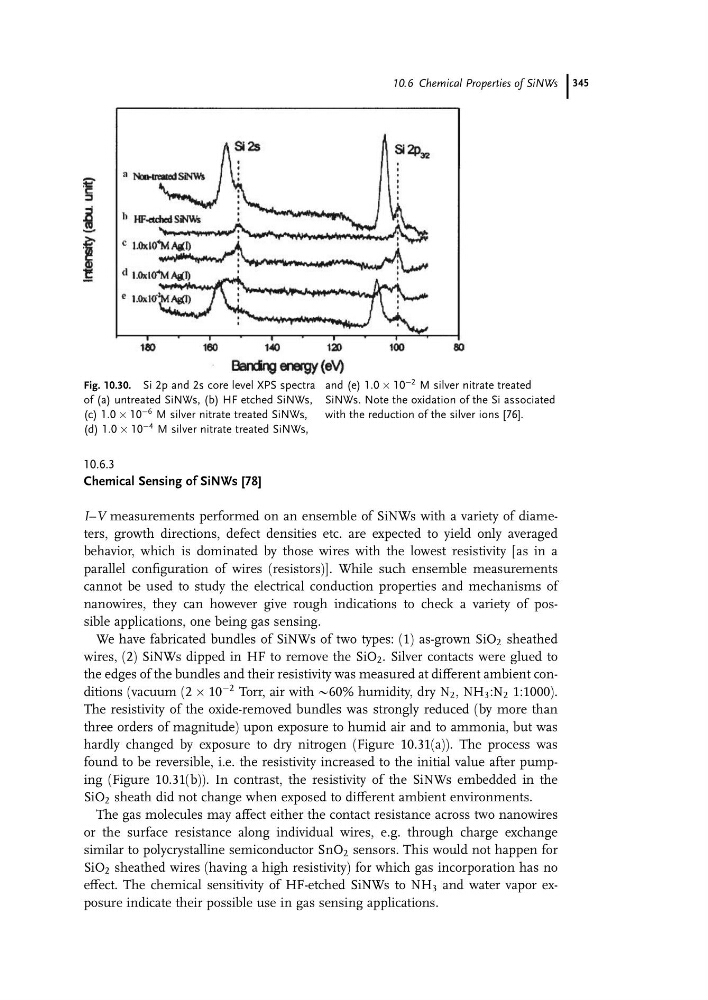
Fig. 10.30. Si 2p and 2s core level XPS spectra
of (a) untreated SiNWs, (b) HF etched SiNWs,
(c) 1:0 Â 10
À6 M silver nitrate treated SiNWs,
(d) 1:0 Â 10
À4 M silver nitrate treated SiNWs,
and (e) 1:0 Â 10
À2 M silver nitrate treated
SiNWs. Note the oxidation of the Si associated
with the reduction of the silver ions [76].
10.6 Chemical Properties of SiNWs 345
Chemical Sensing of SiNWs [78]
I–V measurements performed on an ensemble of SiNWs with a variety of diameters, growth directions, defect densities etc. are expected to yield only averaged
behavior, which is dominated by those wires with the lowest resistivity [as in a
parallel configuration of wires (resistors)]. While such ensemble measurements
cannot be used to study the electrical conduction properties and mechanisms of
nanowires, they can however give rough indications to check a variety of possible applications, one being gas sensing.
We have fabricated bundles of SiNWs of two types: (1) as-grown SiO 2 sheathed
wires, (2) SiNWs dipped in HF to remove the SiO 2 . Silver contacts were glued to
the edges of the bundles and their resistivity was measured at different ambient conditions (vacuum (2 Â 10
À2 Torr, air with @60% humidity, dry N 2 , NH 3 :N 2 1:1000).
The resistivity of the oxide-removed bundles was strongly reduced (by more than
three orders of magnitude) upon exposure to humid air and to ammonia, but was
hardly changed by exposure to dry nitrogen (Figure 10.31(a)). The process was
found to be reversible, i.e. the resistivity increased to the initial value after pumping (Figure 10.31(b)). In contrast, the resistivity of the SiNWs embedded in the
SiO 2 sheath did not change when exposed to different ambient environments.
The gas molecules may affect either the contact resistance across two nanowires
or the surface resistance along individual wires, e.g. through charge exchange
similar to polycrystalline semiconductor SnO 2 sensors. This would not happen for
SiO 2 sheathed wires (having a high resistivity) for which gas incorporation has no
effect. The chemical sensitivity of HF-etched SiNWs to NH 3 and water vapor exposure indicate their possible use in gas sensing applications.
Fig. 10.30. Si 2p and 2s core level XPS spectra
of (a) untreated SiNWs, (b) HF etched SiNWs,
(c) 1:0 Â 10
À6 M silver nitrate treated SiNWs,
(d) 1:0 Â 10
À4 M silver nitrate treated SiNWs,
and (e) 1:0 Â 10
À2 M silver nitrate treated
SiNWs. Note the oxidation of the Si associated
with the reduction of the silver ions [76].
10.6 Chemical Properties of SiNWs 345