

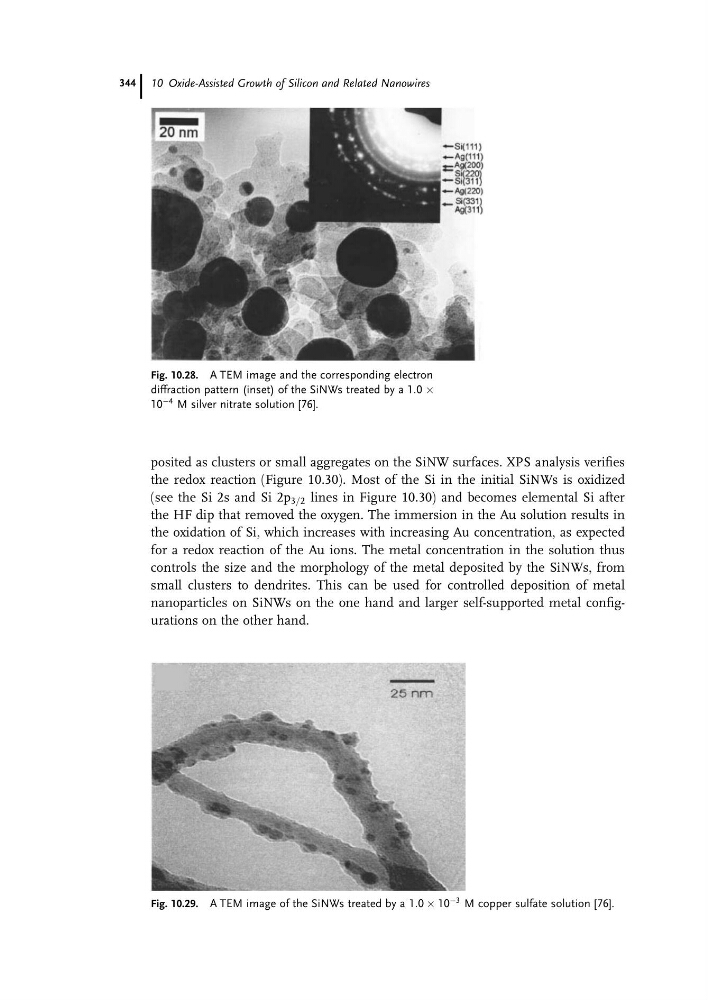
posited as clusters or small aggregates on the SiNW surfaces. XPS analysis verifies
the redox reaction (Figure 10.30). Most of the Si in the initial SiNWs is oxidized
(see the Si 2s and Si 2p 3=2 lines in Figure 10.30) and becomes elemental Si after
the HF dip that removed the oxygen. The immersion in the Au solution results in
the oxidation of Si, which increases with increasing Au concentration, as expected
for a redox reaction of the Au ions. The metal concentration in the solution thus
controls the size and the morphology of the metal deposited by the SiNWs, from
small clusters to dendrites. This can be used for controlled deposition of metal
nanoparticles on SiNWs on the one hand and larger self-supported metal configurations on the other hand.
Fig. 10.28. A TEM image and the corresponding electron
diffraction pattern (inset) of the SiNWs treated by a 1:0 Â
10
À4 M silver nitrate solution [76].
Fig. 10.29. A TEM image of the SiNWs treated by a 1:0 Â 10
À3 M copper sulfate solution [76].
10 Oxide-Assisted Growth of Silicon and Related Nanowires
344
the redox reaction (Figure 10.30). Most of the Si in the initial SiNWs is oxidized
(see the Si 2s and Si 2p 3=2 lines in Figure 10.30) and becomes elemental Si after
the HF dip that removed the oxygen. The immersion in the Au solution results in
the oxidation of Si, which increases with increasing Au concentration, as expected
for a redox reaction of the Au ions. The metal concentration in the solution thus
controls the size and the morphology of the metal deposited by the SiNWs, from
small clusters to dendrites. This can be used for controlled deposition of metal
nanoparticles on SiNWs on the one hand and larger self-supported metal configurations on the other hand.
Fig. 10.28. A TEM image and the corresponding electron
diffraction pattern (inset) of the SiNWs treated by a 1:0 Â
10
À4 M silver nitrate solution [76].
Fig. 10.29. A TEM image of the SiNWs treated by a 1:0 Â 10
À3 M copper sulfate solution [76].
10 Oxide-Assisted Growth of Silicon and Related Nanowires
344