

monitor the wires (1) as grown, (2) after 5 min immersion in a 5% HF (or DF)
solution, (3) upon exposure to air or water for different times, (4) after annealing to
different temperatures. We note that the FTIR signals originate mostly from the
large-diameter SiNWs (the surfaces of which are larger) and only a small fraction
of the signal represents the small-diameter SiNWs. This means that if the stability
of SiNW surfaces is size-dependent (as indicated by theoretical calculations, see
Section 10.8), this would not be revealed in the experiment.
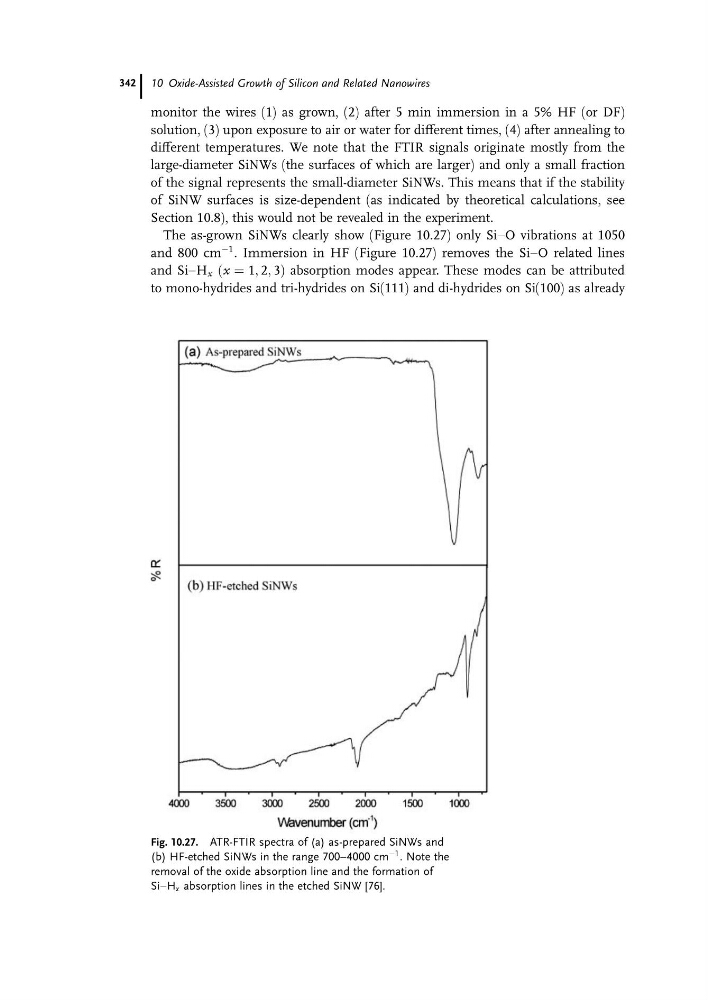
The as-grown SiNWs clearly show (Figure 10.27) only SiaO vibrations at 1050
and 800 cm
À1 . Immersion in HF (Figure 10.27) removes the SiaO related lines
and SiaH x ðx ¼ 1; 2; 3Þ absorption modes appear. These modes can be attributed
to mono-hydrides and tri-hydrides on Si(111) and di-hydrides on Si(100) as already
Fig. 10.27. ATR-FTIR spectra of (a) as-prepared SiNWs and
(b) HF-etched SiNWs in the range 700–4000 cm
À1 . Note the
removal of the oxide absorption line and the formation of
SiaH x absorption lines in the etched SiNW [76].
10 Oxide-Assisted Growth of Silicon and Related Nanowires
342
solution, (3) upon exposure to air or water for different times, (4) after annealing to
different temperatures. We note that the FTIR signals originate mostly from the
large-diameter SiNWs (the surfaces of which are larger) and only a small fraction
of the signal represents the small-diameter SiNWs. This means that if the stability
of SiNW surfaces is size-dependent (as indicated by theoretical calculations, see
Section 10.8), this would not be revealed in the experiment.
The as-grown SiNWs clearly show (Figure 10.27) only SiaO vibrations at 1050
and 800 cm
À1 . Immersion in HF (Figure 10.27) removes the SiaO related lines
and SiaH x ðx ¼ 1; 2; 3Þ absorption modes appear. These modes can be attributed
to mono-hydrides and tri-hydrides on Si(111) and di-hydrides on Si(100) as already
Fig. 10.27. ATR-FTIR spectra of (a) as-prepared SiNWs and
(b) HF-etched SiNWs in the range 700–4000 cm
À1 . Note the
removal of the oxide absorption line and the formation of
SiaH x absorption lines in the etched SiNW [76].
10 Oxide-Assisted Growth of Silicon and Related Nanowires
342