

of the initial droplet. The formation of the SiNWs is restricted to the temperature
region for which the temperature is high enough so that the solid particle melts
and forms a liquid droplet (lower temperature of region I) on the one hand, and
the temperature is low enough to melt and condense from the vapor (upper temperature region) on the other hand. Previous work on Si whiskers revealed that
there is a critical whisker diameter at which growth stops completely, due to the
Gibbs–Thomson effect [58]. This may be the reason why the smallest nanowires
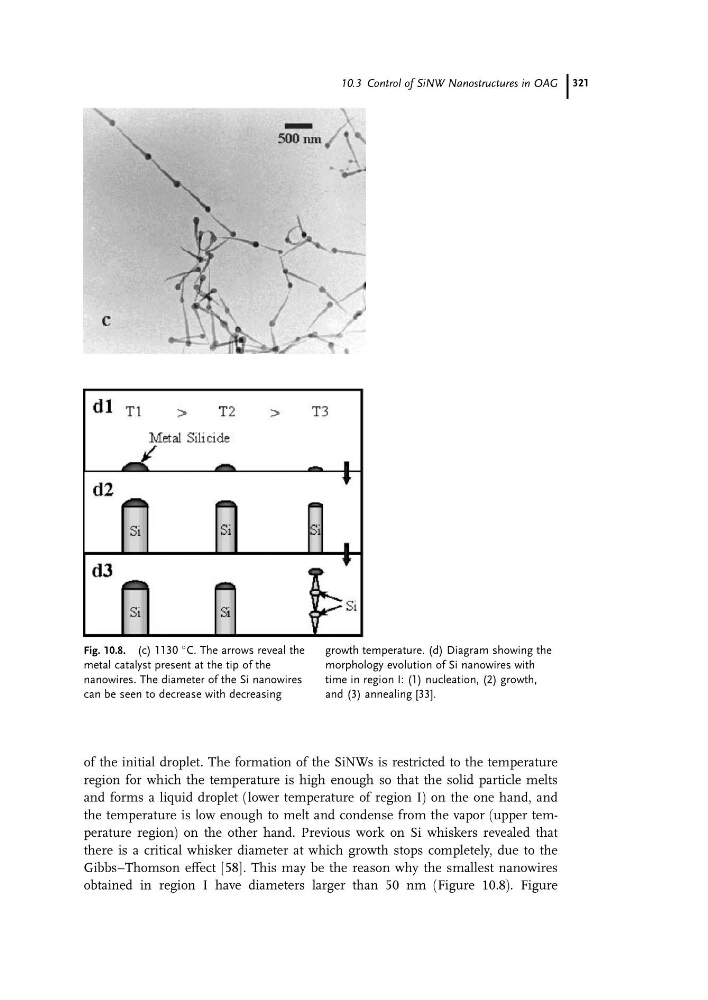
obtained in region I have diameters larger than 50 nm (Figure 10.8). Figure
Fig. 10.8. (c) 1130
C. The arrows reveal the
metal catalyst present at the tip of the
nanowires. The diameter of the Si nanowires
can be seen to decrease with decreasing
growth temperature. (d) Diagram showing the
morphology evolution of Si nanowires with
time in region I: (1) nucleation, (2) growth,
and (3) annealing [33].
10.3 Control of SiNW Nanostructures in OAG 321
region for which the temperature is high enough so that the solid particle melts
and forms a liquid droplet (lower temperature of region I) on the one hand, and
the temperature is low enough to melt and condense from the vapor (upper temperature region) on the other hand. Previous work on Si whiskers revealed that
there is a critical whisker diameter at which growth stops completely, due to the
Gibbs–Thomson effect [58]. This may be the reason why the smallest nanowires
obtained in region I have diameters larger than 50 nm (Figure 10.8). Figure
Fig. 10.8. (c) 1130
C. The arrows reveal the
metal catalyst present at the tip of the
nanowires. The diameter of the Si nanowires
can be seen to decrease with decreasing
growth temperature. (d) Diagram showing the
morphology evolution of Si nanowires with
time in region I: (1) nucleation, (2) growth,
and (3) annealing [33].
10.3 Control of SiNW Nanostructures in OAG 321