

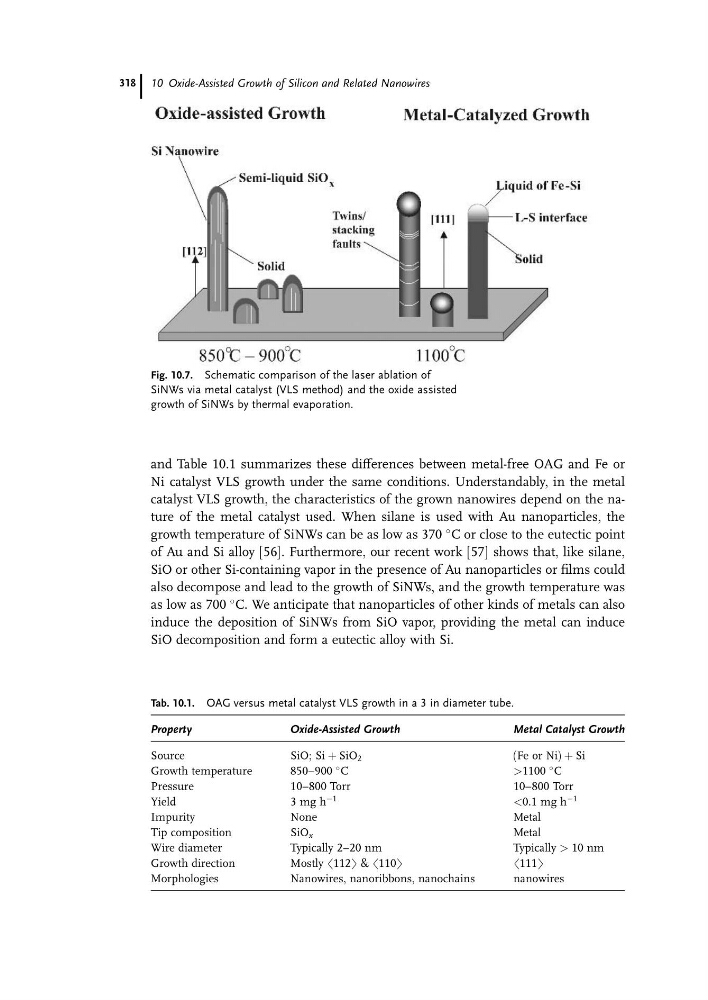
and Table 10.1 summarizes these differences between metal-free OAG and Fe or
Ni catalyst VLS growth under the same conditions. Understandably, in the metal
catalyst VLS growth, the characteristics of the grown nanowires depend on the nature of the metal catalyst used. When silane is used with Au nanoparticles, the
growth temperature of SiNWs can be as low as 370
C or close to the eutectic point
of Au and Si alloy [56]. Furthermore, our recent work [57] shows that, like silane,
SiO or other Si-containing vapor in the presence of Au nanoparticles or films could
also decompose and lead to the growth of SiNWs, and the growth temperature was
as low as 700
C. We anticipate that nanoparticles of other kinds of metals can also
induce the deposition of SiNWs from SiO vapor, providing the metal can induce
SiO decomposition and form a eutectic alloy with Si.
Fig. 10.7. Schematic comparison of the laser ablation of
SiNWs via metal catalyst (VLS method) and the oxide assisted
growth of SiNWs by thermal evaporation.
Tab. 10.1. OAG versus metal catalyst VLS growth in a 3 in diameter tube.
Property
Oxide-Assisted Growth
Metal Catalyst Growth
Source
SiO; Si þ SiO 2
(Fe or Ni) þ Si
Growth temperature
850–900
C
>1100
C
Pressure
10–800 Torr
10–800 Torr
Yield
3 mg h
À1
<0.1 mg h
À1
Impurity
None
Metal
Tip composition
SiO x
Metal
Wire diameter
Typically 2–20 nm
Typically > 10 nm
Growth direction
Mostly h112i & h110i
h 111i
Morphologies
Nanowires, nanoribbons, nanochains
nanowires
10 Oxide-Assisted Growth of Silicon and Related Nanowires
318
Ni catalyst VLS growth under the same conditions. Understandably, in the metal
catalyst VLS growth, the characteristics of the grown nanowires depend on the nature of the metal catalyst used. When silane is used with Au nanoparticles, the
growth temperature of SiNWs can be as low as 370
C or close to the eutectic point
of Au and Si alloy [56]. Furthermore, our recent work [57] shows that, like silane,
SiO or other Si-containing vapor in the presence of Au nanoparticles or films could
also decompose and lead to the growth of SiNWs, and the growth temperature was
as low as 700
C. We anticipate that nanoparticles of other kinds of metals can also
induce the deposition of SiNWs from SiO vapor, providing the metal can induce
SiO decomposition and form a eutectic alloy with Si.
Fig. 10.7. Schematic comparison of the laser ablation of
SiNWs via metal catalyst (VLS method) and the oxide assisted
growth of SiNWs by thermal evaporation.
Tab. 10.1. OAG versus metal catalyst VLS growth in a 3 in diameter tube.
Property
Oxide-Assisted Growth
Metal Catalyst Growth
Source
SiO; Si þ SiO 2
(Fe or Ni) þ Si
Growth temperature
850–900
C
>1100
C
Pressure
10–800 Torr
10–800 Torr
Yield
3 mg h
À1
<0.1 mg h
À1
Impurity
None
Metal
Tip composition
SiO x
Metal
Wire diameter
Typically 2–20 nm
Typically > 10 nm
Growth direction
Mostly h112i & h110i
h 111i
Morphologies
Nanowires, nanoribbons, nanochains
nanowires
10 Oxide-Assisted Growth of Silicon and Related Nanowires
318