

suggesting that interactions between surfactant molecules in solution with surfaceadsorbed amphiphiles were important aspects of the assembly process. The hydrophilic nature of the gold nanoparticles prior to assembly indicates that the surfactant molecules in the outer layer of the surface coating are oriented with their
cationic headgroups exposed to the solvent. However, as the surfactant-coated
nanorods approach each other in solution, expulsion of the outermost ‘‘cationic
head out’’ CTAB molecules and their associated counterions could result in the
formation of hydrophobic nanorods in which the remaining CTAB hydrophobic
tails face the solvent; thus, the resulting nanorods spontaneously self-assembly in a
side-on fashion to minimize the unfavorable hydrophilic–hydrophobic interactions
with water and promote interdigitation of the surfactant tails.
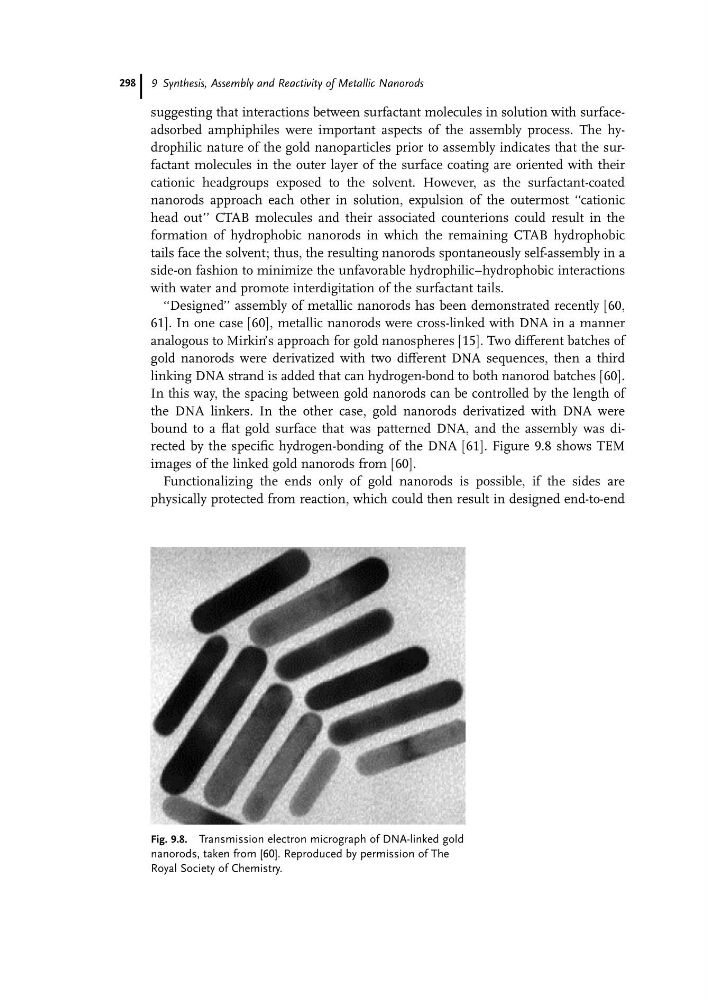
‘‘Designed’’ assembly of metallic nanorods has been demonstrated recently [60,
61]. In one case [60], metallic nanorods were cross-linked with DNA in a manner
analogous to Mirkin’s approach for gold nanospheres [15]. Two different batches of
gold nanorods were derivatized with two different DNA sequences, then a third
linking DNA strand is added that can hydrogen-bond to both nanorod batches [60].
In this way, the spacing between gold nanorods can be controlled by the length of
the DNA linkers. In the other case, gold nanorods derivatized with DNA were
bound to a flat gold surface that was patterned DNA, and the assembly was directed by the specific hydrogen-bonding of the DNA [61]. Figure 9.8 shows TEM
images of the linked gold nanorods from [60].
Functionalizing the ends only of gold nanorods is possible, if the sides are
physically protected from reaction, which could then result in designed end-to-end
Fig. 9.8. Transmission electron micrograph of DNA-linked gold
nanorods, taken from [60]. Reproduced by permission of The
Royal Society of Chemistry.
9 Synthesis, Assembly and Reactivity of Metallic Nanorods
298
cationic headgroups exposed to the solvent. However, as the surfactant-coated
nanorods approach each other in solution, expulsion of the outermost ‘‘cationic
head out’’ CTAB molecules and their associated counterions could result in the
formation of hydrophobic nanorods in which the remaining CTAB hydrophobic
tails face the solvent; thus, the resulting nanorods spontaneously self-assembly in a
side-on fashion to minimize the unfavorable hydrophilic–hydrophobic interactions
with water and promote interdigitation of the surfactant tails.
‘‘Designed’’ assembly of metallic nanorods has been demonstrated recently [60,
61]. In one case [60], metallic nanorods were cross-linked with DNA in a manner
analogous to Mirkin’s approach for gold nanospheres [15]. Two different batches of
gold nanorods were derivatized with two different DNA sequences, then a third
linking DNA strand is added that can hydrogen-bond to both nanorod batches [60].
In this way, the spacing between gold nanorods can be controlled by the length of
the DNA linkers. In the other case, gold nanorods derivatized with DNA were
bound to a flat gold surface that was patterned DNA, and the assembly was directed by the specific hydrogen-bonding of the DNA [61]. Figure 9.8 shows TEM
images of the linked gold nanorods from [60].
Functionalizing the ends only of gold nanorods is possible, if the sides are
physically protected from reaction, which could then result in designed end-to-end
Fig. 9.8. Transmission electron micrograph of DNA-linked gold
nanorods, taken from [60]. Reproduced by permission of The
Royal Society of Chemistry.
9 Synthesis, Assembly and Reactivity of Metallic Nanorods
298