

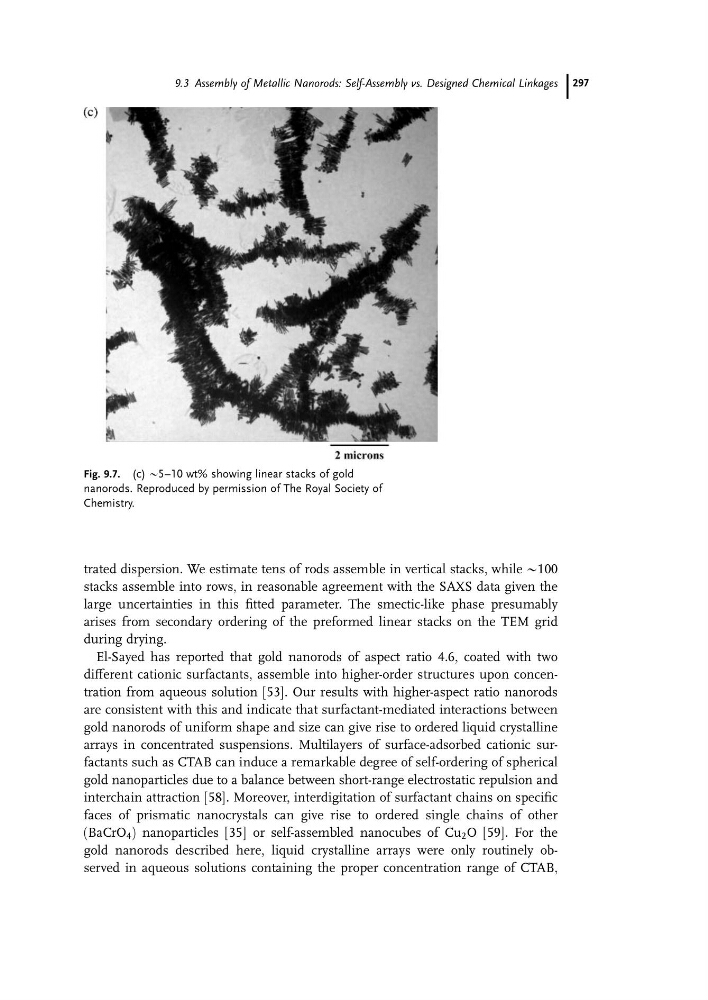
trated dispersion. We estimate tens of rods assemble in vertical stacks, while @100
stacks assemble into rows, in reasonable agreement with the SAXS data given the
large uncertainties in this fitted parameter. The smectic-like phase presumably
arises from secondary ordering of the preformed linear stacks on the TEM grid
during drying.
El-Sayed has reported that gold nanorods of aspect ratio 4.6, coated with two
different cationic surfactants, assemble into higher-order structures upon concentration from aqueous solution [53]. Our results with higher-aspect ratio nanorods
are consistent with this and indicate that surfactant-mediated interactions between
gold nanorods of uniform shape and size can give rise to ordered liquid crystalline
arrays in concentrated suspensions. Multilayers of surface-adsorbed cationic surfactants such as CTAB can induce a remarkable degree of self-ordering of spherical
gold nanoparticles due to a balance between short-range electrostatic repulsion and
interchain attraction [58]. Moreover, interdigitation of surfactant chains on specific
faces of prismatic nanocrystals can give rise to ordered single chains of other
(BaCrO 4 ) nanoparticles [35] or self-assembled nanocubes of Cu 2 O [59]. For the
gold nanorods described here, liquid crystalline arrays were only routinely observed in aqueous solutions containing the proper concentration range of CTAB,
Fig. 9.7. (c) @5–10 wt% showing linear stacks of gold
nanorods. Reproduced by permission of The Royal Society of
Chemistry.
9.3 Assembly of Metallic Nanorods: Self-Assembly vs. Designed Chemical Linkages 297
stacks assemble into rows, in reasonable agreement with the SAXS data given the
large uncertainties in this fitted parameter. The smectic-like phase presumably
arises from secondary ordering of the preformed linear stacks on the TEM grid
during drying.
El-Sayed has reported that gold nanorods of aspect ratio 4.6, coated with two
different cationic surfactants, assemble into higher-order structures upon concentration from aqueous solution [53]. Our results with higher-aspect ratio nanorods
are consistent with this and indicate that surfactant-mediated interactions between
gold nanorods of uniform shape and size can give rise to ordered liquid crystalline
arrays in concentrated suspensions. Multilayers of surface-adsorbed cationic surfactants such as CTAB can induce a remarkable degree of self-ordering of spherical
gold nanoparticles due to a balance between short-range electrostatic repulsion and
interchain attraction [58]. Moreover, interdigitation of surfactant chains on specific
faces of prismatic nanocrystals can give rise to ordered single chains of other
(BaCrO 4 ) nanoparticles [35] or self-assembled nanocubes of Cu 2 O [59]. For the
gold nanorods described here, liquid crystalline arrays were only routinely observed in aqueous solutions containing the proper concentration range of CTAB,
Fig. 9.7. (c) @5–10 wt% showing linear stacks of gold
nanorods. Reproduced by permission of The Royal Society of
Chemistry.
9.3 Assembly of Metallic Nanorods: Self-Assembly vs. Designed Chemical Linkages 297