

sired material was generated through the decomposition of organometallic precursors. They have grown InP, InAs and GaAs nanowhiskers by low temperature
(a203
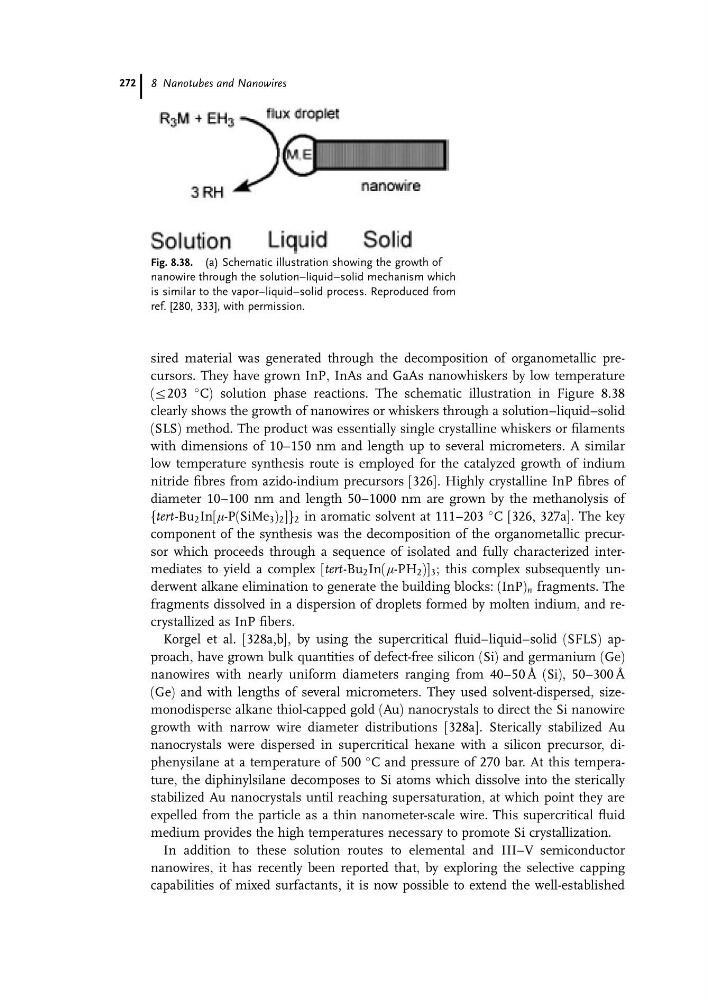
C) solution phase reactions. The schematic illustration in Figure 8.38
clearly shows the growth of nanowires or whiskers through a solution–liquid–solid
(SLS) method. The product was essentially single crystalline whiskers or filaments
with dimensions of 10–150 nm and length up to several micrometers. A similar
low temperature synthesis route is employed for the catalyzed growth of indium
nitride fibres from azido-indium precursors [326]. Highly crystalline InP fibres of
diameter 10–100 nm and length 50–1000 nm are grown by the methanolysis of
{tert-Bu 2 In[m-P(SiMe 3 ) 2 ]} 2 in aromatic solvent at 111–203
C [326, 327a]. The key
component of the synthesis was the decomposition of the organometallic precursor which proceeds through a sequence of isolated and fully characterized intermediates to yield a complex [tert-Bu 2 In(m-PH 2 )] 3 ; this complex subsequently underwent alkane elimination to generate the building blocks: (InP) n fragments. The
fragments dissolved in a dispersion of droplets formed by molten indium, and recrystallized as InP fibers.
Korgel et al. [328a,b], by using the supercritical fluid–liquid–solid (SFLS) approach, have grown bulk quantities of defect-free silicon (Si) and germanium (Ge)
nanowires with nearly uniform diameters ranging from 40–50 A ˚ (Si), 50–300 A ˚
(Ge) and with lengths of several micrometers. They used solvent-dispersed, sizemonodisperse alkane thiol-capped gold (Au) nanocrystals to direct the Si nanowire
growth with narrow wire diameter distributions [328a]. Sterically stabilized Au
nanocrystals were dispersed in supercritical hexane with a silicon precursor, diphenysilane at a temperature of 500
C and pressure of 270 bar. At this temperature, the diphinylsilane decomposes to Si atoms which dissolve into the sterically
stabilized Au nanocrystals until reaching supersaturation, at which point they are
expelled from the particle as a thin nanometer-scale wire. This supercritical fluid
medium provides the high temperatures necessary to promote Si crystallization.
In addition to these solution routes to elemental and III–V semiconductor
nanowires, it has recently been reported that, by exploring the selective capping
capabilities of mixed surfactants, it is now possible to extend the well-established
Fig. 8.38. (a) Schematic illustration showing the growth of
nanowire through the solution–liquid–solid mechanism which
is similar to the vapor–liquid–solid process. Reproduced from
ref. [280, 333], with permission.
8 Nanotubes and Nanowires
272
(a203
C) solution phase reactions. The schematic illustration in Figure 8.38
clearly shows the growth of nanowires or whiskers through a solution–liquid–solid
(SLS) method. The product was essentially single crystalline whiskers or filaments
with dimensions of 10–150 nm and length up to several micrometers. A similar
low temperature synthesis route is employed for the catalyzed growth of indium
nitride fibres from azido-indium precursors [326]. Highly crystalline InP fibres of
diameter 10–100 nm and length 50–1000 nm are grown by the methanolysis of
{tert-Bu 2 In[m-P(SiMe 3 ) 2 ]} 2 in aromatic solvent at 111–203
C [326, 327a]. The key
component of the synthesis was the decomposition of the organometallic precursor which proceeds through a sequence of isolated and fully characterized intermediates to yield a complex [tert-Bu 2 In(m-PH 2 )] 3 ; this complex subsequently underwent alkane elimination to generate the building blocks: (InP) n fragments. The
fragments dissolved in a dispersion of droplets formed by molten indium, and recrystallized as InP fibers.
Korgel et al. [328a,b], by using the supercritical fluid–liquid–solid (SFLS) approach, have grown bulk quantities of defect-free silicon (Si) and germanium (Ge)
nanowires with nearly uniform diameters ranging from 40–50 A ˚ (Si), 50–300 A ˚
(Ge) and with lengths of several micrometers. They used solvent-dispersed, sizemonodisperse alkane thiol-capped gold (Au) nanocrystals to direct the Si nanowire
growth with narrow wire diameter distributions [328a]. Sterically stabilized Au
nanocrystals were dispersed in supercritical hexane with a silicon precursor, diphenysilane at a temperature of 500
C and pressure of 270 bar. At this temperature, the diphinylsilane decomposes to Si atoms which dissolve into the sterically
stabilized Au nanocrystals until reaching supersaturation, at which point they are
expelled from the particle as a thin nanometer-scale wire. This supercritical fluid
medium provides the high temperatures necessary to promote Si crystallization.
In addition to these solution routes to elemental and III–V semiconductor
nanowires, it has recently been reported that, by exploring the selective capping
capabilities of mixed surfactants, it is now possible to extend the well-established
Fig. 8.38. (a) Schematic illustration showing the growth of
nanowire through the solution–liquid–solid mechanism which
is similar to the vapor–liquid–solid process. Reproduced from
ref. [280, 333], with permission.
8 Nanotubes and Nanowires
272