

involve a direct forcing of the free charge carriers in the nanotubes by the fluctuating Coulombic field of the liquid flowing past it. They propose an explanation
based on pulsating asymmetric ratchets. Their work highlights the device potential
for nanotubes as sensitive flow sensors and for energy conversion.
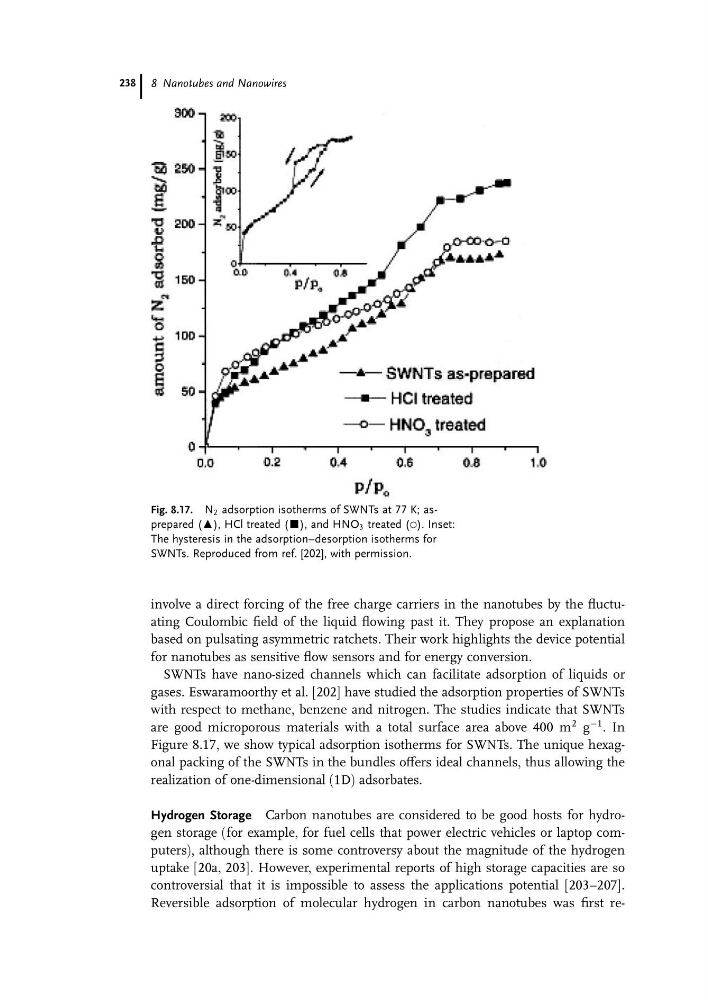
SWNTs have nano-sized channels which can facilitate adsorption of liquids or
gases. Eswaramoorthy et al. [202] have studied the adsorption properties of SWNTs
with respect to methane, benzene and nitrogen. The studies indicate that SWNTs
are good microporous materials with a total surface area above 400 m
2 g
À1 . In
Figure 8.17, we show typical adsorption isotherms for SWNTs. The unique hexagonal packing of the SWNTs in the bundles offers ideal channels, thus allowing the
realization of one-dimensional (1D) adsorbates.
Hydrogen Storage Carbon nanotubes are considered to be good hosts for hydrogen storage (for example, for fuel cells that power electric vehicles or laptop computers), although there is some controversy about the magnitude of the hydrogen
uptake [20a, 203]. However, experimental reports of high storage capacities are so
controversial that it is impossible to assess the applications potential [203–207].
Reversible adsorption of molecular hydrogen in carbon nanotubes was first reFig. 8.17. N 2 adsorption isotherms of SWNTs at 77 K; asprepared (C), HCl treated (o), and HNO 3 treated (b). Inset:
The hysteresis in the adsorption–desorption isotherms for
SWNTs. Reproduced from ref. [202], with permission.
8 Nanotubes and Nanowires
238
based on pulsating asymmetric ratchets. Their work highlights the device potential
for nanotubes as sensitive flow sensors and for energy conversion.
SWNTs have nano-sized channels which can facilitate adsorption of liquids or
gases. Eswaramoorthy et al. [202] have studied the adsorption properties of SWNTs
with respect to methane, benzene and nitrogen. The studies indicate that SWNTs
are good microporous materials with a total surface area above 400 m
2 g
À1 . In
Figure 8.17, we show typical adsorption isotherms for SWNTs. The unique hexagonal packing of the SWNTs in the bundles offers ideal channels, thus allowing the
realization of one-dimensional (1D) adsorbates.
Hydrogen Storage Carbon nanotubes are considered to be good hosts for hydrogen storage (for example, for fuel cells that power electric vehicles or laptop computers), although there is some controversy about the magnitude of the hydrogen
uptake [20a, 203]. However, experimental reports of high storage capacities are so
controversial that it is impossible to assess the applications potential [203–207].
Reversible adsorption of molecular hydrogen in carbon nanotubes was first reFig. 8.17. N 2 adsorption isotherms of SWNTs at 77 K; asprepared (C), HCl treated (o), and HNO 3 treated (b). Inset:
The hysteresis in the adsorption–desorption isotherms for
SWNTs. Reproduced from ref. [202], with permission.
8 Nanotubes and Nanowires
238