

discovered. Nanostructures are also ideal for computer simulation and modelling,
their size being sufficiently small to accommodate considerable rigor in treatment.
In computations related to nanomaterials, one deals with a spatial scaling from 1 A ˚
to 1 mm and a temporal scaling from 1 fs to 1 s, the limit of accuracy going beyond
1 kcal mol
À1 . Prototype circuits involving nanoparticles and nanotubes for nanoelectronic devices have been fabricated. Quantum computing has made a beginning and appropriate quantum algorithms are being developed.
Let us not forget that not everything in nanoscience is new. Many existing technologies employ nanoscale processes, catalysis and photography being well-known
examples. Our capability to synthesize, organize and tailor-make materials at the
nanoscale is, however, of recent origin. Novel chemistry has been generated by
employing nanoparticles, nanowires and other nanostructures. This includes electrochemical, photochemical, catalytic and other aspects. The immediate objectives
of the science and technology of nanomaterials are: (i) to fully master the synthesis
of isolated nanostructures (building blocks) and their assemblies with the desired
properties, (ii) to explore and establish nanodevice concepts and systems architectures, (iii) to generate new classes of high performance materials, (iv) to connect
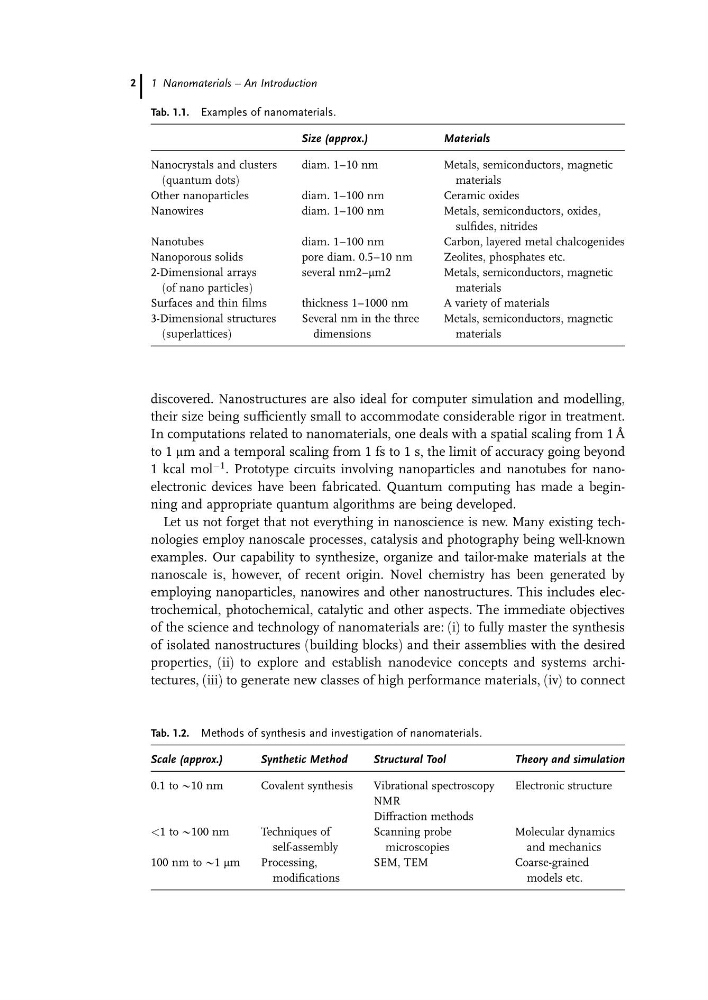
Tab. 1.1. Examples of nanomaterials.
Size (approx.)
Materials
Nanocrystals and clusters
(quantum dots)
diam. 1–10 nm
Metals, semiconductors, magnetic
materials
Other nanoparticles
diam. 1–100 nm
Ceramic oxides
Nanowires
diam. 1–100 nm
Metals, semiconductors, oxides,
sulfides, nitrides
Nanotubes
diam. 1–100 nm
Carbon, layered metal chalcogenides
Nanoporous solids
pore diam. 0.5–10 nm
Zeolites, phosphates etc.
2-Dimensional arrays
(of nano particles)
several nm2–mm2
Metals, semiconductors, magnetic
materials
Surfaces and thin films
thickness 1–1000 nm
A variety of materials
3-Dimensional structures
(superlattices)
Several nm in the three
dimensions
Metals, semiconductors, magnetic
materials
Tab. 1.2. Methods of synthesis and investigation of nanomaterials.
Scale (approx.)
Synthetic Method
Structural Tool
Theory and simulation
0.1 to @10 nm
Covalent synthesis
Vibrational spectroscopy
NMR
Diffraction methods
Electronic structure
<1 to @100 nm
Techniques of
self-assembly
Scanning probe
microscopies
Molecular dynamics
and mechanics
100 nm to @1 mm
Processing,
modifications
SEM, TEM
Coarse-grained
models etc.
1 Nanomaterials – An Introduction
2
their size being sufficiently small to accommodate considerable rigor in treatment.
In computations related to nanomaterials, one deals with a spatial scaling from 1 A ˚
to 1 mm and a temporal scaling from 1 fs to 1 s, the limit of accuracy going beyond
1 kcal mol
À1 . Prototype circuits involving nanoparticles and nanotubes for nanoelectronic devices have been fabricated. Quantum computing has made a beginning and appropriate quantum algorithms are being developed.
Let us not forget that not everything in nanoscience is new. Many existing technologies employ nanoscale processes, catalysis and photography being well-known
examples. Our capability to synthesize, organize and tailor-make materials at the
nanoscale is, however, of recent origin. Novel chemistry has been generated by
employing nanoparticles, nanowires and other nanostructures. This includes electrochemical, photochemical, catalytic and other aspects. The immediate objectives
of the science and technology of nanomaterials are: (i) to fully master the synthesis
of isolated nanostructures (building blocks) and their assemblies with the desired
properties, (ii) to explore and establish nanodevice concepts and systems architectures, (iii) to generate new classes of high performance materials, (iv) to connect
Tab. 1.1. Examples of nanomaterials.
Size (approx.)
Materials
Nanocrystals and clusters
(quantum dots)
diam. 1–10 nm
Metals, semiconductors, magnetic
materials
Other nanoparticles
diam. 1–100 nm
Ceramic oxides
Nanowires
diam. 1–100 nm
Metals, semiconductors, oxides,
sulfides, nitrides
Nanotubes
diam. 1–100 nm
Carbon, layered metal chalcogenides
Nanoporous solids
pore diam. 0.5–10 nm
Zeolites, phosphates etc.
2-Dimensional arrays
(of nano particles)
several nm2–mm2
Metals, semiconductors, magnetic
materials
Surfaces and thin films
thickness 1–1000 nm
A variety of materials
3-Dimensional structures
(superlattices)
Several nm in the three
dimensions
Metals, semiconductors, magnetic
materials
Tab. 1.2. Methods of synthesis and investigation of nanomaterials.
Scale (approx.)
Synthetic Method
Structural Tool
Theory and simulation
0.1 to @10 nm
Covalent synthesis
Vibrational spectroscopy
NMR
Diffraction methods
Electronic structure
<1 to @100 nm
Techniques of
self-assembly
Scanning probe
microscopies
Molecular dynamics
and mechanics
100 nm to @1 mm
Processing,
modifications
SEM, TEM
Coarse-grained
models etc.
1 Nanomaterials – An Introduction
2