

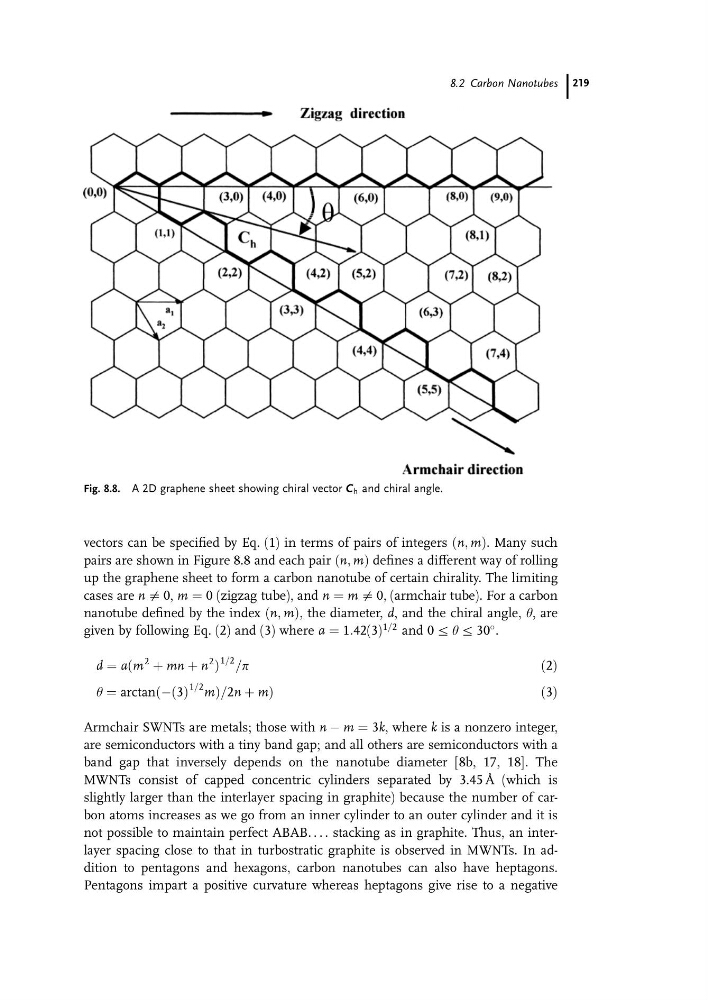
vectors can be specified by Eq. (1) in terms of pairs of integers ðn; mÞ. Many such
pairs are shown in Figure 8.8 and each pair ðn; mÞ defines a different way of rolling
up the graphene sheet to form a carbon nanotube of certain chirality. The limiting
cases are n 0 0, m ¼ 0 (zigzag tube), and n ¼ m 0 0, (armchair tube). For a carbon
nanotube defined by the index ðn; mÞ, the diameter, d, and the chiral angle, y, are
given by following Eq. (2) and (3) where a ¼ 1:42(3)
1=2 and 0 a y a 30
.
d ¼ aðm
2 þ mn þ n
2 Þ
1=2 =p
ð2Þ
y ¼ arctanðÀð3Þ
1=2 mÞ=2n þ mÞ
ð 3Þ
Armchair SWNTs are metals; those with n À m ¼ 3k, where k is a nonzero integer,
are semiconductors with a tiny band gap; and all others are semiconductors with a
band gap that inversely depends on the nanotube diameter [8b, 17, 18]. The
MWNTs consist of capped concentric cylinders separated by 3.45 A ˚ (which is
slightly larger than the interlayer spacing in graphite) because the number of carbon atoms increases as we go from an inner cylinder to an outer cylinder and it is
not possible to maintain perfect ABAB. . . . stacking as in graphite. Thus, an interlayer spacing close to that in turbostratic graphite is observed in MWNTs. In addition to pentagons and hexagons, carbon nanotubes can also have heptagons.
Pentagons impart a positive curvature whereas heptagons give rise to a negative
Fig. 8.8. A 2D graphene sheet showing chiral vector C h and chiral angle.
8.2 Carbon Nanotubes 219
pairs are shown in Figure 8.8 and each pair ðn; mÞ defines a different way of rolling
up the graphene sheet to form a carbon nanotube of certain chirality. The limiting
cases are n 0 0, m ¼ 0 (zigzag tube), and n ¼ m 0 0, (armchair tube). For a carbon
nanotube defined by the index ðn; mÞ, the diameter, d, and the chiral angle, y, are
given by following Eq. (2) and (3) where a ¼ 1:42(3)
1=2 and 0 a y a 30
.
d ¼ aðm
2 þ mn þ n
2 Þ
1=2 =p
ð2Þ
y ¼ arctanðÀð3Þ
1=2 mÞ=2n þ mÞ
ð 3Þ
Armchair SWNTs are metals; those with n À m ¼ 3k, where k is a nonzero integer,
are semiconductors with a tiny band gap; and all others are semiconductors with a
band gap that inversely depends on the nanotube diameter [8b, 17, 18]. The
MWNTs consist of capped concentric cylinders separated by 3.45 A ˚ (which is
slightly larger than the interlayer spacing in graphite) because the number of carbon atoms increases as we go from an inner cylinder to an outer cylinder and it is
not possible to maintain perfect ABAB. . . . stacking as in graphite. Thus, an interlayer spacing close to that in turbostratic graphite is observed in MWNTs. In addition to pentagons and hexagons, carbon nanotubes can also have heptagons.
Pentagons impart a positive curvature whereas heptagons give rise to a negative
Fig. 8.8. A 2D graphene sheet showing chiral vector C h and chiral angle.
8.2 Carbon Nanotubes 219