

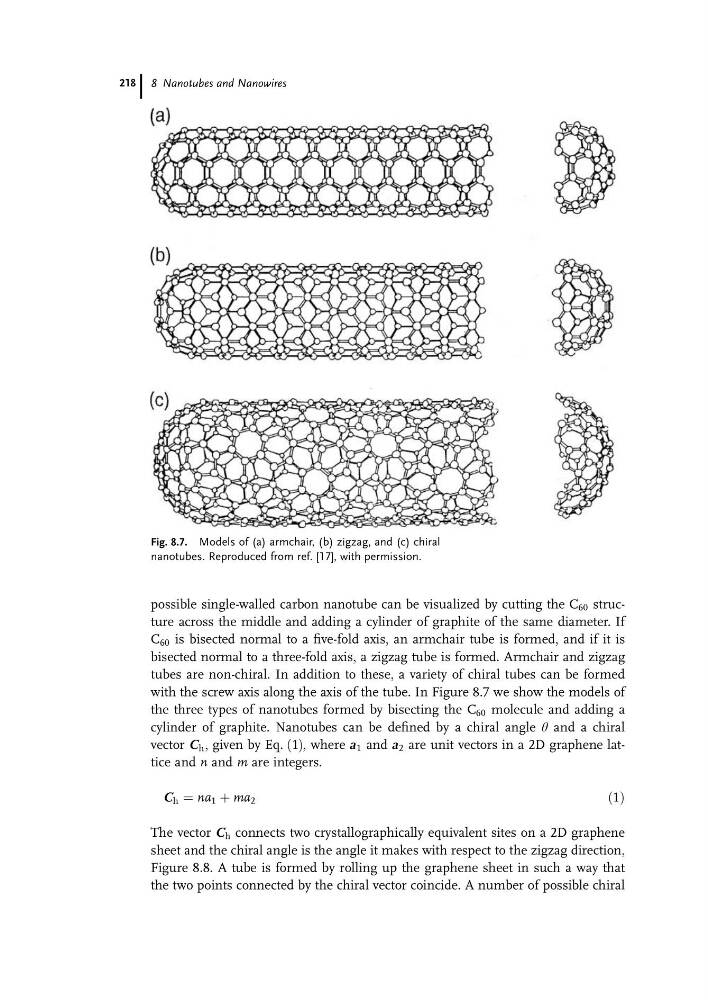
possible single-walled carbon nanotube can be visualized by cutting the C 60 structure across the middle and adding a cylinder of graphite of the same diameter. If
C 60 is bisected normal to a five-fold axis, an armchair tube is formed, and if it is
bisected normal to a three-fold axis, a zigzag tube is formed. Armchair and zigzag
tubes are non-chiral. In addition to these, a variety of chiral tubes can be formed
with the screw axis along the axis of the tube. In Figure 8.7 we show the models of
the three types of nanotubes formed by bisecting the C 60 molecule and adding a
cylinder of graphite. Nanotubes can be defined by a chiral angle y and a chiral
vector C h , given by Eq. (1), where a 1 and a 2 are unit vectors in a 2D graphene lattice and n and m are integers.
C h ¼ na 1 þ ma 2
ð1Þ
The vector C h connects two crystallographically equivalent sites on a 2D graphene
sheet and the chiral angle is the angle it makes with respect to the zigzag direction,
Figure 8.8. A tube is formed by rolling up the graphene sheet in such a way that
the two points connected by the chiral vector coincide. A number of possible chiral
Fig. 8.7. Models of (a) armchair, (b) zigzag, and (c) chiral
nanotubes. Reproduced from ref. [17], with permission.
8 Nanotubes and Nanowires
218
C 60 is bisected normal to a five-fold axis, an armchair tube is formed, and if it is
bisected normal to a three-fold axis, a zigzag tube is formed. Armchair and zigzag
tubes are non-chiral. In addition to these, a variety of chiral tubes can be formed
with the screw axis along the axis of the tube. In Figure 8.7 we show the models of
the three types of nanotubes formed by bisecting the C 60 molecule and adding a
cylinder of graphite. Nanotubes can be defined by a chiral angle y and a chiral
vector C h , given by Eq. (1), where a 1 and a 2 are unit vectors in a 2D graphene lattice and n and m are integers.
C h ¼ na 1 þ ma 2
ð1Þ
The vector C h connects two crystallographically equivalent sites on a 2D graphene
sheet and the chiral angle is the angle it makes with respect to the zigzag direction,
Figure 8.8. A tube is formed by rolling up the graphene sheet in such a way that
the two points connected by the chiral vector coincide. A number of possible chiral
Fig. 8.7. Models of (a) armchair, (b) zigzag, and (c) chiral
nanotubes. Reproduced from ref. [17], with permission.
8 Nanotubes and Nanowires
218