

selenides, but crystallization-treatment at 250–500
C was necessary [135]. Therefore, it is necessary to explore a milder and simpler synthetic route for metal selenide nanocrystallites.
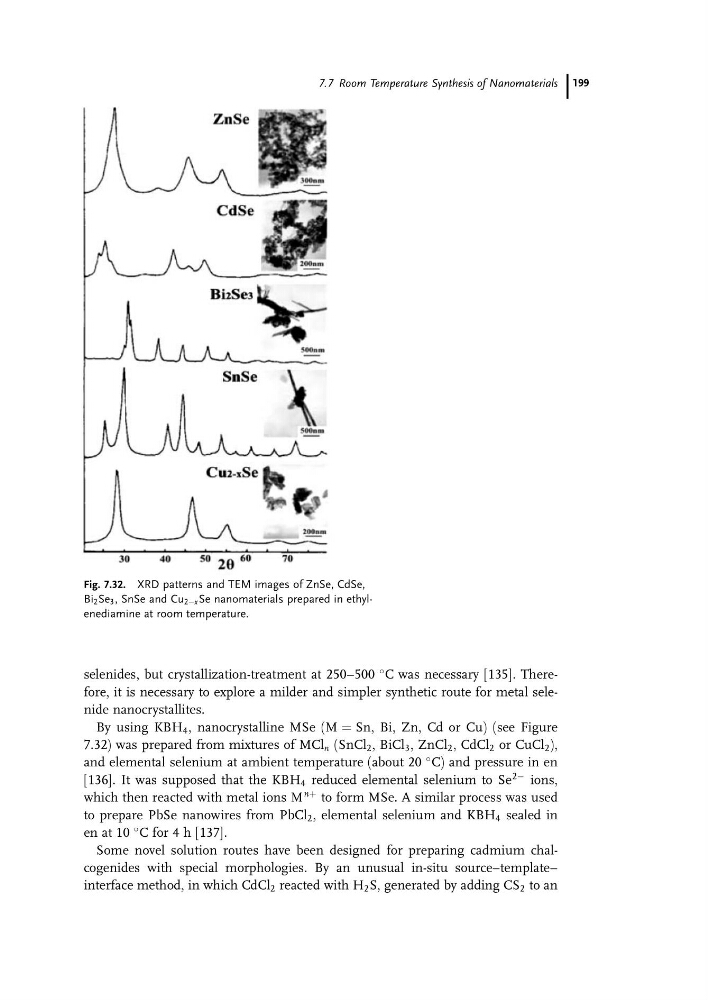
By using KBH 4 , nanocrystalline MSe (M ¼ Sn, Bi, Zn, Cd or Cu) (see Figure
7.32) was prepared from mixtures of MCl n (SnCl 2 , BiCl 3 , ZnCl 2 , CdCl 2 or CuCl 2 ),
and elemental selenium at ambient temperature (about 20
C) and pressure in en
[136]. It was supposed that the KBH 4 reduced elemental selenium to Se
2À ions,
which then reacted with metal ions M
nþ to form MSe. A similar process was used
to prepare PbSe nanowires from PbCl 2 , elemental selenium and KBH 4 sealed in
en at 10
C for 4 h [137].
Some novel solution routes have been designed for preparing cadmium chalcogenides with special morphologies. By an unusual in-situ source–template–
interface method, in which CdCl 2 reacted with H 2 S, generated by adding CS 2 to an
Fig. 7.32. XRD patterns and TEM images of ZnSe, CdSe,
Bi 2 Se 3 , SnSe and Cu 2Àx Se nanomaterials prepared in ethylenediamine at room temperature.
7.7 Room Temperature Synthesis of Nanomaterials 199
C was necessary [135]. Therefore, it is necessary to explore a milder and simpler synthetic route for metal selenide nanocrystallites.
By using KBH 4 , nanocrystalline MSe (M ¼ Sn, Bi, Zn, Cd or Cu) (see Figure
7.32) was prepared from mixtures of MCl n (SnCl 2 , BiCl 3 , ZnCl 2 , CdCl 2 or CuCl 2 ),
and elemental selenium at ambient temperature (about 20
C) and pressure in en
[136]. It was supposed that the KBH 4 reduced elemental selenium to Se
2À ions,
which then reacted with metal ions M
nþ to form MSe. A similar process was used
to prepare PbSe nanowires from PbCl 2 , elemental selenium and KBH 4 sealed in
en at 10
C for 4 h [137].
Some novel solution routes have been designed for preparing cadmium chalcogenides with special morphologies. By an unusual in-situ source–template–
interface method, in which CdCl 2 reacted with H 2 S, generated by adding CS 2 to an
Fig. 7.32. XRD patterns and TEM images of ZnSe, CdSe,
Bi 2 Se 3 , SnSe and Cu 2Àx Se nanomaterials prepared in ethylenediamine at room temperature.
7.7 Room Temperature Synthesis of Nanomaterials 199