

a gel with small pores. It was supposed that the growth of CdS nanocrystallites
was confined within the pores to form nanowires. Sphalerite-type CdSe nanowires
were fabricated through a poly(vinyl alcohol) (PVA) assisted solvothermal reaction
at 160–180
C in en [105]. These as-prepared nanowires exhibit straight or zigzag
shapes and most of them are grown with [111] orientation.
Rod-shaped PbS nanocrystals with diameters of 30–160 nm and lengths of up to
several micrometers were also prepared by a biphasic solvothermal interface reaction at 140–160
C [106]. Closed PbS nanowires with regular geometric morphologies (ellipse and parallelogram shape) were prepared with shape control by the
polymer poly[N-(2-aminoethyl) acrylamide] in en and H 2 O (3:1, v/v) solvent at
110–150
C [107]. VA group chalcogenides, nanorods or nanowires, were also
solvothermally prepared, e.g., Sb 2 E 3 [108, 109], Bi 2 E 3 (E ¼ S or Se) [110, 111, 112]
and Bi 3 Se 4 [113].
Interestingly, a novel a-NiS layer-rolled structure, intermediate between a twodimensional layered structure and three-dimensional isotropic material, was prepared by adding CS 2 step-by-step to an aqueous ammonia solution containing
Ni(NH 3 ) 6
2þ ions at about 60
C [114]. By reacting CS 2 with Ni(NH 3 ) 6
2þ , a new
complex, Ni(NH 3 ) 3 (CS 3 ), may form. These complexes orientate and become linked
in the least destabilizing mutual arrangement due to the NHaH 2 O hydrogen
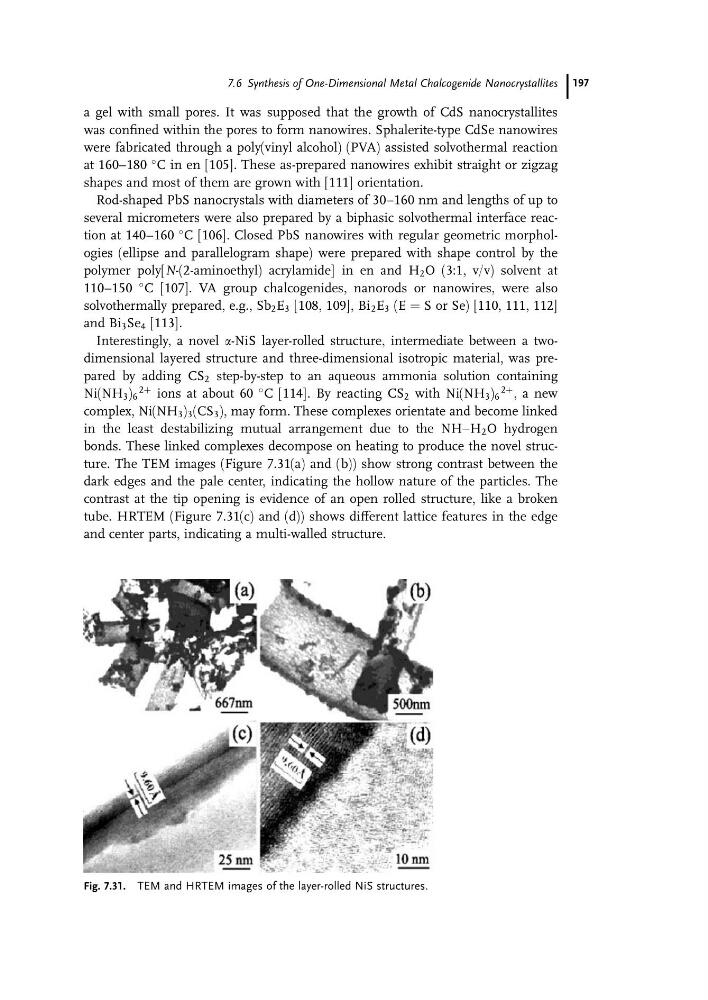
bonds. These linked complexes decompose on heating to produce the novel structure. The TEM images (Figure 7.31(a) and (b)) show strong contrast between the
dark edges and the pale center, indicating the hollow nature of the particles. The
contrast at the tip opening is evidence of an open rolled structure, like a broken
tube. HRTEM (Figure 7.31(c) and (d)) shows different lattice features in the edge
and center parts, indicating a multi-walled structure.
Fig. 7.31. TEM and HRTEM images of the layer-rolled NiS structures.
7.6 Synthesis of One-Dimensional Metal Chalcogenide Nanocrystallites 197
was confined within the pores to form nanowires. Sphalerite-type CdSe nanowires
were fabricated through a poly(vinyl alcohol) (PVA) assisted solvothermal reaction
at 160–180
C in en [105]. These as-prepared nanowires exhibit straight or zigzag
shapes and most of them are grown with [111] orientation.
Rod-shaped PbS nanocrystals with diameters of 30–160 nm and lengths of up to
several micrometers were also prepared by a biphasic solvothermal interface reaction at 140–160
C [106]. Closed PbS nanowires with regular geometric morphologies (ellipse and parallelogram shape) were prepared with shape control by the
polymer poly[N-(2-aminoethyl) acrylamide] in en and H 2 O (3:1, v/v) solvent at
110–150
C [107]. VA group chalcogenides, nanorods or nanowires, were also
solvothermally prepared, e.g., Sb 2 E 3 [108, 109], Bi 2 E 3 (E ¼ S or Se) [110, 111, 112]
and Bi 3 Se 4 [113].
Interestingly, a novel a-NiS layer-rolled structure, intermediate between a twodimensional layered structure and three-dimensional isotropic material, was prepared by adding CS 2 step-by-step to an aqueous ammonia solution containing
Ni(NH 3 ) 6
2þ ions at about 60
C [114]. By reacting CS 2 with Ni(NH 3 ) 6
2þ , a new
complex, Ni(NH 3 ) 3 (CS 3 ), may form. These complexes orientate and become linked
in the least destabilizing mutual arrangement due to the NHaH 2 O hydrogen
bonds. These linked complexes decompose on heating to produce the novel structure. The TEM images (Figure 7.31(a) and (b)) show strong contrast between the
dark edges and the pale center, indicating the hollow nature of the particles. The
contrast at the tip opening is evidence of an open rolled structure, like a broken
tube. HRTEM (Figure 7.31(c) and (d)) shows different lattice features in the edge
and center parts, indicating a multi-walled structure.
Fig. 7.31. TEM and HRTEM images of the layer-rolled NiS structures.
7.6 Synthesis of One-Dimensional Metal Chalcogenide Nanocrystallites 197