

particles (Figure 7.29(b)) were synthesized at 180
C in en and pyridine, respectively [99].
The en molecules play an important role in controlling the nucleation and
growth of the CdS nanorods. As a bidentate ligand, en molecules may react with
Cd
2þ ions and form relatively stable complexes. Under appropriate solvothermal
conditions, the complexes become unstable and decompose, which results in the
formation of CdS nanorods [100]. A mono-dentate ligand, n-butylamine, was
found to be a shape controller for nanorods of CdS and MSe (M ¼ Zn, Cd or Pb)
[101]. Similarly, the precursor of ZnE(en) 0:5 (E ¼ S, Se) could also form in en
which then is converted to ZnSe nanoparticles via pyrolysis in solvothermal conditions [102]. The coordinating ability of the solvent was found to play an important role in the nucleation and growth of nanocrystallites [103].
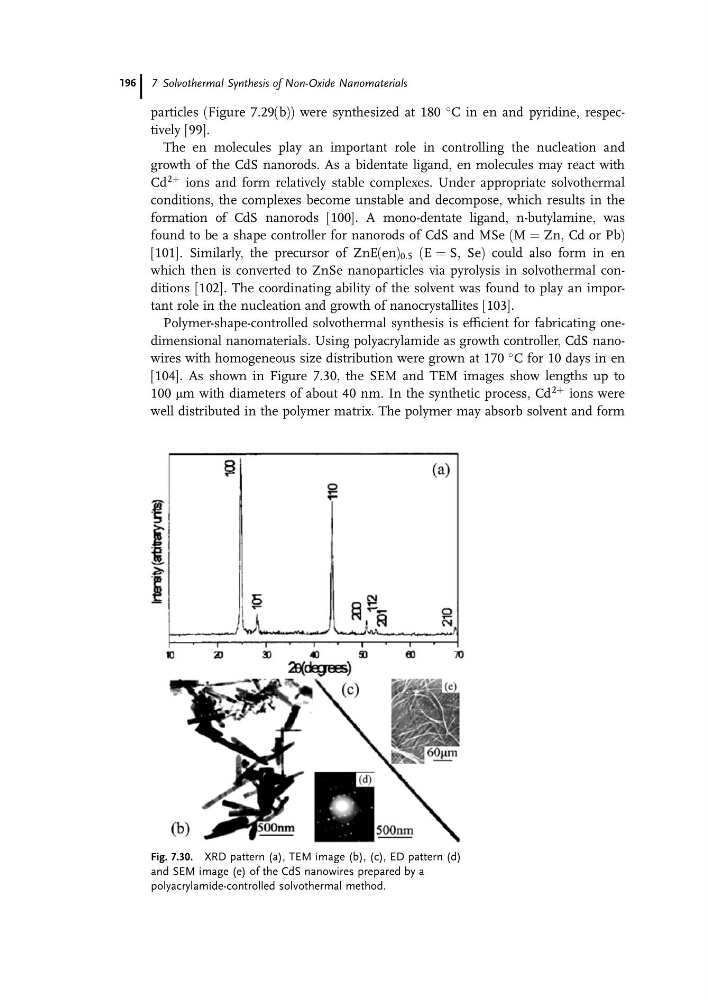
Polymer-shape-controlled solvothermal synthesis is efficient for fabricating onedimensional nanomaterials. Using polyacrylamide as growth controller, CdS nanowires with homogeneous size distribution were grown at 170
C for 10 days in en
[104]. As shown in Figure 7.30, the SEM and TEM images show lengths up to
100 mm with diameters of about 40 nm. In the synthetic process, Cd
2þ ions were
well distributed in the polymer matrix. The polymer may absorb solvent and form
Fig. 7.30. XRD pattern (a), TEM image (b), (c), ED pattern (d)
and SEM image (e) of the CdS nanowires prepared by a
polyacrylamide-controlled solvothermal method.
7 Solvothermal Synthesis of Non-Oxide Nanomaterials
196
C in en and pyridine, respectively [99].
The en molecules play an important role in controlling the nucleation and
growth of the CdS nanorods. As a bidentate ligand, en molecules may react with
Cd
2þ ions and form relatively stable complexes. Under appropriate solvothermal
conditions, the complexes become unstable and decompose, which results in the
formation of CdS nanorods [100]. A mono-dentate ligand, n-butylamine, was
found to be a shape controller for nanorods of CdS and MSe (M ¼ Zn, Cd or Pb)
[101]. Similarly, the precursor of ZnE(en) 0:5 (E ¼ S, Se) could also form in en
which then is converted to ZnSe nanoparticles via pyrolysis in solvothermal conditions [102]. The coordinating ability of the solvent was found to play an important role in the nucleation and growth of nanocrystallites [103].
Polymer-shape-controlled solvothermal synthesis is efficient for fabricating onedimensional nanomaterials. Using polyacrylamide as growth controller, CdS nanowires with homogeneous size distribution were grown at 170
C for 10 days in en
[104]. As shown in Figure 7.30, the SEM and TEM images show lengths up to
100 mm with diameters of about 40 nm. In the synthetic process, Cd
2þ ions were
well distributed in the polymer matrix. The polymer may absorb solvent and form
Fig. 7.30. XRD pattern (a), TEM image (b), (c), ED pattern (d)
and SEM image (e) of the CdS nanowires prepared by a
polyacrylamide-controlled solvothermal method.
7 Solvothermal Synthesis of Non-Oxide Nanomaterials
196