

grains. Alternatively, from the same reaction, 15–20 nm InP nanocrystals were
prepared at about 120
C in ethylenediamine (en) [47].
A similar reaction was also used to prepare InSb nanomaterials by NaBH 4 reduction of InCl 3 in the presence of metallic antimony in en (Reaction (12)).
2InCl 3 þ 2Sb þ KBH 4 !
ethylenediamine
200 C
2InSb þ 6KCl þ 6BH 3 þ H 2
ð12Þ
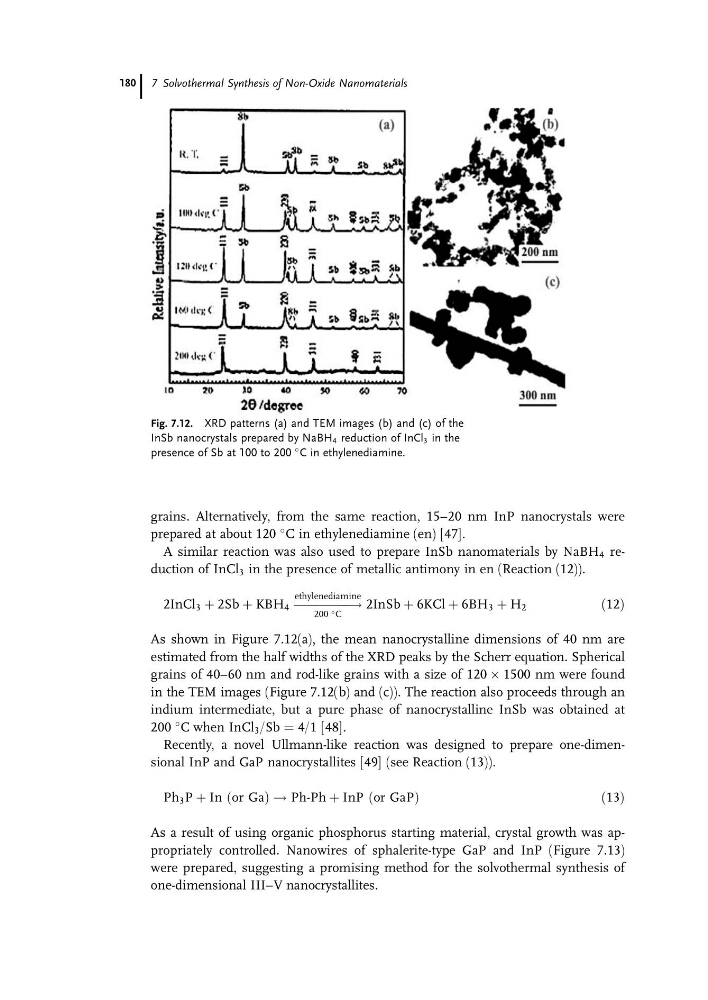
As shown in Figure 7.12(a), the mean nanocrystalline dimensions of 40 nm are
estimated from the half widths of the XRD peaks by the Scherr equation. Spherical
grains of 40–60 nm and rod-like grains with a size of 120 Â 1500 nm were found
in the TEM images (Figure 7.12(b) and (c)). The reaction also proceeds through an
indium intermediate, but a pure phase of nanocrystalline InSb was obtained at
200
C when InCl 3 /Sb ¼ 4/1 [48].
Recently, a novel Ullmann-like reaction was designed to prepare one-dimensional InP and GaP nanocrystallites [49] (see Reaction (13)).
Ph 3 P þ In ðor GaÞ ! Ph-Ph þ InP ðor GaPÞ
ð 13Þ
As a result of using organic phosphorus starting material, crystal growth was appropriately controlled. Nanowires of sphalerite-type GaP and InP (Figure 7.13)
were prepared, suggesting a promising method for the solvothermal synthesis of
one-dimensional III–V nanocrystallites.
Fig. 7.12. XRD patterns (a) and TEM images (b) and (c) of the
InSb nanocrystals prepared by NaBH 4 reduction of InCl 3 in the
presence of Sb at 100 to 200
C in ethylenediamine.
7 Solvothermal Synthesis of Non-Oxide Nanomaterials
180
prepared at about 120
C in ethylenediamine (en) [47].
A similar reaction was also used to prepare InSb nanomaterials by NaBH 4 reduction of InCl 3 in the presence of metallic antimony in en (Reaction (12)).
2InCl 3 þ 2Sb þ KBH 4 !
ethylenediamine
200 C
2InSb þ 6KCl þ 6BH 3 þ H 2
ð12Þ
As shown in Figure 7.12(a), the mean nanocrystalline dimensions of 40 nm are
estimated from the half widths of the XRD peaks by the Scherr equation. Spherical
grains of 40–60 nm and rod-like grains with a size of 120 Â 1500 nm were found
in the TEM images (Figure 7.12(b) and (c)). The reaction also proceeds through an
indium intermediate, but a pure phase of nanocrystalline InSb was obtained at
200
C when InCl 3 /Sb ¼ 4/1 [48].
Recently, a novel Ullmann-like reaction was designed to prepare one-dimensional InP and GaP nanocrystallites [49] (see Reaction (13)).
Ph 3 P þ In ðor GaÞ ! Ph-Ph þ InP ðor GaPÞ
ð 13Þ
As a result of using organic phosphorus starting material, crystal growth was appropriately controlled. Nanowires of sphalerite-type GaP and InP (Figure 7.13)
were prepared, suggesting a promising method for the solvothermal synthesis of
one-dimensional III–V nanocrystallites.
Fig. 7.12. XRD patterns (a) and TEM images (b) and (c) of the
InSb nanocrystals prepared by NaBH 4 reduction of InCl 3 in the
presence of Sb at 100 to 200
C in ethylenediamine.
7 Solvothermal Synthesis of Non-Oxide Nanomaterials
180