

irradiating the starting solution for 90 min resulted in a DSC signal which was
an order of magnitude smaller than that obtained after 6 h of sonication. In a parallel experiment, a 1 M aqueous solution of GaCl 3 was heated to 300
C in a highpressure cell, without sonication. No noticeable powder formation occurred after
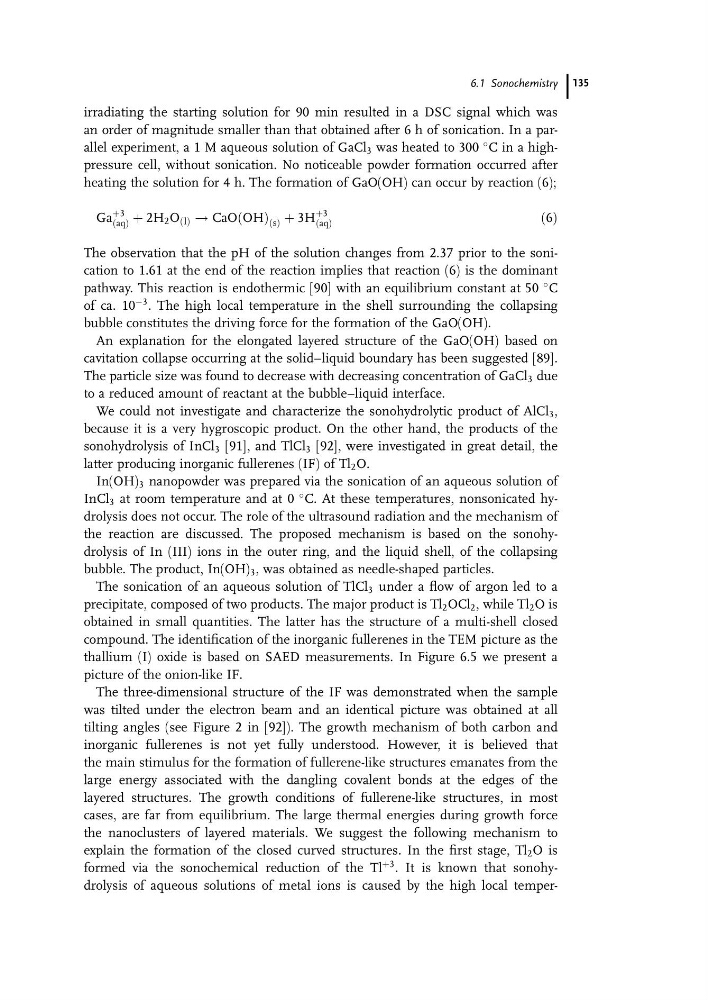
heating the solution for 4 h. The formation of GaO(OH) can occur by reaction (6);
Ga
þ3
ðaqÞ þ 2H 2 O ðlÞ ! CaOðOHÞ ðsÞ þ 3H
þ3
ðaqÞ
ð6Þ
The observation that the pH of the solution changes from 2.37 prior to the sonication to 1.61 at the end of the reaction implies that reaction (6) is the dominant
pathway. This reaction is endothermic [90] with an equilibrium constant at 50
C
of ca. 10
À3 . The high local temperature in the shell surrounding the collapsing
bubble constitutes the driving force for the formation of the GaO(OH).
An explanation for the elongated layered structure of the GaO(OH) based on
cavitation collapse occurring at the solid–liquid boundary has been suggested [89].
The particle size was found to decrease with decreasing concentration of GaCl 3 due
to a reduced amount of reactant at the bubble–liquid interface.
We could not investigate and characterize the sonohydrolytic product of AlCl 3 ,
because it is a very hygroscopic product. On the other hand, the products of the
sonohydrolysis of InCl 3 [91], and TlCl 3 [92], were investigated in great detail, the
latter producing inorganic fullerenes (IF) of Tl 2 O.
In(OH) 3 nanopowder was prepared via the sonication of an aqueous solution of
InCl 3 at room temperature and at 0
C. At these temperatures, nonsonicated hydrolysis does not occur. The role of the ultrasound radiation and the mechanism of
the reaction are discussed. The proposed mechanism is based on the sonohydrolysis of In (III) ions in the outer ring, and the liquid shell, of the collapsing
bubble. The product, In(OH) 3 , was obtained as needle-shaped particles.
The sonication of an aqueous solution of TlCl 3 under a flow of argon led to a
precipitate, composed of two products. The major product is Tl 2 OCl 2 , while Tl 2 O is
obtained in small quantities. The latter has the structure of a multi-shell closed
compound. The identification of the inorganic fullerenes in the TEM picture as the
thallium (I) oxide is based on SAED measurements. In Figure 6.5 we present a
picture of the onion-like IF.
The three-dimensional structure of the IF was demonstrated when the sample
was tilted under the electron beam and an identical picture was obtained at all
tilting angles (see Figure 2 in [92]). The growth mechanism of both carbon and
inorganic fullerenes is not yet fully understood. However, it is believed that
the main stimulus for the formation of fullerene-like structures emanates from the
large energy associated with the dangling covalent bonds at the edges of the
layered structures. The growth conditions of fullerene-like structures, in most
cases, are far from equilibrium. The large thermal energies during growth force
the nanoclusters of layered materials. We suggest the following mechanism to
explain the formation of the closed curved structures. In the first stage, Tl 2 O is
formed via the sonochemical reduction of the Tl
þ3 . It is known that sonohydrolysis of aqueous solutions of metal ions is caused by the high local temper6.1 Sonochemistry 135
an order of magnitude smaller than that obtained after 6 h of sonication. In a parallel experiment, a 1 M aqueous solution of GaCl 3 was heated to 300
C in a highpressure cell, without sonication. No noticeable powder formation occurred after
heating the solution for 4 h. The formation of GaO(OH) can occur by reaction (6);
Ga
þ3
ðaqÞ þ 2H 2 O ðlÞ ! CaOðOHÞ ðsÞ þ 3H
þ3
ðaqÞ
ð6Þ
The observation that the pH of the solution changes from 2.37 prior to the sonication to 1.61 at the end of the reaction implies that reaction (6) is the dominant
pathway. This reaction is endothermic [90] with an equilibrium constant at 50
C
of ca. 10
À3 . The high local temperature in the shell surrounding the collapsing
bubble constitutes the driving force for the formation of the GaO(OH).
An explanation for the elongated layered structure of the GaO(OH) based on
cavitation collapse occurring at the solid–liquid boundary has been suggested [89].
The particle size was found to decrease with decreasing concentration of GaCl 3 due
to a reduced amount of reactant at the bubble–liquid interface.
We could not investigate and characterize the sonohydrolytic product of AlCl 3 ,
because it is a very hygroscopic product. On the other hand, the products of the
sonohydrolysis of InCl 3 [91], and TlCl 3 [92], were investigated in great detail, the
latter producing inorganic fullerenes (IF) of Tl 2 O.
In(OH) 3 nanopowder was prepared via the sonication of an aqueous solution of
InCl 3 at room temperature and at 0
C. At these temperatures, nonsonicated hydrolysis does not occur. The role of the ultrasound radiation and the mechanism of
the reaction are discussed. The proposed mechanism is based on the sonohydrolysis of In (III) ions in the outer ring, and the liquid shell, of the collapsing
bubble. The product, In(OH) 3 , was obtained as needle-shaped particles.
The sonication of an aqueous solution of TlCl 3 under a flow of argon led to a
precipitate, composed of two products. The major product is Tl 2 OCl 2 , while Tl 2 O is
obtained in small quantities. The latter has the structure of a multi-shell closed
compound. The identification of the inorganic fullerenes in the TEM picture as the
thallium (I) oxide is based on SAED measurements. In Figure 6.5 we present a
picture of the onion-like IF.
The three-dimensional structure of the IF was demonstrated when the sample
was tilted under the electron beam and an identical picture was obtained at all
tilting angles (see Figure 2 in [92]). The growth mechanism of both carbon and
inorganic fullerenes is not yet fully understood. However, it is believed that
the main stimulus for the formation of fullerene-like structures emanates from the
large energy associated with the dangling covalent bonds at the edges of the
layered structures. The growth conditions of fullerene-like structures, in most
cases, are far from equilibrium. The large thermal energies during growth force
the nanoclusters of layered materials. We suggest the following mechanism to
explain the formation of the closed curved structures. In the first stage, Tl 2 O is
formed via the sonochemical reduction of the Tl
þ3 . It is known that sonohydrolysis of aqueous solutions of metal ions is caused by the high local temper6.1 Sonochemistry 135