

ing of metallic nanoparticles on surfaces, SAM (self-assembled monolayer coating)
on nanosized amorphous metals, and the formation of metal–polymer composites.
The next section will be devoted to the sonochemical synthesis of mesoporous
materials, and the use of ultrasound for the insertion of nanomaterials into the
pores. In the final section we will discuss other important nanomaterials that have
been prepared by the sonochemical technique (apart from chalcogenides).
6.1.1
Sonochemical Fabrication of Nanometals
6.1.1.1 Sonochemical Synthesis of Powders of Metallic Nanoparticles
In addition to the synthesis of the transition metals produced from the corresponding carbonyls (Fe from Fe(CO) 5 [6, 11], Ni from Ni(CO) 4 [12], and Co from
Co(CO) 3 NO [13], other metals have also been synthesized sonochemically. Sonication of aqueous Co
þ2 and hydrazine resulted [14] in the formation of anisometric (disk-shaped) cobalt nanoclusters that averaged about 100 nm in width and
15 nm in thickness. Electron diffraction from single particles revealed that they
were oriented (001) crystals that conformed to a trigonal or hexagonal unit cell four
times the size of the cell adopted by bulk alpha-cobalt. Nanophased particles of
metallic copper [15] were formed by the sonochemical reduction of copper (II)
hydrazine carboxylate (Cu(N 2 H 3 COO) 2 Á2H 2 O) in an aqueous solution. When the
sonication was carried out under argon a mixture of Cu 2 O and metallic copper was
obtained. However, sonicating the precursor solution under a mixture of hydrogen
and argon yielded pure copper. The particles were obtained as porous materials
with diameter 50 nm, smaller than those obtained by the thermal decomposition
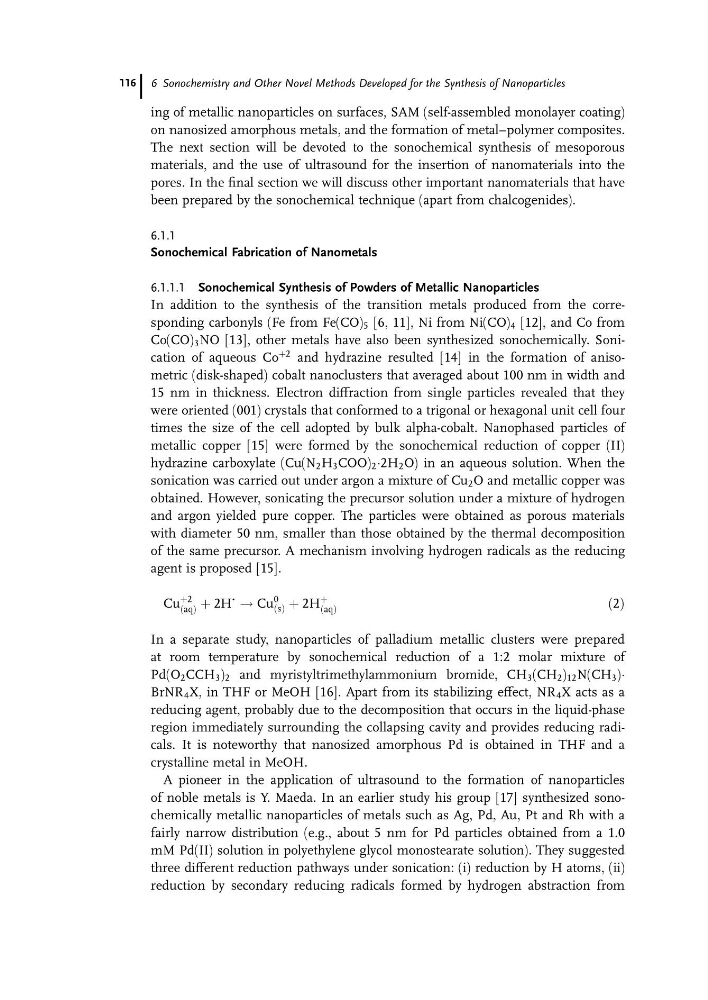
of the same precursor. A mechanism involving hydrogen radicals as the reducing
agent is proposed [15].
Cu
þ2
ðaqÞ þ 2H
. ! Cu
0
ðsÞ þ 2H
þ
ðaqÞ
ð2Þ
In a separate study, nanoparticles of palladium metallic clusters were prepared
at room temperature by sonochemical reduction of a 1:2 molar mixture of
Pd(O 2 CCH 3 ) 2 and myristyltrimethylammonium bromide, CH 3 (CH 2 ) 12 N(CH 3 )Á
BrNR 4 X, in THF or MeOH [16]. Apart from its stabilizing effect, NR 4 X acts as a
reducing agent, probably due to the decomposition that occurs in the liquid-phase
region immediately surrounding the collapsing cavity and provides reducing radicals. It is noteworthy that nanosized amorphous Pd is obtained in THF and a
crystalline metal in MeOH.
A pioneer in the application of ultrasound to the formation of nanoparticles
of noble metals is Y. Maeda. In an earlier study his group [17] synthesized sonochemically metallic nanoparticles of metals such as Ag, Pd, Au, Pt and Rh with a
fairly narrow distribution (e.g., about 5 nm for Pd particles obtained from a 1.0
mM Pd(II) solution in polyethylene glycol monostearate solution). They suggested
three different reduction pathways under sonication: (i) reduction by H atoms, (ii)
reduction by secondary reducing radicals formed by hydrogen abstraction from
6 Sonochemistry and Other Novel Methods Developed for the Synthesis of Nanoparticles
116
on nanosized amorphous metals, and the formation of metal–polymer composites.
The next section will be devoted to the sonochemical synthesis of mesoporous
materials, and the use of ultrasound for the insertion of nanomaterials into the
pores. In the final section we will discuss other important nanomaterials that have
been prepared by the sonochemical technique (apart from chalcogenides).
6.1.1
Sonochemical Fabrication of Nanometals
6.1.1.1 Sonochemical Synthesis of Powders of Metallic Nanoparticles
In addition to the synthesis of the transition metals produced from the corresponding carbonyls (Fe from Fe(CO) 5 [6, 11], Ni from Ni(CO) 4 [12], and Co from
Co(CO) 3 NO [13], other metals have also been synthesized sonochemically. Sonication of aqueous Co
þ2 and hydrazine resulted [14] in the formation of anisometric (disk-shaped) cobalt nanoclusters that averaged about 100 nm in width and
15 nm in thickness. Electron diffraction from single particles revealed that they
were oriented (001) crystals that conformed to a trigonal or hexagonal unit cell four
times the size of the cell adopted by bulk alpha-cobalt. Nanophased particles of
metallic copper [15] were formed by the sonochemical reduction of copper (II)
hydrazine carboxylate (Cu(N 2 H 3 COO) 2 Á2H 2 O) in an aqueous solution. When the
sonication was carried out under argon a mixture of Cu 2 O and metallic copper was
obtained. However, sonicating the precursor solution under a mixture of hydrogen
and argon yielded pure copper. The particles were obtained as porous materials
with diameter 50 nm, smaller than those obtained by the thermal decomposition
of the same precursor. A mechanism involving hydrogen radicals as the reducing
agent is proposed [15].
Cu
þ2
ðaqÞ þ 2H
. ! Cu
0
ðsÞ þ 2H
þ
ðaqÞ
ð2Þ
In a separate study, nanoparticles of palladium metallic clusters were prepared
at room temperature by sonochemical reduction of a 1:2 molar mixture of
Pd(O 2 CCH 3 ) 2 and myristyltrimethylammonium bromide, CH 3 (CH 2 ) 12 N(CH 3 )Á
BrNR 4 X, in THF or MeOH [16]. Apart from its stabilizing effect, NR 4 X acts as a
reducing agent, probably due to the decomposition that occurs in the liquid-phase
region immediately surrounding the collapsing cavity and provides reducing radicals. It is noteworthy that nanosized amorphous Pd is obtained in THF and a
crystalline metal in MeOH.
A pioneer in the application of ultrasound to the formation of nanoparticles
of noble metals is Y. Maeda. In an earlier study his group [17] synthesized sonochemically metallic nanoparticles of metals such as Ag, Pd, Au, Pt and Rh with a
fairly narrow distribution (e.g., about 5 nm for Pd particles obtained from a 1.0
mM Pd(II) solution in polyethylene glycol monostearate solution). They suggested
three different reduction pathways under sonication: (i) reduction by H atoms, (ii)
reduction by secondary reducing radicals formed by hydrogen abstraction from
6 Sonochemistry and Other Novel Methods Developed for the Synthesis of Nanoparticles
116