

temperature in this ring is lower than inside the collapsing bubble, but higher than
the temperature of the bulk. Suslick has estimated the temperature in the ring
region as 1900
C [7]. In short, in almost all the sonochemical reactions leading
to inorganic products, nanomaterials were obtained. They varied in size, shape,
structure, and in their solid phase (amorphous or crystalline), but they were always
of nanometer size.
We cannot mention here how the various parameters: frequencies, power, gas
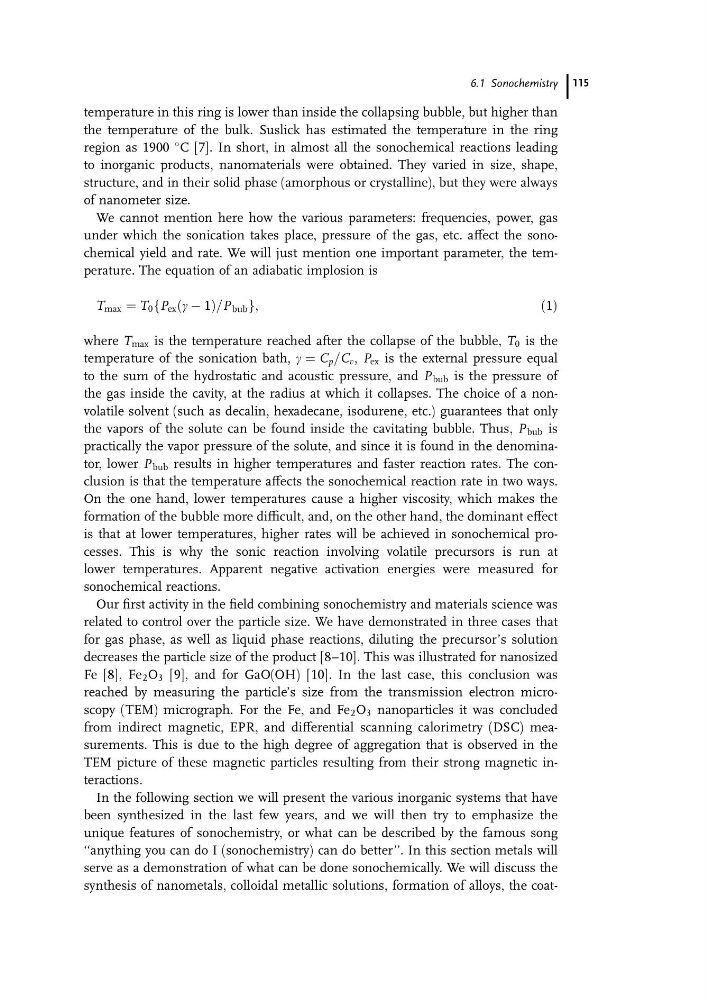
under which the sonication takes place, pressure of the gas, etc. affect the sonochemical yield and rate. We will just mention one important parameter, the temperature. The equation of an adiabatic implosion is
T max ¼ T 0 fP ex ðg À 1Þ=P bub g;
ð1Þ
where T max is the temperature reached after the collapse of the bubble, T 0 is the
temperature of the sonication bath, g ¼ C p =C v , P ex is the external pressure equal
to the sum of the hydrostatic and acoustic pressure, and P bub is the pressure of
the gas inside the cavity, at the radius at which it collapses. The choice of a nonvolatile solvent (such as decalin, hexadecane, isodurene, etc.) guarantees that only
the vapors of the solute can be found inside the cavitating bubble. Thus, P bub is
practically the vapor pressure of the solute, and since it is found in the denominator, lower P bub results in higher temperatures and faster reaction rates. The conclusion is that the temperature affects the sonochemical reaction rate in two ways.
On the one hand, lower temperatures cause a higher viscosity, which makes the
formation of the bubble more difficult, and, on the other hand, the dominant effect
is that at lower temperatures, higher rates will be achieved in sonochemical processes. This is why the sonic reaction involving volatile precursors is run at
lower temperatures. Apparent negative activation energies were measured for
sonochemical reactions.
Our first activity in the field combining sonochemistry and materials science was
related to control over the particle size. We have demonstrated in three cases that
for gas phase, as well as liquid phase reactions, diluting the precursor’s solution
decreases the particle size of the product [8–10]. This was illustrated for nanosized
Fe [8], Fe 2 O 3 [9], and for GaO(OH) [10]. In the last case, this conclusion was
reached by measuring the particle’s size from the transmission electron microscopy (TEM) micrograph. For the Fe, and Fe 2 O 3 nanoparticles it was concluded
from indirect magnetic, EPR, and differential scanning calorimetry (DSC) measurements. This is due to the high degree of aggregation that is observed in the
TEM picture of these magnetic particles resulting from their strong magnetic interactions.
In the following section we will present the various inorganic systems that have
been synthesized in the last few years, and we will then try to emphasize the
unique features of sonochemistry, or what can be described by the famous song
‘‘anything you can do I (sonochemistry) can do better’’. In this section metals will
serve as a demonstration of what can be done sonochemically. We will discuss the
synthesis of nanometals, colloidal metallic solutions, formation of alloys, the coat6.1 Sonochemistry 115
the temperature of the bulk. Suslick has estimated the temperature in the ring
region as 1900
C [7]. In short, in almost all the sonochemical reactions leading
to inorganic products, nanomaterials were obtained. They varied in size, shape,
structure, and in their solid phase (amorphous or crystalline), but they were always
of nanometer size.
We cannot mention here how the various parameters: frequencies, power, gas
under which the sonication takes place, pressure of the gas, etc. affect the sonochemical yield and rate. We will just mention one important parameter, the temperature. The equation of an adiabatic implosion is
T max ¼ T 0 fP ex ðg À 1Þ=P bub g;
ð1Þ
where T max is the temperature reached after the collapse of the bubble, T 0 is the
temperature of the sonication bath, g ¼ C p =C v , P ex is the external pressure equal
to the sum of the hydrostatic and acoustic pressure, and P bub is the pressure of
the gas inside the cavity, at the radius at which it collapses. The choice of a nonvolatile solvent (such as decalin, hexadecane, isodurene, etc.) guarantees that only
the vapors of the solute can be found inside the cavitating bubble. Thus, P bub is
practically the vapor pressure of the solute, and since it is found in the denominator, lower P bub results in higher temperatures and faster reaction rates. The conclusion is that the temperature affects the sonochemical reaction rate in two ways.
On the one hand, lower temperatures cause a higher viscosity, which makes the
formation of the bubble more difficult, and, on the other hand, the dominant effect
is that at lower temperatures, higher rates will be achieved in sonochemical processes. This is why the sonic reaction involving volatile precursors is run at
lower temperatures. Apparent negative activation energies were measured for
sonochemical reactions.
Our first activity in the field combining sonochemistry and materials science was
related to control over the particle size. We have demonstrated in three cases that
for gas phase, as well as liquid phase reactions, diluting the precursor’s solution
decreases the particle size of the product [8–10]. This was illustrated for nanosized
Fe [8], Fe 2 O 3 [9], and for GaO(OH) [10]. In the last case, this conclusion was
reached by measuring the particle’s size from the transmission electron microscopy (TEM) micrograph. For the Fe, and Fe 2 O 3 nanoparticles it was concluded
from indirect magnetic, EPR, and differential scanning calorimetry (DSC) measurements. This is due to the high degree of aggregation that is observed in the
TEM picture of these magnetic particles resulting from their strong magnetic interactions.
In the following section we will present the various inorganic systems that have
been synthesized in the last few years, and we will then try to emphasize the
unique features of sonochemistry, or what can be described by the famous song
‘‘anything you can do I (sonochemistry) can do better’’. In this section metals will
serve as a demonstration of what can be done sonochemically. We will discuss the
synthesis of nanometals, colloidal metallic solutions, formation of alloys, the coat6.1 Sonochemistry 115