

where the source of the sulfide ion in solution could be Na 2 S or thiourea or the
like, it is not possible to frame a similar reaction scheme for oxides. On the other
hand, it is possible to directly oxidize a metal source in solution. A popular route
to this is to use zero-valent carbonyls, for example Fe(CO) 5 . Decomposing these
carbonyls in solvents results in very finely divided metal particles that are easily
susceptible to oxidation. In fact, exposing them to an atmosphere of air is usually
sufficient to convert the particles to oxides.
Bentzon et al. [11] have prepared iron oxide nanoparticles by decomposing
Fe(CO) 5 in decalin in the presence of oleic acid as the stabilizing ligand. Aging the
ferrofluid so formed in air for several weeks results in a mixture of hematite and
spinel phases. The fascinating aspect of this work is that it is among the first reports of nanocrystal superlattice formations, and is still only one of few reports on
highly coherent oxide nanocrystal superlattices. More recently, Hyeon et al. have
prepared monodisperse g-Fe 2 O 3 nanoparticles in the size range 4–16 nm by decomposing Fe(CO) 5 complexes in octyl ether at 300
C in the presence of oleic
acid. Oxidation of bcc-Fe to g-Fe 2 O 3 was achieved by the addition of the organic
oxidant (CH 2 ) 2 NO. The resulting capped oxide nanoparticles can easily be redispersed in organic solvents such as hexane or toluene. Particle sizes are altered by
varying the ratio of Fe to the capping agent (oleic or lauric acids). The remarkable feature of this preparation is that the as-prepared particles are sufficiently
monodisperse that they form nanocrystal superlattices without the need for a sizeselection process.
Wagner and coworkers have prepared yttrium oxide [55] and europium-doped
yttrium oxide nanoparticles [56] by first reducing rare-earth salts in solution using
alkalides (strong reducing agents that are complexes of crown ethers with alkali
metals, and where the anion is a complexed electron) and then oxidizing the rareearth metal nanoparticle so formed, in aerated water. The white powders were then
annealed in air. Some more examples of oxide nanoparticles prepared through
direct oxidation will be discussed in the solvothermal methods section.
5.3.3
Thermolysis
If one starts with a precursor complex wherein the ligands bind to metal ions
through oxygen, it could be possible to envisage a decomposition reaction that
would leave behind the metal oxide.
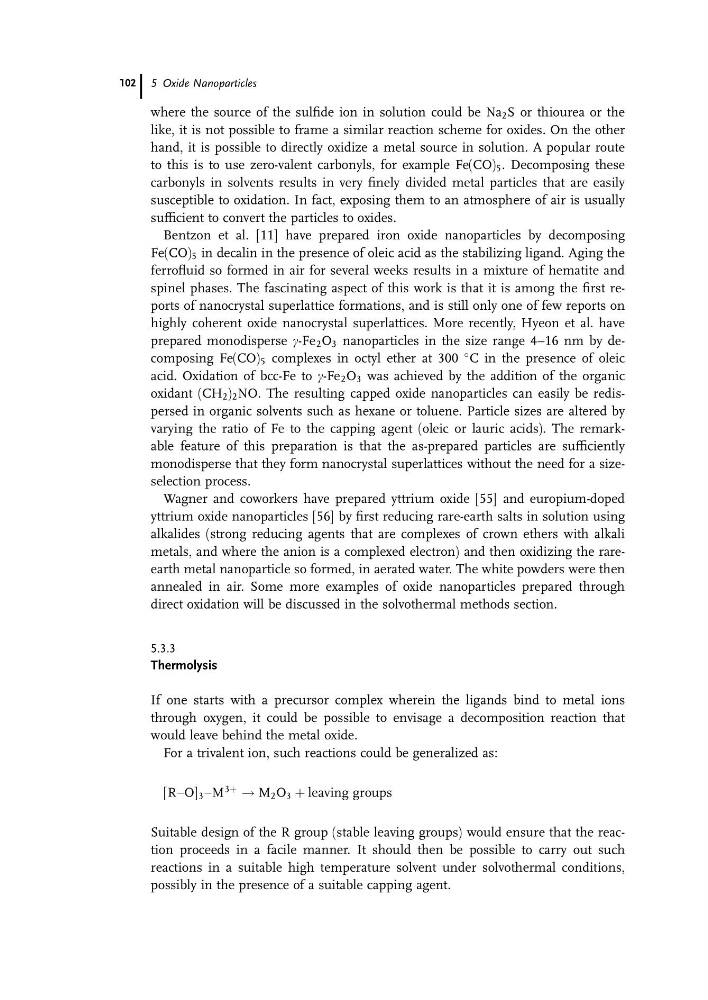
For a trivalent ion, such reactions could be generalized as:
[RaO] 3 aM
3þ ! M 2 O 3 þ leaving groups
Suitable design of the R group (stable leaving groups) would ensure that the reaction proceeds in a facile manner. It should then be possible to carry out such
reactions in a suitable high temperature solvent under solvothermal conditions,
possibly in the presence of a suitable capping agent.
5 Oxide Nanoparticles
102
like, it is not possible to frame a similar reaction scheme for oxides. On the other
hand, it is possible to directly oxidize a metal source in solution. A popular route
to this is to use zero-valent carbonyls, for example Fe(CO) 5 . Decomposing these
carbonyls in solvents results in very finely divided metal particles that are easily
susceptible to oxidation. In fact, exposing them to an atmosphere of air is usually
sufficient to convert the particles to oxides.
Bentzon et al. [11] have prepared iron oxide nanoparticles by decomposing
Fe(CO) 5 in decalin in the presence of oleic acid as the stabilizing ligand. Aging the
ferrofluid so formed in air for several weeks results in a mixture of hematite and
spinel phases. The fascinating aspect of this work is that it is among the first reports of nanocrystal superlattice formations, and is still only one of few reports on
highly coherent oxide nanocrystal superlattices. More recently, Hyeon et al. have
prepared monodisperse g-Fe 2 O 3 nanoparticles in the size range 4–16 nm by decomposing Fe(CO) 5 complexes in octyl ether at 300
C in the presence of oleic
acid. Oxidation of bcc-Fe to g-Fe 2 O 3 was achieved by the addition of the organic
oxidant (CH 2 ) 2 NO. The resulting capped oxide nanoparticles can easily be redispersed in organic solvents such as hexane or toluene. Particle sizes are altered by
varying the ratio of Fe to the capping agent (oleic or lauric acids). The remarkable feature of this preparation is that the as-prepared particles are sufficiently
monodisperse that they form nanocrystal superlattices without the need for a sizeselection process.
Wagner and coworkers have prepared yttrium oxide [55] and europium-doped
yttrium oxide nanoparticles [56] by first reducing rare-earth salts in solution using
alkalides (strong reducing agents that are complexes of crown ethers with alkali
metals, and where the anion is a complexed electron) and then oxidizing the rareearth metal nanoparticle so formed, in aerated water. The white powders were then
annealed in air. Some more examples of oxide nanoparticles prepared through
direct oxidation will be discussed in the solvothermal methods section.
5.3.3
Thermolysis
If one starts with a precursor complex wherein the ligands bind to metal ions
through oxygen, it could be possible to envisage a decomposition reaction that
would leave behind the metal oxide.
For a trivalent ion, such reactions could be generalized as:
[RaO] 3 aM
3þ ! M 2 O 3 þ leaving groups
Suitable design of the R group (stable leaving groups) would ensure that the reaction proceeds in a facile manner. It should then be possible to carry out such
reactions in a suitable high temperature solvent under solvothermal conditions,
possibly in the presence of a suitable capping agent.
5 Oxide Nanoparticles
102