

water sphere, its growth is limited by the size constraint of the water droplet. Pillai
and Shah [45] have utilized this route to prepare high-coercivity CoFe 2 O 4 nanoparticles by mixing two water-in-oil microemulsions, one containing metal ions
and the other containing base. These authors calcine the particles, so the resulting
material is nanophase, rather than nanoparticulate. MnFe 2 O 4 [46] and CoCrFeO 4
[47] have been prepared using such reverse-micelle routes by Zhang et al., and
characterized by using a combination of magnetization studies and powder neutron diffraction.
Pileni has also pioneered the use of the surfactant-as-reactant approach in the
preparation of nanoparticles. For example, in the preparation of CoFe 2 O 4 nanoparticles with sizes between 2 and 5 nm, instead of preparing inverse-micellar dispersions of the Co and Fe salts, Moumen and Pileni [48] prepared the dodecylsulfonate (DS) analogs Fe(DS) 2 and Co(DS) 2 . These were made to form micellar
solutions, to raise the pH, aqueous methylamine solution was added. Stirring for
2 h resulted in a magnetic precipitate. Due to the low yield of Fe(II) to Fe(III)
oxidation under these conditions, an excess of Fe(DS) 2 is required.
With an increase in concentration of the reactants, there is an increase in particle size. Zinc-doped cobalt ferrite nanoparticles [49] and zinc ferrite [50] have also
been prepared using these methods. The 10 nm ferrite nanocrystal ferrofluids
prepared using the Fe(DS) 2 route form deposits with different morphologies when
evaporated on oriented graphite substrates [51]. The morphology can be strongly
influenced by applying a magnetic field during the evaporation process. Thus
magnetic properties of deposits prepared in the presence and absence of a field are
quite different.
Hydrolysis can be assisted by using irradiation of the reacting bath with ultrasound. In these sonochemical preparations, acoustic cavitation results in the production of concentrated spots of extremely high temperatures. These ‘‘hot spots’’
accelerate the rate of metal ion hydrolysis. Gedanken and coworkers [52] have
prepared ZnO, CuO, Co 3 O 4 and Fe 3 O 4 particles by subjecting solutions of the
acetates to ultrasound irradiation using a high-intensity horn. Particle morphologies could be altered by using mixtures of water and dimethyl formamide instead
of pure water as the solvent. Magnetite nanorods have been prepared by these
authors [53] by ultrasonically irradiation of Fe(II) acetate in water in the presence
of b-cyclodextrin. The authors suggest that cyclodextrin molecules are acting as
size-stabilizing agents.
5.3.2
Oxidation
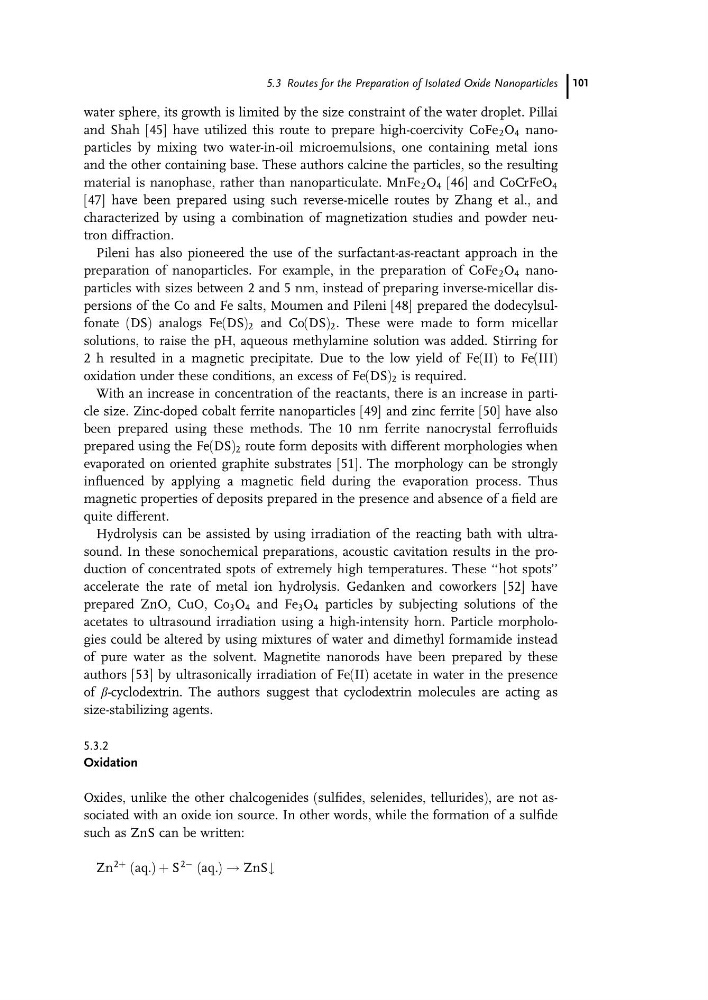
Oxides, unlike the other chalcogenides (sulfides, selenides, tellurides), are not associated with an oxide ion source. In other words, while the formation of a sulfide
such as ZnS can be written:
Zn
2þ (aq.) þ S
2À (aq.) ! ZnS#
5.3 Routes for the Preparation of Isolated Oxide Nanoparticles 101
and Shah [45] have utilized this route to prepare high-coercivity CoFe 2 O 4 nanoparticles by mixing two water-in-oil microemulsions, one containing metal ions
and the other containing base. These authors calcine the particles, so the resulting
material is nanophase, rather than nanoparticulate. MnFe 2 O 4 [46] and CoCrFeO 4
[47] have been prepared using such reverse-micelle routes by Zhang et al., and
characterized by using a combination of magnetization studies and powder neutron diffraction.
Pileni has also pioneered the use of the surfactant-as-reactant approach in the
preparation of nanoparticles. For example, in the preparation of CoFe 2 O 4 nanoparticles with sizes between 2 and 5 nm, instead of preparing inverse-micellar dispersions of the Co and Fe salts, Moumen and Pileni [48] prepared the dodecylsulfonate (DS) analogs Fe(DS) 2 and Co(DS) 2 . These were made to form micellar
solutions, to raise the pH, aqueous methylamine solution was added. Stirring for
2 h resulted in a magnetic precipitate. Due to the low yield of Fe(II) to Fe(III)
oxidation under these conditions, an excess of Fe(DS) 2 is required.
With an increase in concentration of the reactants, there is an increase in particle size. Zinc-doped cobalt ferrite nanoparticles [49] and zinc ferrite [50] have also
been prepared using these methods. The 10 nm ferrite nanocrystal ferrofluids
prepared using the Fe(DS) 2 route form deposits with different morphologies when
evaporated on oriented graphite substrates [51]. The morphology can be strongly
influenced by applying a magnetic field during the evaporation process. Thus
magnetic properties of deposits prepared in the presence and absence of a field are
quite different.
Hydrolysis can be assisted by using irradiation of the reacting bath with ultrasound. In these sonochemical preparations, acoustic cavitation results in the production of concentrated spots of extremely high temperatures. These ‘‘hot spots’’
accelerate the rate of metal ion hydrolysis. Gedanken and coworkers [52] have
prepared ZnO, CuO, Co 3 O 4 and Fe 3 O 4 particles by subjecting solutions of the
acetates to ultrasound irradiation using a high-intensity horn. Particle morphologies could be altered by using mixtures of water and dimethyl formamide instead
of pure water as the solvent. Magnetite nanorods have been prepared by these
authors [53] by ultrasonically irradiation of Fe(II) acetate in water in the presence
of b-cyclodextrin. The authors suggest that cyclodextrin molecules are acting as
size-stabilizing agents.
5.3.2
Oxidation
Oxides, unlike the other chalcogenides (sulfides, selenides, tellurides), are not associated with an oxide ion source. In other words, while the formation of a sulfide
such as ZnS can be written:
Zn
2þ (aq.) þ S
2À (aq.) ! ZnS#
5.3 Routes for the Preparation of Isolated Oxide Nanoparticles 101