

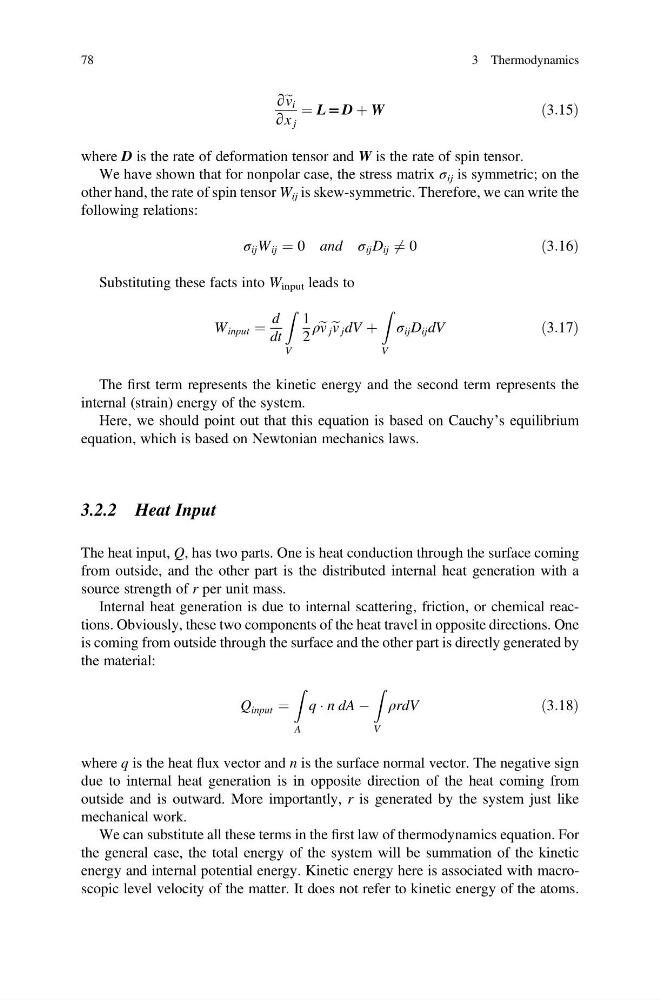
∂e v i
∂x j
¼ L = D þ W
ð3:15Þ
where D is the rate of deformation tensor and W is the rate of spin tensor.
We have shown that for nonpolar case, the stress matrix σ ij is symmetric; on the
other hand, the rate of spin tensor W ij is skew-symmetric. Therefore, we can write the
following relations:
σ ij W ij ¼ 0 and σ ij D ij 6 ¼ 0
ð3:16Þ
Substituting these facts into W input leads to
W input ¼
d
dt
Z
V
1
2
ρe v j e v j dV þ
Z
V
σ ij D ij dV
ð3:17Þ
The first term represents the kinetic energy and the second term represents the
internal (strain) energy of the system.
Here, we should point out that this equation is based on Cauchy’s equilibrium
equation, which is based on Newtonian mechanics laws.
3.2.2 Heat Input
The heat input, Q, has two parts. One is heat conduction through the surface coming
from outside, and the other part is the distributed internal heat generation with a
source strength of r per unit mass.
Internal heat generation is due to internal scattering, friction, or chemical reactions. Obviously, these two components of the heat travel in opposite directions. One
is coming from outside through the surface and the other part is directly generated by
the material:
Q input ¼
Z
A
q Á n dA À
Z
V
ρrdV
ð3:18Þ
where q is the heat flux vector and n is the surface normal vector. The negative sign
due to internal heat generation is in opposite direction of the heat coming from
outside and is outward. More importantly, r is generated by the system just like
mechanical work.
We can substitute all these terms in the first law of thermodynamics equation. For
the general case, the total energy of the system will be summation of the kinetic
energy and internal potential energy. Kinetic energy here is associated with macroscopic level velocity of the matter. It does not refer to kinetic energy of the atoms.
78
3 Thermodynamics
∂x j
¼ L = D þ W
ð3:15Þ
where D is the rate of deformation tensor and W is the rate of spin tensor.
We have shown that for nonpolar case, the stress matrix σ ij is symmetric; on the
other hand, the rate of spin tensor W ij is skew-symmetric. Therefore, we can write the
following relations:
σ ij W ij ¼ 0 and σ ij D ij 6 ¼ 0
ð3:16Þ
Substituting these facts into W input leads to
W input ¼
d
dt
Z
V
1
2
ρe v j e v j dV þ
Z
V
σ ij D ij dV
ð3:17Þ
The first term represents the kinetic energy and the second term represents the
internal (strain) energy of the system.
Here, we should point out that this equation is based on Cauchy’s equilibrium
equation, which is based on Newtonian mechanics laws.
3.2.2 Heat Input
The heat input, Q, has two parts. One is heat conduction through the surface coming
from outside, and the other part is the distributed internal heat generation with a
source strength of r per unit mass.
Internal heat generation is due to internal scattering, friction, or chemical reactions. Obviously, these two components of the heat travel in opposite directions. One
is coming from outside through the surface and the other part is directly generated by
the material:
Q input ¼
Z
A
q Á n dA À
Z
V
ρrdV
ð3:18Þ
where q is the heat flux vector and n is the surface normal vector. The negative sign
due to internal heat generation is in opposite direction of the heat coming from
outside and is outward. More importantly, r is generated by the system just like
mechanical work.
We can substitute all these terms in the first law of thermodynamics equation. For
the general case, the total energy of the system will be summation of the kinetic
energy and internal potential energy. Kinetic energy here is associated with macroscopic level velocity of the matter. It does not refer to kinetic energy of the atoms.
78
3 Thermodynamics