

σ
n
ð Þ
j ¼ σ ij n i
ð3:8Þ
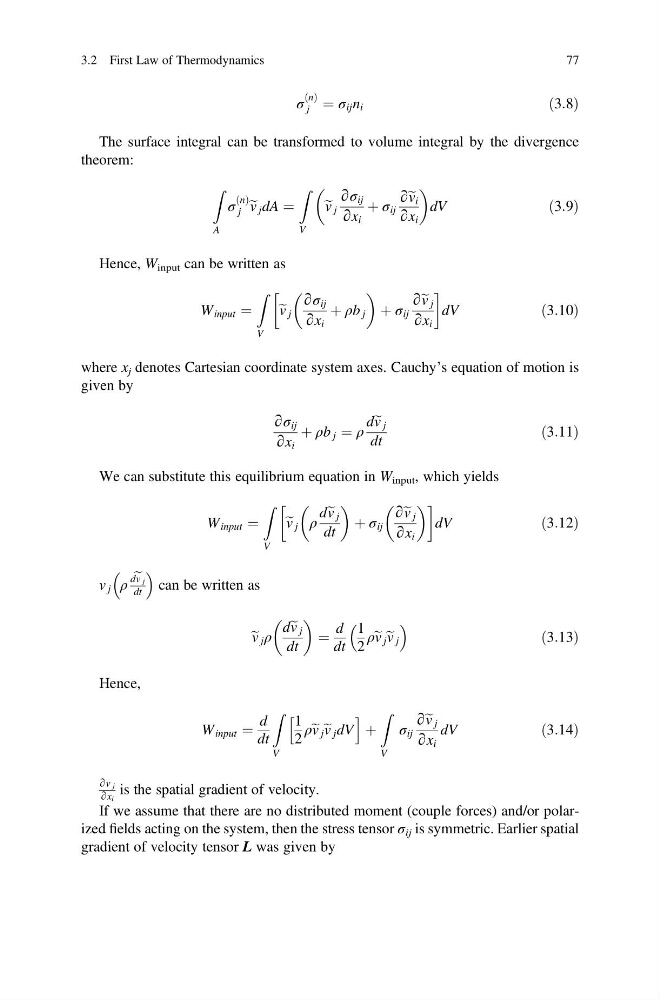
The surface integral can be transformed to volume integral by the divergence
theorem:
Z
A
σ
n
ð Þ
j e v j dA ¼
Z
V
e v j
∂σ ij
∂x i
þ σ ij
∂e v i
∂x i
dV
ð3:9Þ
Hence, W input can be written as
W input ¼
Z
V
e v j
∂σ ij
∂x i
þ ρb j
þ σ ij
∂e v j
∂x i
!
dV
ð3:10Þ
where x j denotes Cartesian coordinate system axes. Cauchy’s equation of motion is
given by
∂σ ij
∂x i
þ ρb j ¼ ρ
de v j
dt
ð3:11Þ
We can substitute this equilibrium equation in W input , which yields
W input ¼
Z
V
e v j ρ
de v j
dt
þ σ ij
∂e v j
∂x i
!
dV
ð3:12Þ
v j ρ
de v j
dt
can be written as
e v j ρ
de v j
dt
¼
d
dt
1
2
ρe v j e v j
ð3:13Þ
Hence,
W input ¼
d
dt
Z
V
1
2
ρe v j e v j dV
h
i
þ
Z
V
σ ij
∂e v j
∂x i
dV
ð3:14Þ
∂v j
∂x i
is the spatial gradient of velocity.
If we assume that there are no distributed moment (couple forces) and/or polarized fields acting on the system, then the stress tensor σ ij is symmetric. Earlier spatial
gradient of velocity tensor L was given by
3.2 First Law of Thermodynamics
77
n
ð Þ
j ¼ σ ij n i
ð3:8Þ
The surface integral can be transformed to volume integral by the divergence
theorem:
Z
A
σ
n
ð Þ
j e v j dA ¼
Z
V
e v j
∂σ ij
∂x i
þ σ ij
∂e v i
∂x i
dV
ð3:9Þ
Hence, W input can be written as
W input ¼
Z
V
e v j
∂σ ij
∂x i
þ ρb j
þ σ ij
∂e v j
∂x i
!
dV
ð3:10Þ
where x j denotes Cartesian coordinate system axes. Cauchy’s equation of motion is
given by
∂σ ij
∂x i
þ ρb j ¼ ρ
de v j
dt
ð3:11Þ
We can substitute this equilibrium equation in W input , which yields
W input ¼
Z
V
e v j ρ
de v j
dt
þ σ ij
∂e v j
∂x i
!
dV
ð3:12Þ
v j ρ
de v j
dt
can be written as
e v j ρ
de v j
dt
¼
d
dt
1
2
ρe v j e v j
ð3:13Þ
Hence,
W input ¼
d
dt
Z
V
1
2
ρe v j e v j dV
h
i
þ
Z
V
σ ij
∂e v j
∂x i
dV
ð3:14Þ
∂v j
∂x i
is the spatial gradient of velocity.
If we assume that there are no distributed moment (couple forces) and/or polarized fields acting on the system, then the stress tensor σ ij is symmetric. Earlier spatial
gradient of velocity tensor L was given by
3.2 First Law of Thermodynamics
77