

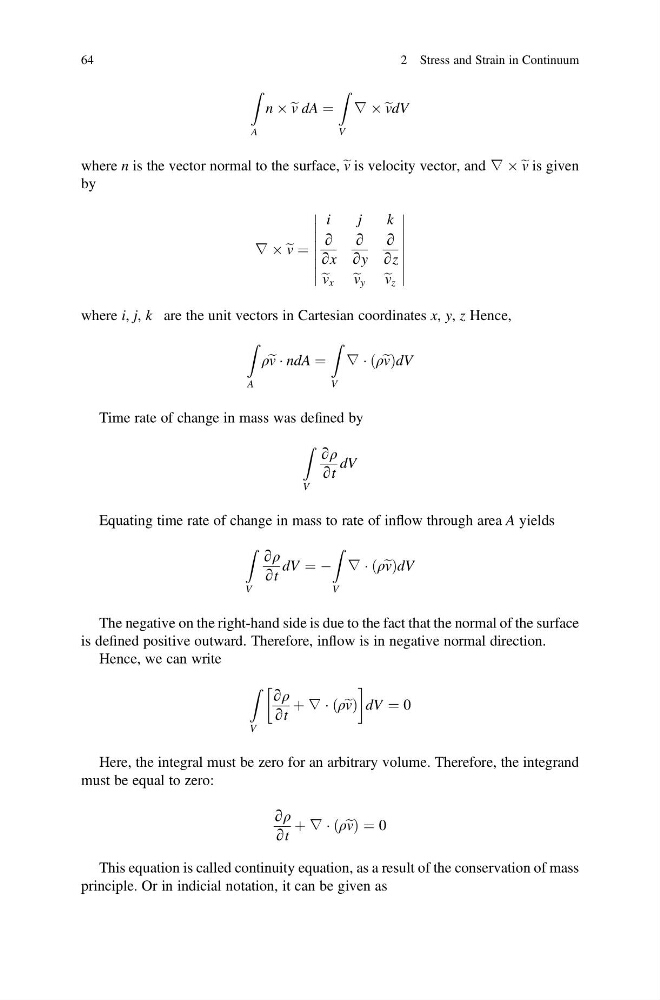
Z
A
n  e v dA ¼
Z
V
∇ Â e vdV
where n is the vector normal to the surface, e v is velocity vector, and ∇ Â e v is given
by
∇ Â e v ¼
i
j
k
∂
∂x
∂
∂y
∂
∂z
e v x e v y e v z
where i, j, k are the unit vectors in Cartesian coordinates x, y, z Hence,
Z
A
ρe v Á ndA ¼
Z
V
∇ Á ρe v
ð ÞdV
Time rate of change in mass was defined by
Z
V
∂ρ
∂t
dV
Equating time rate of change in mass to rate of inflow through area A yields
Z
V
∂ρ
∂t
dV ¼ À
Z
V
∇ Á ρe v
ð ÞdV
The negative on the right-hand side is due to the fact that the normal of the surface
is defined positive outward. Therefore, inflow is in negative normal direction.
Hence, we can write
Z
V
∂ρ
∂t
þ ∇ Á ρe v
ð Þ
!
dV ¼ 0
Here, the integral must be zero for an arbitrary volume. Therefore, the integrand
must be equal to zero:
∂ρ
∂t
þ ∇ Á ρe v
ð Þ ¼ 0
This equation is called continuity equation, as a result of the conservation of mass
principle. Or in indicial notation, it can be given as
64
2 Stress and Strain in Continuum
A
n  e v dA ¼
Z
V
∇ Â e vdV
where n is the vector normal to the surface, e v is velocity vector, and ∇ Â e v is given
by
∇ Â e v ¼
i
j
k
∂
∂x
∂
∂y
∂
∂z
e v x e v y e v z
where i, j, k are the unit vectors in Cartesian coordinates x, y, z Hence,
Z
A
ρe v Á ndA ¼
Z
V
∇ Á ρe v
ð ÞdV
Time rate of change in mass was defined by
Z
V
∂ρ
∂t
dV
Equating time rate of change in mass to rate of inflow through area A yields
Z
V
∂ρ
∂t
dV ¼ À
Z
V
∇ Á ρe v
ð ÞdV
The negative on the right-hand side is due to the fact that the normal of the surface
is defined positive outward. Therefore, inflow is in negative normal direction.
Hence, we can write
Z
V
∂ρ
∂t
þ ∇ Á ρe v
ð Þ
!
dV ¼ 0
Here, the integral must be zero for an arbitrary volume. Therefore, the integrand
must be equal to zero:
∂ρ
∂t
þ ∇ Á ρe v
ð Þ ¼ 0
This equation is called continuity equation, as a result of the conservation of mass
principle. Or in indicial notation, it can be given as
64
2 Stress and Strain in Continuum