

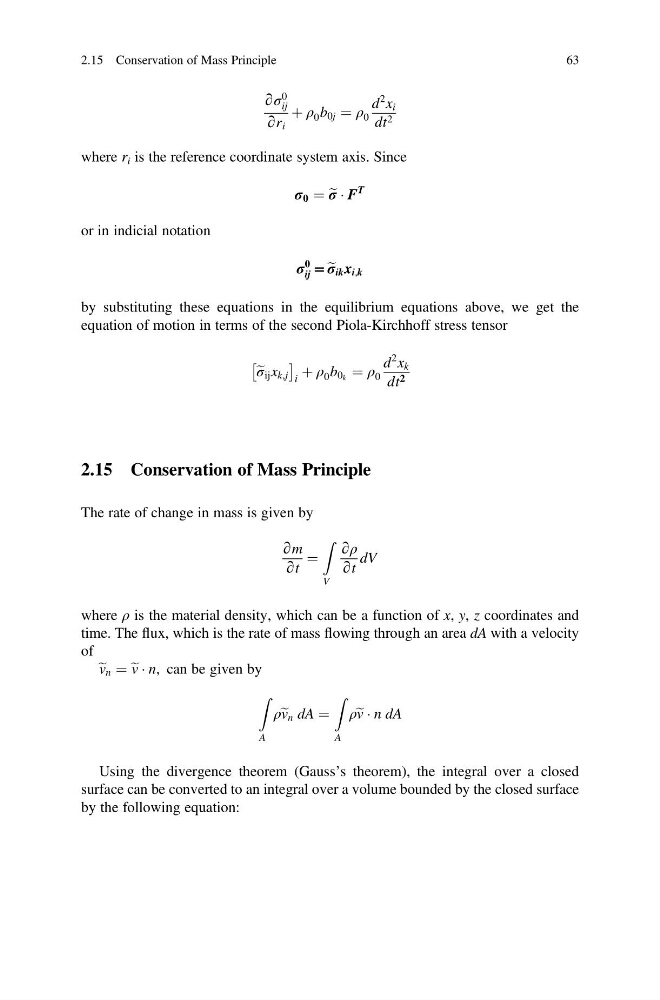
∂σ
0
ij
∂r i
þ ρ 0 b 0j ¼ ρ 0
d
2 x i
dt 2
where r i is the reference coordinate system axis. Since
σ 0 ¼ e σ Á F
T
or in indicial notation
σ
0
ij = e σ ik x i,k
by substituting these equations in the equilibrium equations above, we get the
equation of motion in terms of the second Piola-Kirchhoff stress tensor
e σ ij x k,j
Â
Ã
i
þ ρ 0 b 0 k ¼ ρ 0
d
2 x k
dt 2
2.15 Conservation of Mass Principle
The rate of change in mass is given by
∂m
∂t
¼
Z
V
∂ρ
∂t
dV
where ρ is the material density, which can be a function of x, y, z coordinates and
time. The flux, which is the rate of mass flowing through an area dA with a velocity
of
e v n ¼ e v Á n, can be given by
Z
A
ρe v n dA ¼
Z
A
ρe v Á n dA
Using the divergence theorem (Gauss’s theorem), the integral over a closed
surface can be converted to an integral over a volume bounded by the closed surface
by the following equation:
2.15 Conservation of Mass Principle
63
0
ij
∂r i
þ ρ 0 b 0j ¼ ρ 0
d
2 x i
dt 2
where r i is the reference coordinate system axis. Since
σ 0 ¼ e σ Á F
T
or in indicial notation
σ
0
ij = e σ ik x i,k
by substituting these equations in the equilibrium equations above, we get the
equation of motion in terms of the second Piola-Kirchhoff stress tensor
e σ ij x k,j
Â
Ã
i
þ ρ 0 b 0 k ¼ ρ 0
d
2 x k
dt 2
2.15 Conservation of Mass Principle
The rate of change in mass is given by
∂m
∂t
¼
Z
V
∂ρ
∂t
dV
where ρ is the material density, which can be a function of x, y, z coordinates and
time. The flux, which is the rate of mass flowing through an area dA with a velocity
of
e v n ¼ e v Á n, can be given by
Z
A
ρe v n dA ¼
Z
A
ρe v Á n dA
Using the divergence theorem (Gauss’s theorem), the integral over a closed
surface can be converted to an integral over a volume bounded by the closed surface
by the following equation:
2.15 Conservation of Mass Principle
63