

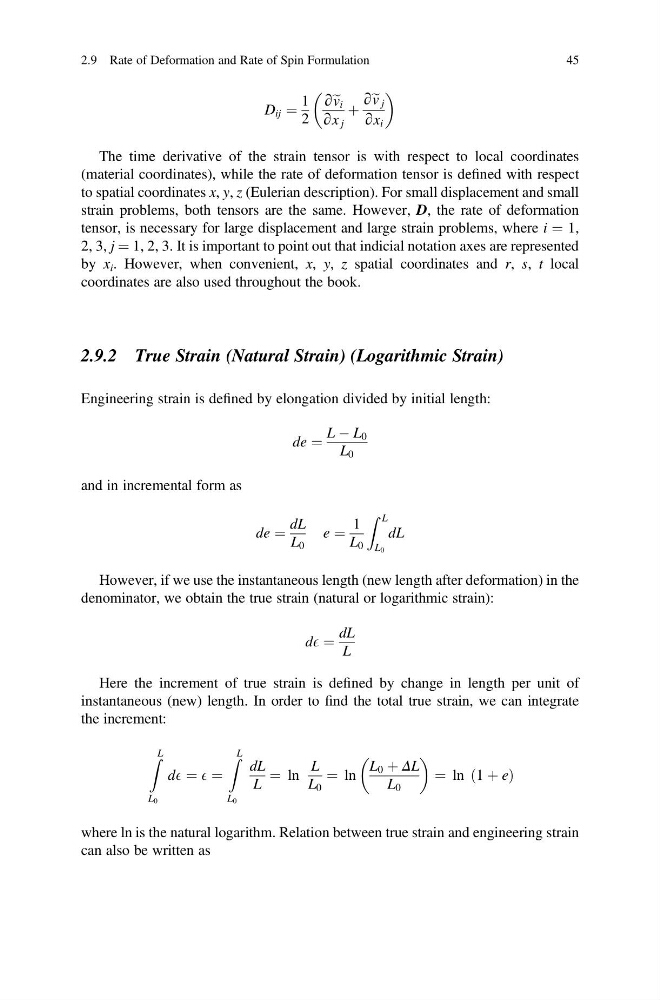
D ij ¼
1
2
∂e v i
∂x j
þ
∂e v j
∂x i
The time derivative of the strain tensor is with respect to local coordinates
(material coordinates), while the rate of deformation tensor is defined with respect
to spatial coordinates x, y, z (Eulerian description). For small displacement and small
strain problems, both tensors are the same. However, D, the rate of deformation
tensor, is necessary for large displacement and large strain problems, where i ¼ 1,
2, 3, j ¼ 1, 2, 3. It is important to point out that indicial notation axes are represented
by x i . However, when convenient, x, y, z spatial coordinates and r, s, t local
coordinates are also used throughout the book.
2.9.2 True Strain (Natural Strain) (Logarithmic Strain)
Engineering strain is defined by elongation divided by initial length:
de ¼
L À L 0
L 0
and in incremental form as
de ¼
dL
L 0
e ¼
1
L 0
Z L
L 0
dL
However, if we use the instantaneous length (new length after deformation) in the
denominator, we obtain the true strain (natural or logarithmic strain):
dE ¼
dL
L
Here the increment of true strain is defined by change in length per unit of
instantaneous (new) length. In order to find the total true strain, we can integrate
the increment:
Z L
L 0
dE ¼ E ¼
Z L
L 0
dL
L
¼ ln
L
L 0
¼ ln
L 0 þ ΔL
L 0
¼ ln 1 þ e
ð
Þ
where ln is the natural logarithm. Relation between true strain and engineering strain
can also be written as
2.9 Rate of Deformation and Rate of Spin Formulation
45
1
2
∂e v i
∂x j
þ
∂e v j
∂x i
The time derivative of the strain tensor is with respect to local coordinates
(material coordinates), while the rate of deformation tensor is defined with respect
to spatial coordinates x, y, z (Eulerian description). For small displacement and small
strain problems, both tensors are the same. However, D, the rate of deformation
tensor, is necessary for large displacement and large strain problems, where i ¼ 1,
2, 3, j ¼ 1, 2, 3. It is important to point out that indicial notation axes are represented
by x i . However, when convenient, x, y, z spatial coordinates and r, s, t local
coordinates are also used throughout the book.
2.9.2 True Strain (Natural Strain) (Logarithmic Strain)
Engineering strain is defined by elongation divided by initial length:
de ¼
L À L 0
L 0
and in incremental form as
de ¼
dL
L 0
e ¼
1
L 0
Z L
L 0
dL
However, if we use the instantaneous length (new length after deformation) in the
denominator, we obtain the true strain (natural or logarithmic strain):
dE ¼
dL
L
Here the increment of true strain is defined by change in length per unit of
instantaneous (new) length. In order to find the total true strain, we can integrate
the increment:
Z L
L 0
dE ¼ E ¼
Z L
L 0
dL
L
¼ ln
L
L 0
¼ ln
L 0 þ ΔL
L 0
¼ ln 1 þ e
ð
Þ
where ln is the natural logarithm. Relation between true strain and engineering strain
can also be written as
2.9 Rate of Deformation and Rate of Spin Formulation
45