

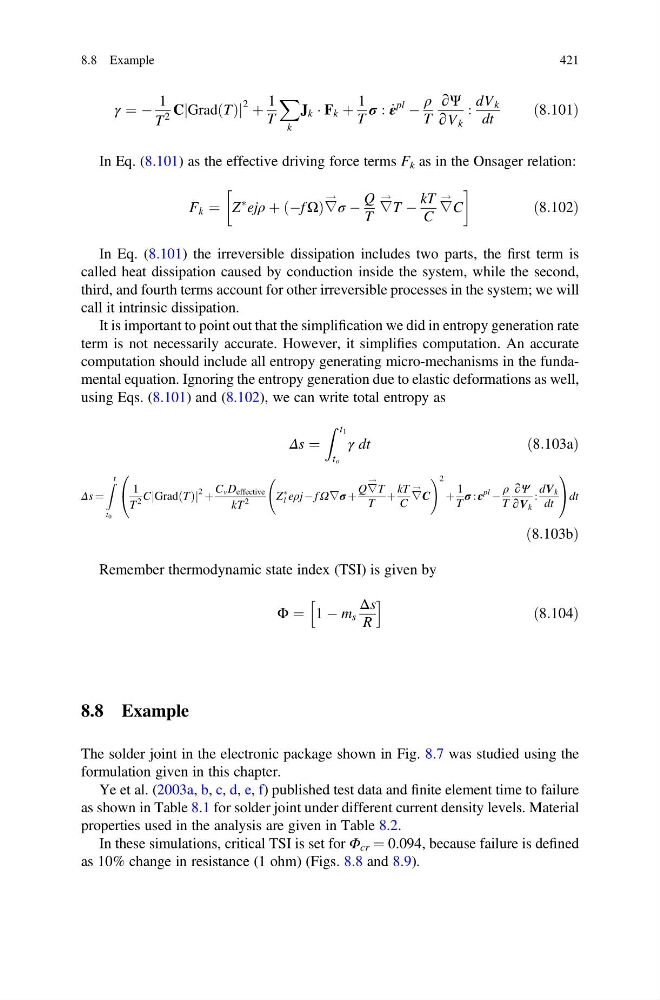
γ ¼ À
1
T
2
C Grad T
ð Þ
j
j
2 þ
1
T
X
k
J k Á F k þ
1
T
σ : _
ε
pl
À
ρ
T
∂Ψ
∂V k
:
dV k
dt
ð8:101Þ
In Eq. (8.101) as the effective driving force terms F k as in the Onsager relation:
F k ¼ Z
à ejρ þ Àf Ω
ð
Þ∇
! σ À
Q
T
∇
!
T À
kT
C
∇
!
C
!
ð8:102Þ
In Eq. (8.101) the irreversible dissipation includes two parts, the first term is
called heat dissipation caused by conduction inside the system, while the second,
third, and fourth terms account for other irreversible processes in the system; we will
call it intrinsic dissipation.
It is important to point out that the simplification we did in entropy generation rate
term is not necessarily accurate. However, it simplifies computation. An accurate
computation should include all entropy generating micro-mechanisms in the fundamental equation. Ignoring the entropy generation due to elastic deformations as well,
using Eqs. (8.101) and (8.102), we can write total entropy as
Δs ¼
Z t 1
t o
γ dt
ð8:103aÞ
Δs ¼
Z t
t0
1
T
2
C Grad T
ð Þ
j
j
2 þ
C v D effective
kT
2
Z
Ã
l eρj À f Ω∇σ þ
Q∇
!
T
T
þ
kT
C
∇
!
C
! 2
þ
1
T
σ : ε
pl À
ρ
T
∂Ψ
∂V k
:
dV k
dt
0
@
1
A dt
ð8:103bÞ
Remember thermodynamic state index (TSI) is given by
Φ ¼ 1 À m s
Δs
R
h
i
ð8:104Þ
8.8 Example
The solder joint in the electronic package shown in Fig. 8.7 was studied using the
formulation given in this chapter.
Ye et al. (2003a, b, c, d, e, f) published test data and finite element time to failure
as shown in Table 8.1 for solder joint under different current density levels. Material
properties used in the analysis are given in Table 8.2.
In these simulations, critical TSI is set for Φ cr ¼ 0.094, because failure is defined
as 10% change in resistance (1 ohm) (Figs. 8.8 and 8.9).
8.8 Example
421
1
T
2
C Grad T
ð Þ
j
j
2 þ
1
T
X
k
J k Á F k þ
1
T
σ : _
ε
pl
À
ρ
T
∂Ψ
∂V k
:
dV k
dt
ð8:101Þ
In Eq. (8.101) as the effective driving force terms F k as in the Onsager relation:
F k ¼ Z
à ejρ þ Àf Ω
ð
Þ∇
! σ À
Q
T
∇
!
T À
kT
C
∇
!
C
!
ð8:102Þ
In Eq. (8.101) the irreversible dissipation includes two parts, the first term is
called heat dissipation caused by conduction inside the system, while the second,
third, and fourth terms account for other irreversible processes in the system; we will
call it intrinsic dissipation.
It is important to point out that the simplification we did in entropy generation rate
term is not necessarily accurate. However, it simplifies computation. An accurate
computation should include all entropy generating micro-mechanisms in the fundamental equation. Ignoring the entropy generation due to elastic deformations as well,
using Eqs. (8.101) and (8.102), we can write total entropy as
Δs ¼
Z t 1
t o
γ dt
ð8:103aÞ
Δs ¼
Z t
t0
1
T
2
C Grad T
ð Þ
j
j
2 þ
C v D effective
kT
2
Z
Ã
l eρj À f Ω∇σ þ
Q∇
!
T
T
þ
kT
C
∇
!
C
! 2
þ
1
T
σ : ε
pl À
ρ
T
∂Ψ
∂V k
:
dV k
dt
0
@
1
A dt
ð8:103bÞ
Remember thermodynamic state index (TSI) is given by
Φ ¼ 1 À m s
Δs
R
h
i
ð8:104Þ
8.8 Example
The solder joint in the electronic package shown in Fig. 8.7 was studied using the
formulation given in this chapter.
Ye et al. (2003a, b, c, d, e, f) published test data and finite element time to failure
as shown in Table 8.1 for solder joint under different current density levels. Material
properties used in the analysis are given in Table 8.2.
In these simulations, critical TSI is set for Φ cr ¼ 0.094, because failure is defined
as 10% change in resistance (1 ohm) (Figs. 8.8 and 8.9).
8.8 Example
421