

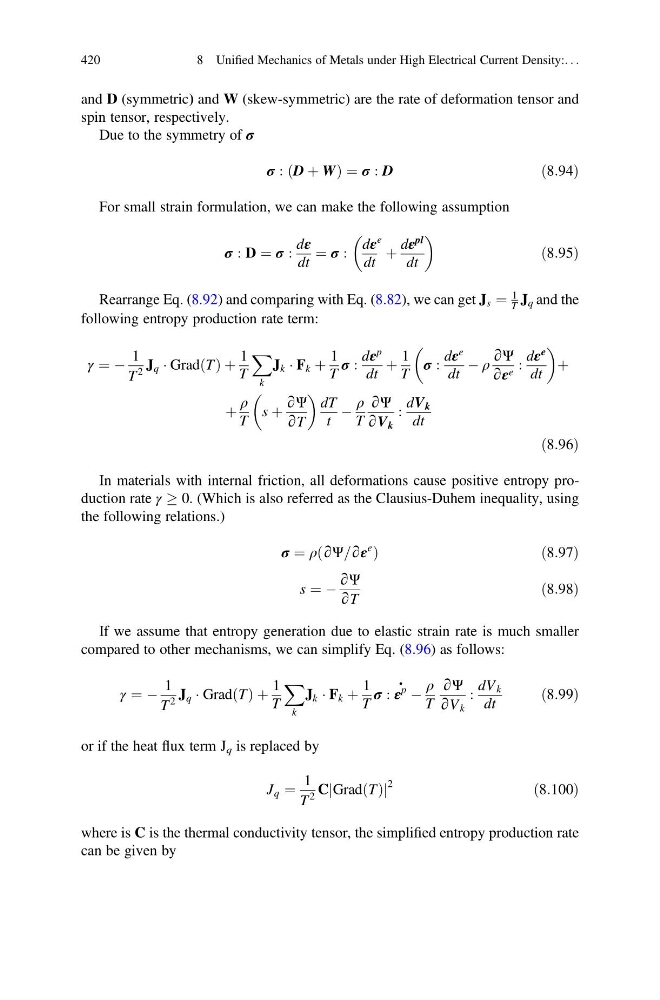
and D (symmetric) and W (skew-symmetric) are the rate of deformation tensor and
spin tensor, respectively.
Due to the symmetry of σ
σ : D þ W
ð
Þ¼σ : D
ð8:94Þ
For small strain formulation, we can make the following assumption
σ : D ¼ σ :
dε
dt
¼ σ :
dε
dt
e
þ
dε
pl
dt
ð8:95Þ
Rearrange Eq. (8.92) and comparing with Eq. (8.82), we can get J s ¼
1
T J q and the
following entropy production rate term:
γ ¼ À
1
T
2
J q Á Grad T
ð Þ þ
1
T
X
k
J k Á F k þ
1
T
σ :
dε
p
dt
þ
1
T
σ :
dε
e
dt
À ρ
∂Ψ
∂ε e :
dε
e
dt
þ
þ
ρ
T
s þ
∂Ψ
∂T
dT
t
À
ρ
T
∂Ψ
∂V k
:
dV k
dt
ð8:96Þ
In materials with internal friction, all deformations cause positive entropy production rate γ ! 0. (Which is also referred as the Clausius-Duhem inequality, using
the following relations.)
σ ¼ ρ ∂Ψ=∂ε
e
ð
Þ
ð 8:97Þ
s ¼ À
∂Ψ
∂T
ð8:98Þ
If we assume that entropy generation due to elastic strain rate is much smaller
compared to other mechanisms, we can simplify Eq. (8.96) as follows:
γ ¼ À
1
T
2
J q Á Grad T
ð Þ þ
1
T
X
k
J k Á F k þ
1
T
σ : ε
p
• À
ρ
T
∂Ψ
∂V k
:
dV k
dt
ð8:99Þ
or if the heat flux term J q is replaced by
J q ¼
1
T
2
C Grad T
ð Þ
j
j
2
ð8:100Þ
where is C is the thermal conductivity tensor, the simplified entropy production rate
can be given by
420
8 Unified Mechanics of Metals under High Electrical Current Density:. . .
spin tensor, respectively.
Due to the symmetry of σ
σ : D þ W
ð
Þ¼σ : D
ð8:94Þ
For small strain formulation, we can make the following assumption
σ : D ¼ σ :
dε
dt
¼ σ :
dε
dt
e
þ
dε
pl
dt
ð8:95Þ
Rearrange Eq. (8.92) and comparing with Eq. (8.82), we can get J s ¼
1
T J q and the
following entropy production rate term:
γ ¼ À
1
T
2
J q Á Grad T
ð Þ þ
1
T
X
k
J k Á F k þ
1
T
σ :
dε
p
dt
þ
1
T
σ :
dε
e
dt
À ρ
∂Ψ
∂ε e :
dε
e
dt
þ
þ
ρ
T
s þ
∂Ψ
∂T
dT
t
À
ρ
T
∂Ψ
∂V k
:
dV k
dt
ð8:96Þ
In materials with internal friction, all deformations cause positive entropy production rate γ ! 0. (Which is also referred as the Clausius-Duhem inequality, using
the following relations.)
σ ¼ ρ ∂Ψ=∂ε
e
ð
Þ
ð 8:97Þ
s ¼ À
∂Ψ
∂T
ð8:98Þ
If we assume that entropy generation due to elastic strain rate is much smaller
compared to other mechanisms, we can simplify Eq. (8.96) as follows:
γ ¼ À
1
T
2
J q Á Grad T
ð Þ þ
1
T
X
k
J k Á F k þ
1
T
σ : ε
p
• À
ρ
T
∂Ψ
∂V k
:
dV k
dt
ð8:99Þ
or if the heat flux term J q is replaced by
J q ¼
1
T
2
C Grad T
ð Þ
j
j
2
ð8:100Þ
where is C is the thermal conductivity tensor, the simplified entropy production rate
can be given by
420
8 Unified Mechanics of Metals under High Electrical Current Density:. . .