

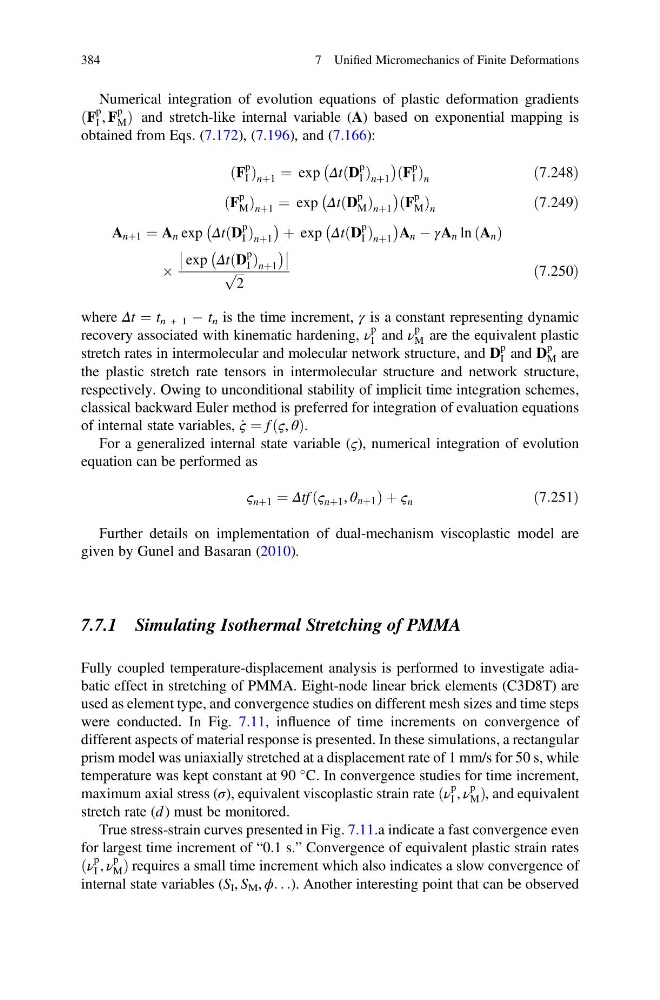
Numerical integration of evolution equations of plastic deformation gradients
F
p
I , F
p
M
ð
Þ and stretch-like internal variable (A) based on exponential mapping is
obtained from Eqs. (7.172), (7.196), and (7.166):
F
p
I
ð Þ nþ1 ¼ exp Δt D
p
I
ð Þ nþ1
À
Á
F
p
I
ð Þ n
ð7:248Þ
F
p
M
ð Þ nþ1 ¼ exp Δt D
p
M
ð Þ nþ1
À
Á
F
p
M
ð Þ n
ð7:249Þ
A nþ1 ¼ A n exp Δt D
p
I
ð Þ nþ1
À
Á þ exp Δt D
p
I
ð Þ nþ1
À
Á
A n À γA n ln A n
ð Þ
Â
exp Δt D
p
I
ð Þ nþ1
À
Á
ffiffi ffi
2
p
ð7:250Þ
where Δt ¼ t n + 1 À t n is the time increment, γ is a constant representing dynamic
recovery associated with kinematic hardening, ν
p
I and ν
p
M are the equivalent plastic
stretch rates in intermolecular and molecular network structure, and D
p
I and D
p
M are
the plastic stretch rate tensors in intermolecular structure and network structure,
respectively. Owing to unconditional stability of implicit time integration schemes,
classical backward Euler method is preferred for integration of evaluation equations
of internal state variables, _
ς ¼ f ς, θ
ð Þ.
For a generalized internal state variable (ς), numerical integration of evolution
equation can be performed as
ς nþ1 ¼ Δtf ς nþ1 , θ nþ1
ð
Þþς n
ð7:251Þ
Further details on implementation of dual-mechanism viscoplastic model are
given by Gunel and Basaran (2010).
7.7.1 Simulating Isothermal Stretching of PMMA
Fully coupled temperature-displacement analysis is performed to investigate adiabatic effect in stretching of PMMA. Eight-node linear brick elements (C3D8T) are
used as element type, and convergence studies on different mesh sizes and time steps
were conducted. In Fig. 7.11, influence of time increments on convergence of
different aspects of material response is presented. In these simulations, a rectangular
prism model was uniaxially stretched at a displacement rate of 1 mm/s for 50 s, while
temperature was kept constant at 90
C. In convergence studies for time increment,
maximum axial stress (σ), equivalent viscoplastic strain rate ν
p
I , ν
p
M
ð
Þ, and equivalent
stretch rate (d ) must be monitored.
True stress-strain curves presented in Fig. 7.11.a indicate a fast convergence even
for largest time increment of “0.1 s.” Convergence of equivalent plastic strain rates
ν
p
I , ν
p
M
ð
Þrequires a small time increment which also indicates a slow convergence of
internal state variables (S I , S M , ϕ. . .). Another interesting point that can be observed
384
7 Unified Micromechanics of Finite Deformations
F
p
I , F
p
M
ð
Þ and stretch-like internal variable (A) based on exponential mapping is
obtained from Eqs. (7.172), (7.196), and (7.166):
F
p
I
ð Þ nþ1 ¼ exp Δt D
p
I
ð Þ nþ1
À
Á
F
p
I
ð Þ n
ð7:248Þ
F
p
M
ð Þ nþ1 ¼ exp Δt D
p
M
ð Þ nþ1
À
Á
F
p
M
ð Þ n
ð7:249Þ
A nþ1 ¼ A n exp Δt D
p
I
ð Þ nþ1
À
Á þ exp Δt D
p
I
ð Þ nþ1
À
Á
A n À γA n ln A n
ð Þ
Â
exp Δt D
p
I
ð Þ nþ1
À
Á
ffiffi ffi
2
p
ð7:250Þ
where Δt ¼ t n + 1 À t n is the time increment, γ is a constant representing dynamic
recovery associated with kinematic hardening, ν
p
I and ν
p
M are the equivalent plastic
stretch rates in intermolecular and molecular network structure, and D
p
I and D
p
M are
the plastic stretch rate tensors in intermolecular structure and network structure,
respectively. Owing to unconditional stability of implicit time integration schemes,
classical backward Euler method is preferred for integration of evaluation equations
of internal state variables, _
ς ¼ f ς, θ
ð Þ.
For a generalized internal state variable (ς), numerical integration of evolution
equation can be performed as
ς nþ1 ¼ Δtf ς nþ1 , θ nþ1
ð
Þþς n
ð7:251Þ
Further details on implementation of dual-mechanism viscoplastic model are
given by Gunel and Basaran (2010).
7.7.1 Simulating Isothermal Stretching of PMMA
Fully coupled temperature-displacement analysis is performed to investigate adiabatic effect in stretching of PMMA. Eight-node linear brick elements (C3D8T) are
used as element type, and convergence studies on different mesh sizes and time steps
were conducted. In Fig. 7.11, influence of time increments on convergence of
different aspects of material response is presented. In these simulations, a rectangular
prism model was uniaxially stretched at a displacement rate of 1 mm/s for 50 s, while
temperature was kept constant at 90
C. In convergence studies for time increment,
maximum axial stress (σ), equivalent viscoplastic strain rate ν
p
I , ν
p
M
ð
Þ, and equivalent
stretch rate (d ) must be monitored.
True stress-strain curves presented in Fig. 7.11.a indicate a fast convergence even
for largest time increment of “0.1 s.” Convergence of equivalent plastic strain rates
ν
p
I , ν
p
M
ð
Þrequires a small time increment which also indicates a slow convergence of
internal state variables (S I , S M , ϕ. . .). Another interesting point that can be observed
384
7 Unified Micromechanics of Finite Deformations