

yield region, whereas parameters from molecular network mechanism
h M , μ M , ν
p
M , Q M , n M
ð
Þ control post-yield behavior at large deformations. 1-D
MATLAB® simulations allow us to observe influence of parameters on different
aspects of stress-strain curves and achieve an overall acceptable curve fitting to
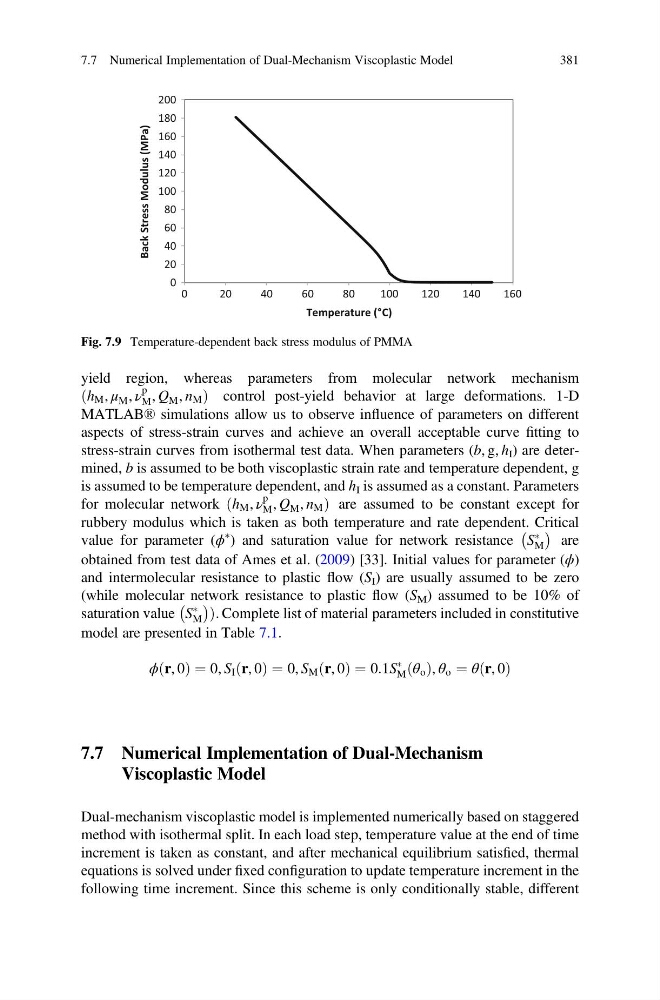
stress-strain curves from isothermal test data. When parameters (b, g, h I ) are determined, b is assumed to be both viscoplastic strain rate and temperature dependent, g
is assumed to be temperature dependent, and h I is assumed as a constant. Parameters
for molecular network h M , ν
p
M , Q M , n M
ð
Þare assumed to be constant except for
rubbery modulus which is taken as both temperature and rate dependent. Critical
value for parameter (ϕ
à ) and saturation value for network resistance S
Ã
M
À Á
are
obtained from test data of Ames et al. (2009) [33]. Initial values for parameter (ϕ)
and intermolecular resistance to plastic flow (S I ) are usually assumed to be zero
(while molecular network resistance to plastic flow (S M ) assumed to be 10% of
saturation value S
Ã
M
À Á Þ: Complete list of material parameters included in constitutive
model are presented in Table 7.1.
ϕ r, 0
ð Þ ¼ 0, S I r, 0
ð Þ ¼ 0, S M r, 0
ð Þ ¼ 0:1S
Ã
M θ o
ð Þ, θ o ¼ θ r, 0
ð Þ
7.7 Numerical Implementation of Dual-Mechanism
Viscoplastic Model
Dual-mechanism viscoplastic model is implemented numerically based on staggered
method with isothermal split. In each load step, temperature value at the end of time
increment is taken as constant, and after mechanical equilibrium satisfied, thermal
equations is solved under fixed configuration to update temperature increment in the
following time increment. Since this scheme is only conditionally stable, different
0
20
40
60
80
100
120
140
160
180
200
0
20
40
60
80
100
120
140
160
Back Stress Modulus (MPa)
Temperature (°C)
Fig. 7.9 Temperature-dependent back stress modulus of PMMA
7.7 Numerical Implementation of Dual-Mechanism Viscoplastic Model
381
h M , μ M , ν
p
M , Q M , n M
ð
Þ control post-yield behavior at large deformations. 1-D
MATLAB® simulations allow us to observe influence of parameters on different
aspects of stress-strain curves and achieve an overall acceptable curve fitting to
stress-strain curves from isothermal test data. When parameters (b, g, h I ) are determined, b is assumed to be both viscoplastic strain rate and temperature dependent, g
is assumed to be temperature dependent, and h I is assumed as a constant. Parameters
for molecular network h M , ν
p
M , Q M , n M
ð
Þare assumed to be constant except for
rubbery modulus which is taken as both temperature and rate dependent. Critical
value for parameter (ϕ
à ) and saturation value for network resistance S
Ã
M
À Á
are
obtained from test data of Ames et al. (2009) [33]. Initial values for parameter (ϕ)
and intermolecular resistance to plastic flow (S I ) are usually assumed to be zero
(while molecular network resistance to plastic flow (S M ) assumed to be 10% of
saturation value S
Ã
M
À Á Þ: Complete list of material parameters included in constitutive
model are presented in Table 7.1.
ϕ r, 0
ð Þ ¼ 0, S I r, 0
ð Þ ¼ 0, S M r, 0
ð Þ ¼ 0:1S
Ã
M θ o
ð Þ, θ o ¼ θ r, 0
ð Þ
7.7 Numerical Implementation of Dual-Mechanism
Viscoplastic Model
Dual-mechanism viscoplastic model is implemented numerically based on staggered
method with isothermal split. In each load step, temperature value at the end of time
increment is taken as constant, and after mechanical equilibrium satisfied, thermal
equations is solved under fixed configuration to update temperature increment in the
following time increment. Since this scheme is only conditionally stable, different
0
20
40
60
80
100
120
140
160
180
200
0
20
40
60
80
100
120
140
160
Back Stress Modulus (MPa)
Temperature (°C)
Fig. 7.9 Temperature-dependent back stress modulus of PMMA
7.7 Numerical Implementation of Dual-Mechanism Viscoplastic Model
381