

Z
Ω
σ
n
ð Þ
• _
χdΩ þ
Z
V
b • _
χdV ¼
Z
V
Γ
e
I : D
e
I þ Γ
e
M : D
e
M
Â
Ã
dV
ð7:110Þ
Z
Ω
σ
n
ð Þ
• _
χ dΩ þ
Z
V
b
• _
χdV ¼
Z
V
Γ
e
I þ Γ
e
M
À
Á : grad _
χ
ð Þ
Â
Ã
dV
ð7:111Þ
Z
Ω
σ
n
ð Þ
• _
χdΩ þ
Z
V
b
• _
χdV ¼
Z
V
div _
χ • Γ
e
I þ Γ
e
M
À
Á
Â
Ã
dV
À
Z
V
div Γ
e
I þ Γ
e
M
À
Á • _
χ dV
ð7:112Þ
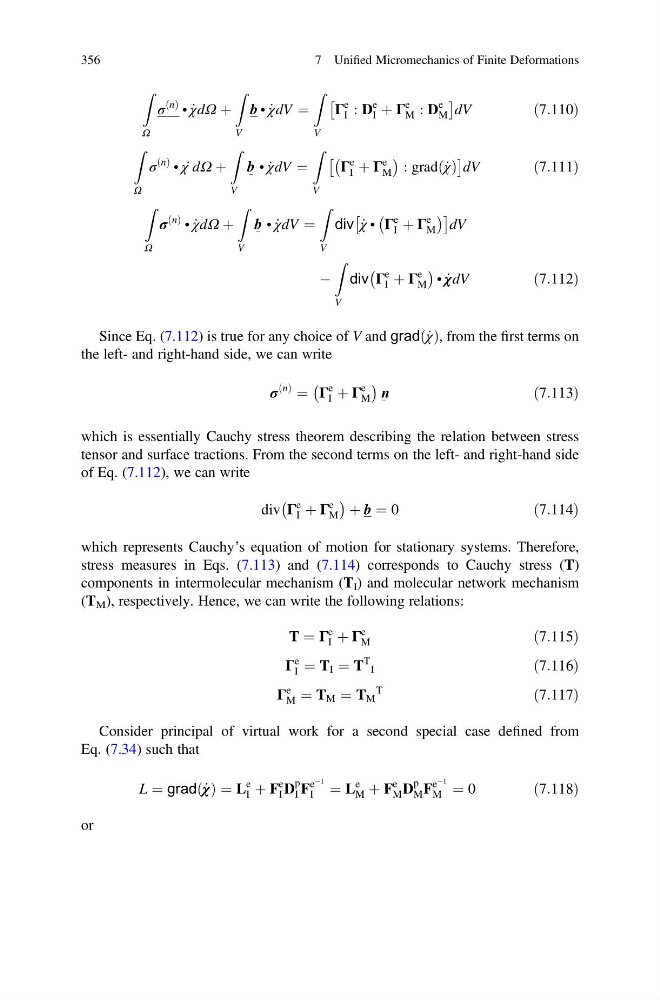
Since Eq. (7.112) is true for any choice of V and grad _
χ
ð Þ, from the first terms on
the left- and right-hand side, we can write
σ
n
ð Þ
¼ Γ
e
I þ Γ
e
M
À
Á n
ð7:113Þ
which is essentially Cauchy stress theorem describing the relation between stress
tensor and surface tractions. From the second terms on the left- and right-hand side
of Eq. (7.112), we can write
div Γ
e
I þ Γ
e
M
À
Á þ b ¼ 0
ð7:114Þ
which represents Cauchy’s equation of motion for stationary systems. Therefore,
stress measures in Eqs. (7.113) and (7.114) corresponds to Cauchy stress (T)
components in intermolecular mechanism (T I ) and molecular network mechanism
(T M ), respectively. Hence, we can write the following relations:
T ¼ Γ
e
I þ Γ
e
M
ð7:115Þ
Γ
e
I ¼ T I ¼ T
T
I
ð7:116Þ
Γ
e
M ¼ T M ¼ T M
T
ð7:117Þ
Consider principal of virtual work for a second special case defined from
Eq. (7.34) such that
L ¼ grad _
χ
ð Þ ¼ L
e
I þ F
e
I D
p
I F
e
À1
I
¼ L
e
M þ F
e
M D
p
M F
e
À1
M ¼ 0
ð7:118Þ
or
356
7 Unified Micromechanics of Finite Deformations
Ω
σ
n
ð Þ
• _
χdΩ þ
Z
V
b • _
χdV ¼
Z
V
Γ
e
I : D
e
I þ Γ
e
M : D
e
M
Â
Ã
dV
ð7:110Þ
Z
Ω
σ
n
ð Þ
• _
χ dΩ þ
Z
V
b
• _
χdV ¼
Z
V
Γ
e
I þ Γ
e
M
À
Á : grad _
χ
ð Þ
Â
Ã
dV
ð7:111Þ
Z
Ω
σ
n
ð Þ
• _
χdΩ þ
Z
V
b
• _
χdV ¼
Z
V
div _
χ • Γ
e
I þ Γ
e
M
À
Á
Â
Ã
dV
À
Z
V
div Γ
e
I þ Γ
e
M
À
Á • _
χ dV
ð7:112Þ
Since Eq. (7.112) is true for any choice of V and grad _
χ
ð Þ, from the first terms on
the left- and right-hand side, we can write
σ
n
ð Þ
¼ Γ
e
I þ Γ
e
M
À
Á n
ð7:113Þ
which is essentially Cauchy stress theorem describing the relation between stress
tensor and surface tractions. From the second terms on the left- and right-hand side
of Eq. (7.112), we can write
div Γ
e
I þ Γ
e
M
À
Á þ b ¼ 0
ð7:114Þ
which represents Cauchy’s equation of motion for stationary systems. Therefore,
stress measures in Eqs. (7.113) and (7.114) corresponds to Cauchy stress (T)
components in intermolecular mechanism (T I ) and molecular network mechanism
(T M ), respectively. Hence, we can write the following relations:
T ¼ Γ
e
I þ Γ
e
M
ð7:115Þ
Γ
e
I ¼ T I ¼ T
T
I
ð7:116Þ
Γ
e
M ¼ T M ¼ T M
T
ð7:117Þ
Consider principal of virtual work for a second special case defined from
Eq. (7.34) such that
L ¼ grad _
χ
ð Þ ¼ L
e
I þ F
e
I D
p
I F
e
À1
I
¼ L
e
M þ F
e
M D
p
M F
e
À1
M ¼ 0
ð7:118Þ
or
356
7 Unified Micromechanics of Finite Deformations