

Γ
e
I ¼ ΩΓ
e
I Ω
T
ð7:100Þ
Γ
e
M ¼ ΩΓ
e
M Ω
T
ð7:101Þ
Γ
e
I ¼ Γ
e
T
I ; Γ
e
I ¼ Γ
e
T
I
ð7:102Þ
Γ
e
M ¼ Γ
e
T
M ; Γ
e
M ¼ Γ
e
T
M
ð7:103Þ
Γ
p
I ¼ Γ
p
I
ð7:104Þ
Γ
p
M ¼ Γ
p
M
ð7:105Þ
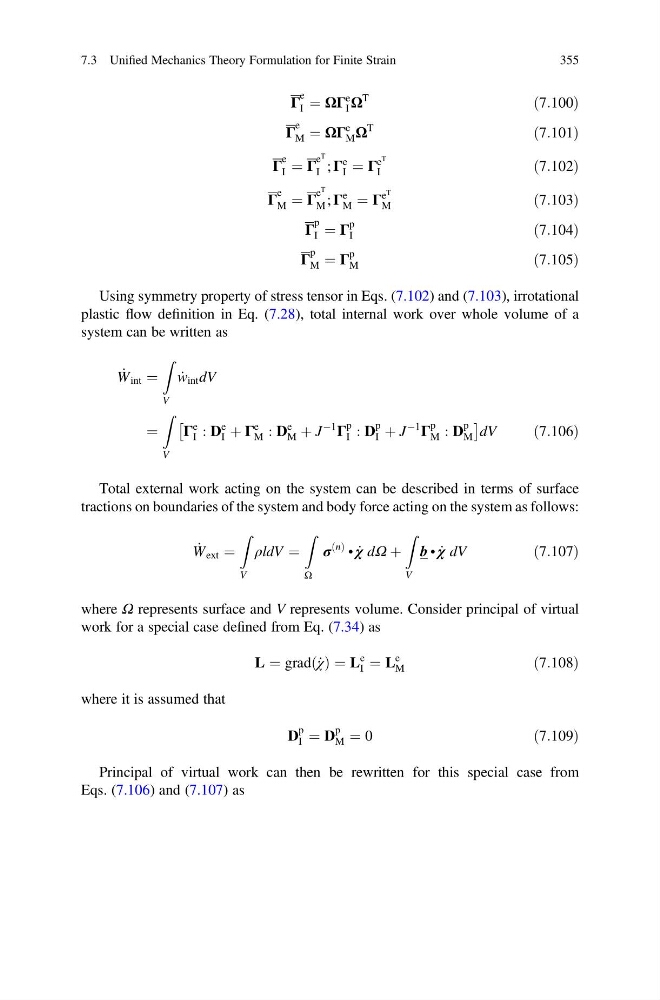
Using symmetry property of stress tensor in Eqs. (7.102) and (7.103), irrotational
plastic flow definition in Eq. (7.28), total internal work over whole volume of a
system can be written as
_
W int ¼
Z
V
_
w int dV
¼
Z
V
Γ
e
I : D
e
I þ Γ
e
M : D
e
M þ J
À1
Γ
p
I : D
p
I þ J
À1
Γ
p
M : D
p
M
Â
Ã
dV
ð7:106Þ
Total external work acting on the system can be described in terms of surface
tractions on boundaries of the system and body force acting on the system as follows:
_
W ext ¼
Z
V
ρldV ¼
Z
Ω
σ
n
ð Þ
• _
χ dΩ þ
Z
V
b • _
χ dV
ð7:107Þ
where Ω represents surface and V represents volume. Consider principal of virtual
work for a special case defined from Eq. (7.34) as
L ¼ grad _
χ
ð Þ ¼ L
e
I ¼ L
e
M
ð7:108Þ
where it is assumed that
D
p
I ¼ D
p
M ¼ 0
ð7:109Þ
Principal of virtual work can then be rewritten for this special case from
Eqs. (7.106) and (7.107) as
7.3 Unified Mechanics Theory Formulation for Finite Strain
355
e
I ¼ ΩΓ
e
I Ω
T
ð7:100Þ
Γ
e
M ¼ ΩΓ
e
M Ω
T
ð7:101Þ
Γ
e
I ¼ Γ
e
T
I ; Γ
e
I ¼ Γ
e
T
I
ð7:102Þ
Γ
e
M ¼ Γ
e
T
M ; Γ
e
M ¼ Γ
e
T
M
ð7:103Þ
Γ
p
I ¼ Γ
p
I
ð7:104Þ
Γ
p
M ¼ Γ
p
M
ð7:105Þ
Using symmetry property of stress tensor in Eqs. (7.102) and (7.103), irrotational
plastic flow definition in Eq. (7.28), total internal work over whole volume of a
system can be written as
_
W int ¼
Z
V
_
w int dV
¼
Z
V
Γ
e
I : D
e
I þ Γ
e
M : D
e
M þ J
À1
Γ
p
I : D
p
I þ J
À1
Γ
p
M : D
p
M
Â
Ã
dV
ð7:106Þ
Total external work acting on the system can be described in terms of surface
tractions on boundaries of the system and body force acting on the system as follows:
_
W ext ¼
Z
V
ρldV ¼
Z
Ω
σ
n
ð Þ
• _
χ dΩ þ
Z
V
b • _
χ dV
ð7:107Þ
where Ω represents surface and V represents volume. Consider principal of virtual
work for a special case defined from Eq. (7.34) as
L ¼ grad _
χ
ð Þ ¼ L
e
I ¼ L
e
M
ð7:108Þ
where it is assumed that
D
p
I ¼ D
p
M ¼ 0
ð7:109Þ
Principal of virtual work can then be rewritten for this special case from
Eqs. (7.106) and (7.107) as
7.3 Unified Mechanics Theory Formulation for Finite Strain
355