

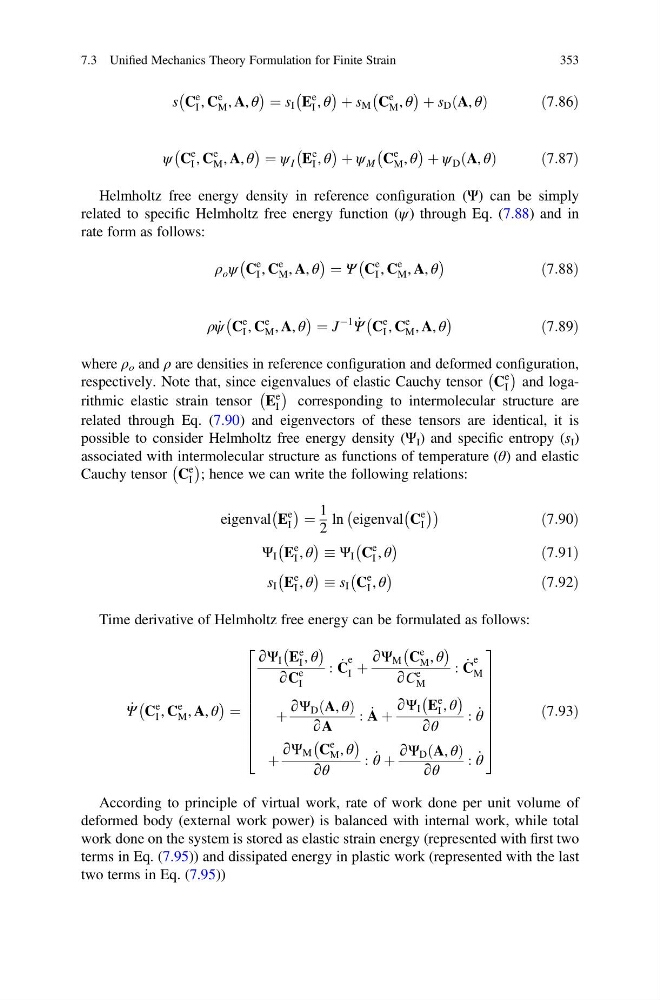
s C
e
I , C
e
M , A, θ
À
Á ¼ s I E
e
I , θ
À
Á þ s M C
e
M , θ
À
Á þ s D A, θ
ð
Þ
ð7:86Þ
ψ C
e
I , C
e
M , A, θ
À
Á ¼ ψ I E
e
I , θ
À
Á þ ψ M C
e
M , θ
À
Á þ ψ D A, θ
ð
Þ
ð7:87Þ
Helmholtz free energy density in reference configuration (Ψ) can be simply
related to specific Helmholtz free energy function (ψ) through Eq. (7.88) and in
rate form as follows:
ρ o ψ C
e
I , C
e
M , A, θ
À
Á ¼ Ψ C
e
I , C
e
M , A, θ
À
Á
ð7:88Þ
ρ _
ψ C
e
I , C
e
M , A, θ
À
Á ¼ J
À1 _
Ψ C
e
I , C
e
M , A, θ
À
Á
ð7:89Þ
where ρ o and ρ are densities in reference configuration and deformed configuration,
respectively. Note that, since eigenvalues of elastic Cauchy tensor C
e
I
À Á
and logarithmic elastic strain tensor E
e
I
À Á
corresponding to intermolecular structure are
related through Eq. (7.90) and eigenvectors of these tensors are identical, it is
possible to consider Helmholtz free energy density (Ψ I ) and specific entropy (s I )
associated with intermolecular structure as functions of temperature (θ) and elastic
Cauchy tensor C
e
I
À Á
; hence we can write the following relations:
eigenval E
e
I
À Á ¼
1
2
ln eigenval C
e
I
À Á
À
Á
ð7:90Þ
Ψ I E
e
I , θ
À
Á Ψ I C
e
I , θ
À
Á
ð7:91Þ
s I E
e
I , θ
À
Á s I C
e
I , θ
À
Á
ð7:92Þ
Time derivative of Helmholtz free energy can be formulated as follows:
_
Ψ C
e
I , C
e
M , A, θ
À
Á ¼
∂Ψ I E
e
I , θ
À
Á
∂C
e
I
: _
C
e
I þ
∂Ψ M C
e
M , θ
À
Á
∂C
e
M
: _
C
e
M
þ
∂Ψ D A, θ
ð
Þ
∂A
: _
A þ
∂Ψ I E
e
I , θ
À
Á
∂θ
: _
θ
þ
∂Ψ M C
e
M , θ
À
Á
∂θ
: _
θ þ
∂Ψ D A, θ
ð
Þ
∂θ
: _
θ
2
6
6
6
6
6
6
6
6
4
3
7
7
7
7
7
7
7
7
5
ð7:93Þ
According to principle of virtual work, rate of work done per unit volume of
deformed body (external work power) is balanced with internal work, while total
work done on the system is stored as elastic strain energy (represented with first two
terms in Eq. (7.95)) and dissipated energy in plastic work (represented with the last
two terms in Eq. (7.95))
7.3 Unified Mechanics Theory Formulation for Finite Strain
353
e
I , C
e
M , A, θ
À
Á ¼ s I E
e
I , θ
À
Á þ s M C
e
M , θ
À
Á þ s D A, θ
ð
Þ
ð7:86Þ
ψ C
e
I , C
e
M , A, θ
À
Á ¼ ψ I E
e
I , θ
À
Á þ ψ M C
e
M , θ
À
Á þ ψ D A, θ
ð
Þ
ð7:87Þ
Helmholtz free energy density in reference configuration (Ψ) can be simply
related to specific Helmholtz free energy function (ψ) through Eq. (7.88) and in
rate form as follows:
ρ o ψ C
e
I , C
e
M , A, θ
À
Á ¼ Ψ C
e
I , C
e
M , A, θ
À
Á
ð7:88Þ
ρ _
ψ C
e
I , C
e
M , A, θ
À
Á ¼ J
À1 _
Ψ C
e
I , C
e
M , A, θ
À
Á
ð7:89Þ
where ρ o and ρ are densities in reference configuration and deformed configuration,
respectively. Note that, since eigenvalues of elastic Cauchy tensor C
e
I
À Á
and logarithmic elastic strain tensor E
e
I
À Á
corresponding to intermolecular structure are
related through Eq. (7.90) and eigenvectors of these tensors are identical, it is
possible to consider Helmholtz free energy density (Ψ I ) and specific entropy (s I )
associated with intermolecular structure as functions of temperature (θ) and elastic
Cauchy tensor C
e
I
À Á
; hence we can write the following relations:
eigenval E
e
I
À Á ¼
1
2
ln eigenval C
e
I
À Á
À
Á
ð7:90Þ
Ψ I E
e
I , θ
À
Á Ψ I C
e
I , θ
À
Á
ð7:91Þ
s I E
e
I , θ
À
Á s I C
e
I , θ
À
Á
ð7:92Þ
Time derivative of Helmholtz free energy can be formulated as follows:
_
Ψ C
e
I , C
e
M , A, θ
À
Á ¼
∂Ψ I E
e
I , θ
À
Á
∂C
e
I
: _
C
e
I þ
∂Ψ M C
e
M , θ
À
Á
∂C
e
M
: _
C
e
M
þ
∂Ψ D A, θ
ð
Þ
∂A
: _
A þ
∂Ψ I E
e
I , θ
À
Á
∂θ
: _
θ
þ
∂Ψ M C
e
M , θ
À
Á
∂θ
: _
θ þ
∂Ψ D A, θ
ð
Þ
∂θ
: _
θ
2
6
6
6
6
6
6
6
6
4
3
7
7
7
7
7
7
7
7
5
ð7:93Þ
According to principle of virtual work, rate of work done per unit volume of
deformed body (external work power) is balanced with internal work, while total
work done on the system is stored as elastic strain energy (represented with first two
terms in Eq. (7.95)) and dissipated energy in plastic work (represented with the last
two terms in Eq. (7.95))
7.3 Unified Mechanics Theory Formulation for Finite Strain
353