

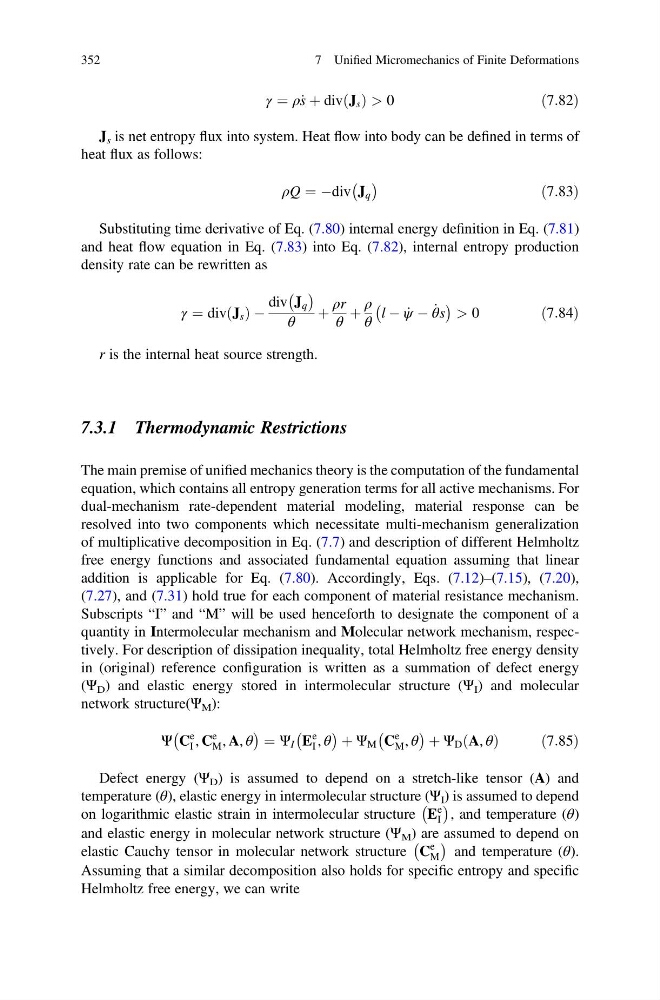
γ ¼ ρ_ s þ div J s
ð Þ > 0
ð7:82Þ
J s is net entropy flux into system. Heat flow into body can be defined in terms of
heat flux as follows:
ρQ ¼ Àdiv J q
À Á
ð7:83Þ
Substituting time derivative of Eq. (7.80) internal energy definition in Eq. (7.81)
and heat flow equation in Eq. (7.83) into Eq. (7.82), internal entropy production
density rate can be rewritten as
γ ¼ div J s
ð Þ À
div J q
À Á
θ
þ
ρr
θ
þ
ρ
θ
l À _
ψ À _
θs
À
Á > 0
ð7:84Þ
r is the internal heat source strength.
7.3.1 Thermodynamic Restrictions
The main premise of unified mechanics theory is the computation of the fundamental
equation, which contains all entropy generation terms for all active mechanisms. For
dual-mechanism rate-dependent material modeling, material response can be
resolved into two components which necessitate multi-mechanism generalization
of multiplicative decomposition in Eq. (7.7) and description of different Helmholtz
free energy functions and associated fundamental equation assuming that linear
addition is applicable for Eq. (7.80). Accordingly, Eqs. (7.12)–(7.15), (7.20),
(7.27), and (7.31) hold true for each component of material resistance mechanism.
Subscripts “I” and “M” will be used henceforth to designate the component of a
quantity in Intermolecular mechanism and Molecular network mechanism, respectively. For description of dissipation inequality, total Helmholtz free energy density
in (original) reference configuration is written as a summation of defect energy
(Ψ D ) and elastic energy stored in intermolecular structure (Ψ I ) and molecular
network structure(Ψ M ):
Ψ C
e
I , C
e
M , A, θ
À
Á ¼ Ψ I E
e
I , θ
À
Á þ Ψ M C
e
M , θ
À
Á þ Ψ D A, θ
ð
Þ
ð7:85Þ
Defect energy (Ψ D ) is assumed to depend on a stretch-like tensor (A) and
temperature (θ), elastic energy in intermolecular structure (Ψ I ) is assumed to depend
on logarithmic elastic strain in intermolecular structure E
e
I
À Á
, and temperature (θ)
and elastic energy in molecular network structure (Ψ M ) are assumed to depend on
elastic Cauchy tensor in molecular network structure C
e
M
À Á
and temperature (θ).
Assuming that a similar decomposition also holds for specific entropy and specific
Helmholtz free energy, we can write
352
7 Unified Micromechanics of Finite Deformations
ð Þ > 0
ð7:82Þ
J s is net entropy flux into system. Heat flow into body can be defined in terms of
heat flux as follows:
ρQ ¼ Àdiv J q
À Á
ð7:83Þ
Substituting time derivative of Eq. (7.80) internal energy definition in Eq. (7.81)
and heat flow equation in Eq. (7.83) into Eq. (7.82), internal entropy production
density rate can be rewritten as
γ ¼ div J s
ð Þ À
div J q
À Á
θ
þ
ρr
θ
þ
ρ
θ
l À _
ψ À _
θs
À
Á > 0
ð7:84Þ
r is the internal heat source strength.
7.3.1 Thermodynamic Restrictions
The main premise of unified mechanics theory is the computation of the fundamental
equation, which contains all entropy generation terms for all active mechanisms. For
dual-mechanism rate-dependent material modeling, material response can be
resolved into two components which necessitate multi-mechanism generalization
of multiplicative decomposition in Eq. (7.7) and description of different Helmholtz
free energy functions and associated fundamental equation assuming that linear
addition is applicable for Eq. (7.80). Accordingly, Eqs. (7.12)–(7.15), (7.20),
(7.27), and (7.31) hold true for each component of material resistance mechanism.
Subscripts “I” and “M” will be used henceforth to designate the component of a
quantity in Intermolecular mechanism and Molecular network mechanism, respectively. For description of dissipation inequality, total Helmholtz free energy density
in (original) reference configuration is written as a summation of defect energy
(Ψ D ) and elastic energy stored in intermolecular structure (Ψ I ) and molecular
network structure(Ψ M ):
Ψ C
e
I , C
e
M , A, θ
À
Á ¼ Ψ I E
e
I , θ
À
Á þ Ψ M C
e
M , θ
À
Á þ Ψ D A, θ
ð
Þ
ð7:85Þ
Defect energy (Ψ D ) is assumed to depend on a stretch-like tensor (A) and
temperature (θ), elastic energy in intermolecular structure (Ψ I ) is assumed to depend
on logarithmic elastic strain in intermolecular structure E
e
I
À Á
, and temperature (θ)
and elastic energy in molecular network structure (Ψ M ) are assumed to depend on
elastic Cauchy tensor in molecular network structure C
e
M
À Á
and temperature (θ).
Assuming that a similar decomposition also holds for specific entropy and specific
Helmholtz free energy, we can write
352
7 Unified Micromechanics of Finite Deformations