

Particle: E f ¼ 70 GPa, v f ¼ 0.24
Matrix: E m ¼ 3.5 GPa, v m ¼ 0.31
Particle volume fraction is φ f ¼ 0.48
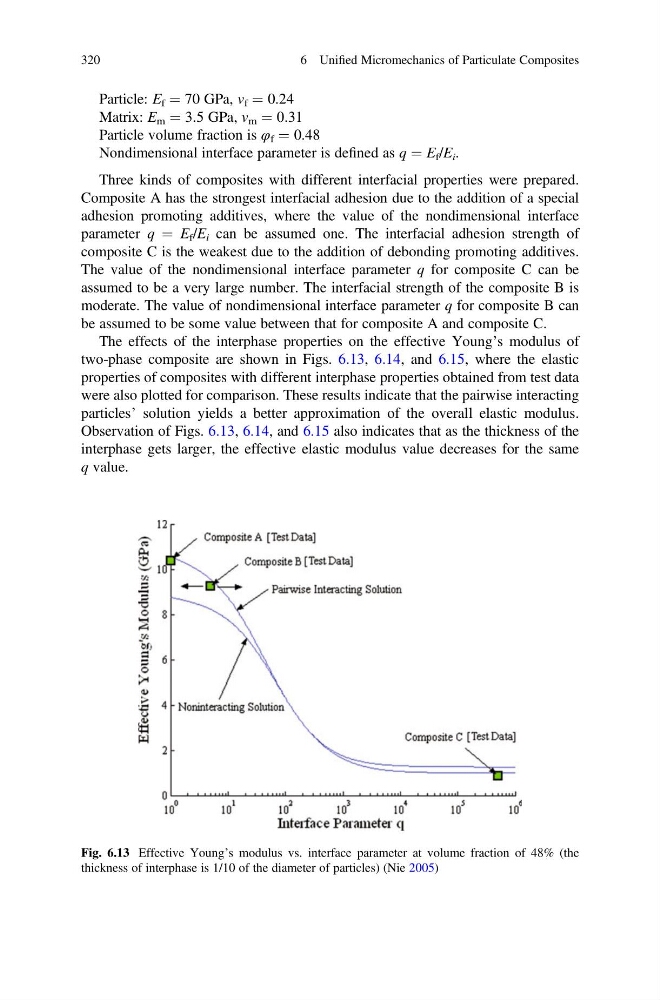
Nondimensional interface parameter is defined as q ¼ E f /E i .
Three kinds of composites with different interfacial properties were prepared.
Composite A has the strongest interfacial adhesion due to the addition of a special
adhesion promoting additives, where the value of the nondimensional interface
parameter q ¼ E f /E i can be assumed one. The interfacial adhesion strength of
composite C is the weakest due to the addition of debonding promoting additives.
The value of the nondimensional interface parameter q for composite C can be
assumed to be a very large number. The interfacial strength of the composite B is
moderate. The value of nondimensional interface parameter q for composite B can
be assumed to be some value between that for composite A and composite C.
The effects of the interphase properties on the effective Young’s modulus of
two-phase composite are shown in Figs. 6.13, 6.14, and 6.15, where the elastic
properties of composites with different interphase properties obtained from test data
were also plotted for comparison. These results indicate that the pairwise interacting
particles’ solution yields a better approximation of the overall elastic modulus.
Observation of Figs. 6.13, 6.14, and 6.15 also indicates that as the thickness of the
interphase gets larger, the effective elastic modulus value decreases for the same
q value.
Fig. 6.13 Effective Young’s modulus vs. interface parameter at volume fraction of 48% (the
thickness of interphase is 1/10 of the diameter of particles) (Nie 2005)
320
6 Unified Micromechanics of Particulate Composites
Matrix: E m ¼ 3.5 GPa, v m ¼ 0.31
Particle volume fraction is φ f ¼ 0.48
Nondimensional interface parameter is defined as q ¼ E f /E i .
Three kinds of composites with different interfacial properties were prepared.
Composite A has the strongest interfacial adhesion due to the addition of a special
adhesion promoting additives, where the value of the nondimensional interface
parameter q ¼ E f /E i can be assumed one. The interfacial adhesion strength of
composite C is the weakest due to the addition of debonding promoting additives.
The value of the nondimensional interface parameter q for composite C can be
assumed to be a very large number. The interfacial strength of the composite B is
moderate. The value of nondimensional interface parameter q for composite B can
be assumed to be some value between that for composite A and composite C.
The effects of the interphase properties on the effective Young’s modulus of
two-phase composite are shown in Figs. 6.13, 6.14, and 6.15, where the elastic
properties of composites with different interphase properties obtained from test data
were also plotted for comparison. These results indicate that the pairwise interacting
particles’ solution yields a better approximation of the overall elastic modulus.
Observation of Figs. 6.13, 6.14, and 6.15 also indicates that as the thickness of the
interphase gets larger, the effective elastic modulus value decreases for the same
q value.
Fig. 6.13 Effective Young’s modulus vs. interface parameter at volume fraction of 48% (the
thickness of interphase is 1/10 of the diameter of particles) (Nie 2005)
320
6 Unified Micromechanics of Particulate Composites