

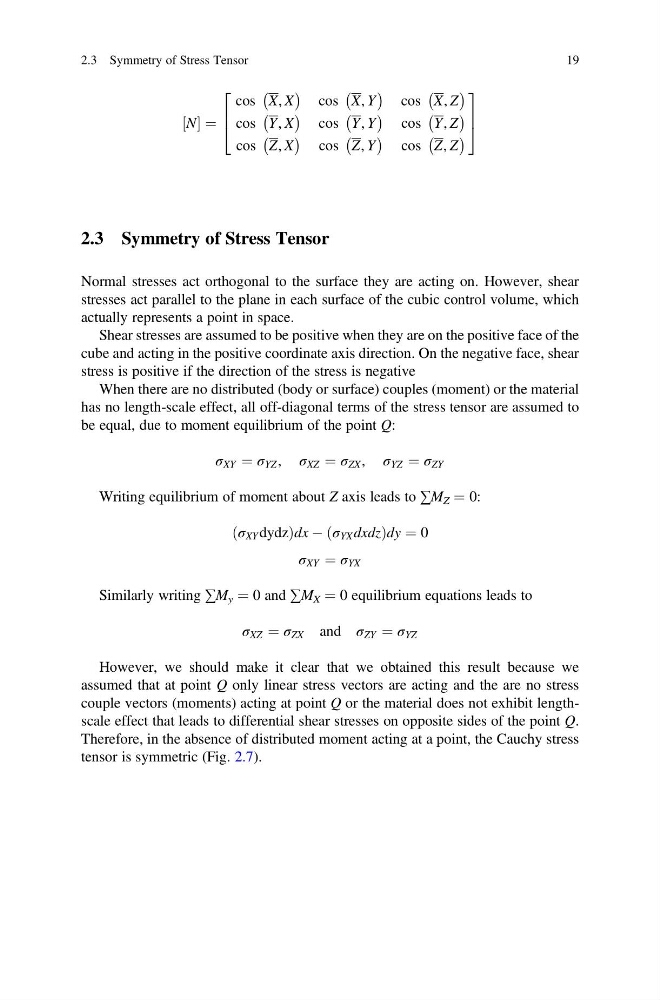
N
½ ¼
cos X, X
À
Á
cos X, Y
À
Á
cos X, Z
À
Á
cos Y, X
À
Á
cos Y, Y
À
Á
cos Y, Z
À
Á
cos Z, X
À
Á
cos Z, Y
À
Á
cos Z, Z
À
Á
2
6
4
3
7
5
2.3 Symmetry of Stress Tensor
Normal stresses act orthogonal to the surface they are acting on. However, shear
stresses act parallel to the plane in each surface of the cubic control volume, which
actually represents a point in space.
Shear stresses are assumed to be positive when they are on the positive face of the
cube and acting in the positive coordinate axis direction. On the negative face, shear
stress is positive if the direction of the stress is negative
When there are no distributed (body or surface) couples (moment) or the material
has no length-scale effect, all off-diagonal terms of the stress tensor are assumed to
be equal, due to moment equilibrium of the point Q:
σ XY ¼ σ YZ , σ XZ ¼ σ ZX , σ YZ ¼ σ ZY
Writing equilibrium of moment about Z axis leads to ∑M Z ¼ 0:
σ XY dydz
ð
Þ dx À σ YX dxdz
ð
Þ dy ¼ 0
σ XY ¼ σ YX
Similarly writing ∑M y ¼ 0 and ∑M X ¼ 0 equilibrium equations leads to
σ XZ ¼ σ ZX and σ ZY ¼ σ YZ
However, we should make it clear that we obtained this result because we
assumed that at point Q only linear stress vectors are acting and the are no stress
couple vectors (moments) acting at point Q or the material does not exhibit lengthscale effect that leads to differential shear stresses on opposite sides of the point Q.
Therefore, in the absence of distributed moment acting at a point, the Cauchy stress
tensor is symmetric (Fig. 2.7).
2.3 Symmetry of Stress Tensor
19
½ ¼
cos X, X
À
Á
cos X, Y
À
Á
cos X, Z
À
Á
cos Y, X
À
Á
cos Y, Y
À
Á
cos Y, Z
À
Á
cos Z, X
À
Á
cos Z, Y
À
Á
cos Z, Z
À
Á
2
6
4
3
7
5
2.3 Symmetry of Stress Tensor
Normal stresses act orthogonal to the surface they are acting on. However, shear
stresses act parallel to the plane in each surface of the cubic control volume, which
actually represents a point in space.
Shear stresses are assumed to be positive when they are on the positive face of the
cube and acting in the positive coordinate axis direction. On the negative face, shear
stress is positive if the direction of the stress is negative
When there are no distributed (body or surface) couples (moment) or the material
has no length-scale effect, all off-diagonal terms of the stress tensor are assumed to
be equal, due to moment equilibrium of the point Q:
σ XY ¼ σ YZ , σ XZ ¼ σ ZX , σ YZ ¼ σ ZY
Writing equilibrium of moment about Z axis leads to ∑M Z ¼ 0:
σ XY dydz
ð
Þ dx À σ YX dxdz
ð
Þ dy ¼ 0
σ XY ¼ σ YX
Similarly writing ∑M y ¼ 0 and ∑M X ¼ 0 equilibrium equations leads to
σ XZ ¼ σ ZX and σ ZY ¼ σ YZ
However, we should make it clear that we obtained this result because we
assumed that at point Q only linear stress vectors are acting and the are no stress
couple vectors (moments) acting at point Q or the material does not exhibit lengthscale effect that leads to differential shear stresses on opposite sides of the point Q.
Therefore, in the absence of distributed moment acting at a point, the Cauchy stress
tensor is symmetric (Fig. 2.7).
2.3 Symmetry of Stress Tensor
19