

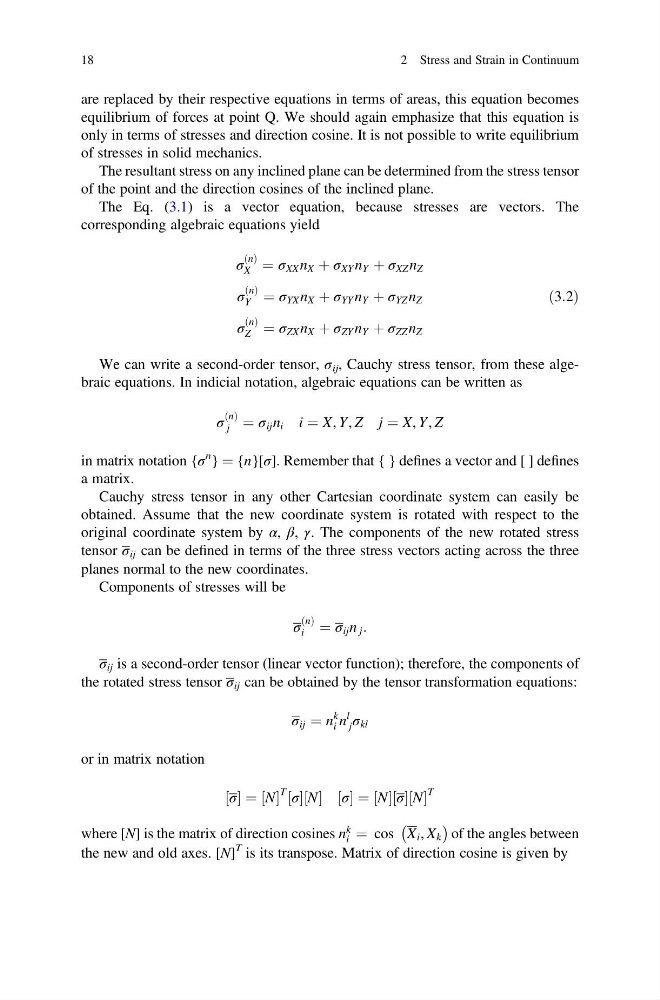
are replaced by their respective equations in terms of areas, this equation becomes
equilibrium of forces at point Q. We should again emphasize that this equation is
only in terms of stresses and direction cosine. It is not possible to write equilibrium
of stresses in solid mechanics.
The resultant stress on any inclined plane can be determined from the stress tensor
of the point and the direction cosines of the inclined plane.
The Eq. (3.1) is a vector equation, because stresses are vectors. The
corresponding algebraic equations yield
σ
n
ð Þ
X ¼ σ XX n X þ σ XY n Y þ σ XZ n Z
σ
n
ð Þ
Y ¼ σ YX n X þ σ YY n Y þ σ YZ n Z
ð3:2Þ
σ
n
ð Þ
Z ¼ σ ZX n X þ σ ZY n Y þ σ ZZ n Z
We can write a second-order tensor, σ ij , Cauchy stress tensor, from these algebraic equations. In indicial notation, algebraic equations can be written as
σ
n
ð Þ
j ¼ σ ij n i i ¼ X, Y, Z j ¼ X, Y, Z
in matrix notation {σ
n } ¼ {n}[σ]. Remember that { } defines a vector and [ ] defines
a matrix.
Cauchy stress tensor in any other Cartesian coordinate system can easily be
obtained. Assume that the new coordinate system is rotated with respect to the
original coordinate system by α, β, γ. The components of the new rotated stress
tensor σ ij can be defined in terms of the three stress vectors acting across the three
planes normal to the new coordinates.
Components of stresses will be
σ
n
ð Þ
i ¼ σ ij n j :
σ ij is a second-order tensor (linear vector function); therefore, the components of
the rotated stress tensor σ ij can be obtained by the tensor transformation equations:
σ ij ¼ n
k
i n
l
j σ kl
or in matrix notation
σ
½ ¼ N
½
T σ
½ N
½ σ
½ ¼ N
½ σ
½ N
½
T
where [N] is the matrix of direction cosines n
k
i ¼ cos X i , X k
À
Á
of the angles between
the new and old axes. [N]
T is its transpose. Matrix of direction cosine is given by
18
2 Stress and Strain in Continuum
equilibrium of forces at point Q. We should again emphasize that this equation is
only in terms of stresses and direction cosine. It is not possible to write equilibrium
of stresses in solid mechanics.
The resultant stress on any inclined plane can be determined from the stress tensor
of the point and the direction cosines of the inclined plane.
The Eq. (3.1) is a vector equation, because stresses are vectors. The
corresponding algebraic equations yield
σ
n
ð Þ
X ¼ σ XX n X þ σ XY n Y þ σ XZ n Z
σ
n
ð Þ
Y ¼ σ YX n X þ σ YY n Y þ σ YZ n Z
ð3:2Þ
σ
n
ð Þ
Z ¼ σ ZX n X þ σ ZY n Y þ σ ZZ n Z
We can write a second-order tensor, σ ij , Cauchy stress tensor, from these algebraic equations. In indicial notation, algebraic equations can be written as
σ
n
ð Þ
j ¼ σ ij n i i ¼ X, Y, Z j ¼ X, Y, Z
in matrix notation {σ
n } ¼ {n}[σ]. Remember that { } defines a vector and [ ] defines
a matrix.
Cauchy stress tensor in any other Cartesian coordinate system can easily be
obtained. Assume that the new coordinate system is rotated with respect to the
original coordinate system by α, β, γ. The components of the new rotated stress
tensor σ ij can be defined in terms of the three stress vectors acting across the three
planes normal to the new coordinates.
Components of stresses will be
σ
n
ð Þ
i ¼ σ ij n j :
σ ij is a second-order tensor (linear vector function); therefore, the components of
the rotated stress tensor σ ij can be obtained by the tensor transformation equations:
σ ij ¼ n
k
i n
l
j σ kl
or in matrix notation
σ
½ ¼ N
½
T σ
½ N
½ σ
½ ¼ N
½ σ
½ N
½
T
where [N] is the matrix of direction cosines n
k
i ¼ cos X i , X k
À
Á
of the angles between
the new and old axes. [N]
T is its transpose. Matrix of direction cosine is given by
18
2 Stress and Strain in Continuum