

6.6 Effective Thermo-Mechanical Properties
In particulate composites, there is a thin layer of interfacial layer (interphase)
between a particle and the matrix. The imperfect interface bond may be due to a
very compliant thin interfacial layer that is assumed to have perfect boundary
conditions with the matrix and the particle. This defines a three-phase composite
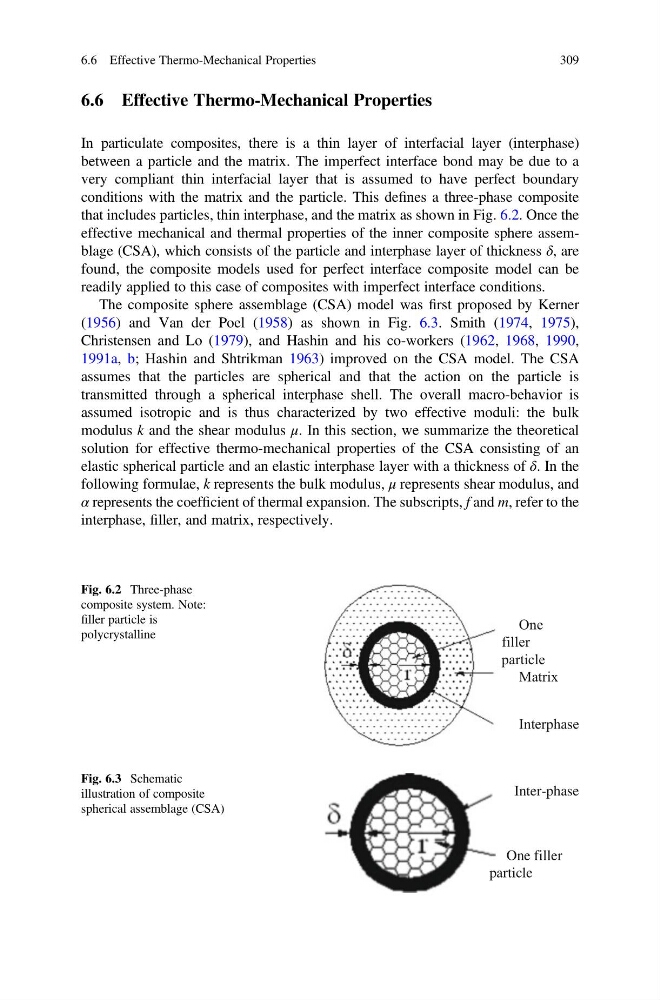
that includes particles, thin interphase, and the matrix as shown in Fig. 6.2. Once the
effective mechanical and thermal properties of the inner composite sphere assemblage (CSA), which consists of the particle and interphase layer of thickness δ, are
found, the composite models used for perfect interface composite model can be
readily applied to this case of composites with imperfect interface conditions.
The composite sphere assemblage (CSA) model was first proposed by Kerner
(1956) and Van der Poel (1958) as shown in Fig. 6.3. Smith (1974, 1975),
Christensen and Lo (1979), and Hashin and his co-workers (1962, 1968, 1990,
1991a, b; Hashin and Shtrikman 1963) improved on the CSA model. The CSA
assumes that the particles are spherical and that the action on the particle is
transmitted through a spherical interphase shell. The overall macro-behavior is
assumed isotropic and is thus characterized by two effective moduli: the bulk
modulus k and the shear modulus μ. In this section, we summarize the theoretical
solution for effective thermo-mechanical properties of the CSA consisting of an
elastic spherical particle and an elastic interphase layer with a thickness of δ. In the
following formulae, k represents the bulk modulus, μ represents shear modulus, and
α represents the coefficient of thermal expansion. The subscripts, f and m, refer to the
interphase, filler, and matrix, respectively.
One
filler
particle
Matrix
Interphase
Fig. 6.2 Three-phase
composite system. Note:
filler particle is
polycrystalline
One filler
particle
Inter-phase
Fig. 6.3 Schematic
illustration of composite
spherical assemblage (CSA)
6.6 Effective Thermo-Mechanical Properties
309
In particulate composites, there is a thin layer of interfacial layer (interphase)
between a particle and the matrix. The imperfect interface bond may be due to a
very compliant thin interfacial layer that is assumed to have perfect boundary
conditions with the matrix and the particle. This defines a three-phase composite
that includes particles, thin interphase, and the matrix as shown in Fig. 6.2. Once the
effective mechanical and thermal properties of the inner composite sphere assemblage (CSA), which consists of the particle and interphase layer of thickness δ, are
found, the composite models used for perfect interface composite model can be
readily applied to this case of composites with imperfect interface conditions.
The composite sphere assemblage (CSA) model was first proposed by Kerner
(1956) and Van der Poel (1958) as shown in Fig. 6.3. Smith (1974, 1975),
Christensen and Lo (1979), and Hashin and his co-workers (1962, 1968, 1990,
1991a, b; Hashin and Shtrikman 1963) improved on the CSA model. The CSA
assumes that the particles are spherical and that the action on the particle is
transmitted through a spherical interphase shell. The overall macro-behavior is
assumed isotropic and is thus characterized by two effective moduli: the bulk
modulus k and the shear modulus μ. In this section, we summarize the theoretical
solution for effective thermo-mechanical properties of the CSA consisting of an
elastic spherical particle and an elastic interphase layer with a thickness of δ. In the
following formulae, k represents the bulk modulus, μ represents shear modulus, and
α represents the coefficient of thermal expansion. The subscripts, f and m, refer to the
interphase, filler, and matrix, respectively.
One
filler
particle
Matrix
Interphase
Fig. 6.2 Three-phase
composite system. Note:
filler particle is
polycrystalline
One filler
particle
Inter-phase
Fig. 6.3 Schematic
illustration of composite
spherical assemblage (CSA)
6.6 Effective Thermo-Mechanical Properties
309