

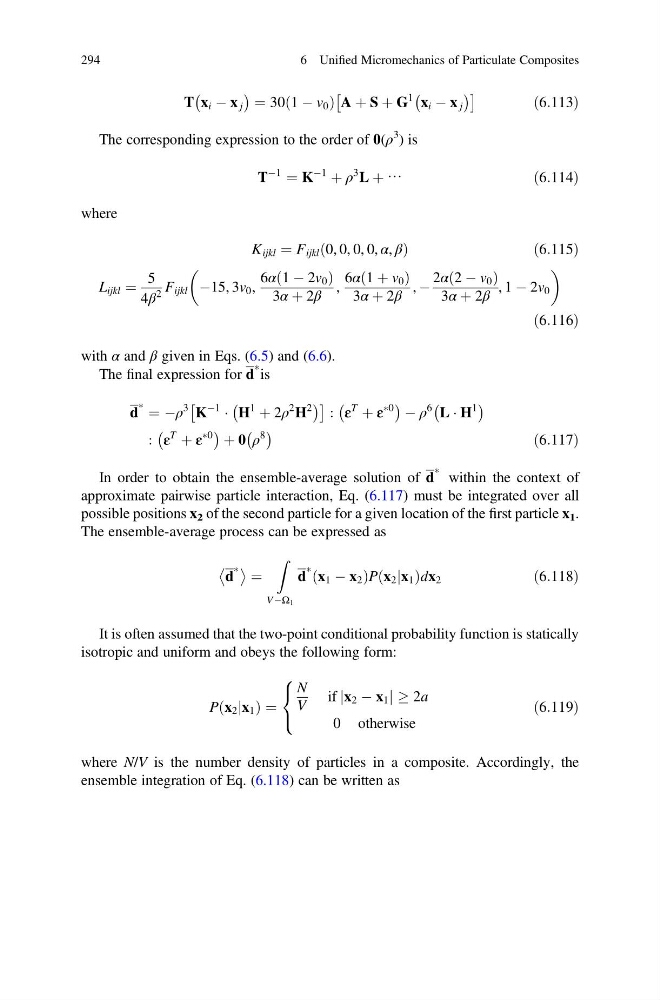
T x i À x j
À
Á ¼ 30 1 À v 0
ð
Þ A þ S þ G
1 x i À x j
À
Á
Â
Ã
ð6:113Þ
The corresponding expression to the order of 0(ρ
3 ) is
T
À1
¼ K
À1
þ ρ
3 L þ ⋯
ð6:114Þ
where
K ijkl ¼ F ijkl 0, 0, 0, 0, α, β
ð
Þ
ð 6:115Þ
L ijkl ¼
5
4β
2
F ijkl À15, 3v 0 ,
6α 1 À 2v 0
ð
Þ
3α þ 2β
,
6α 1 þ v 0
ð
Þ
3α þ 2β
, À
2α 2 À v 0
ð
Þ
3α þ 2β
, 1 À 2v 0
ð6:116Þ
with α and β given in Eqs. (6.5) and (6.6).
The final expression for d
à is
d
à ¼ Àρ
3 K
À1
Á H
1
þ 2ρ
2 H
2
À
Á
Â
à : ε
T
þ ε
Ã0
À
Á À ρ
6 L Á H
1
À
Á
: ε
T
þ ε
Ã0
À
Á þ 0 ρ
8
À Á
ð6:117Þ
In order to obtain the ensemble-average solution of d
à within the context of
approximate pairwise particle interaction, Eq. (6.117) must be integrated over all
possible positions x 2 of the second particle for a given location of the first particle x 1 .
The ensemble-average process can be expressed as
d
Ã
¼
Z
VÀΩ 1
d
à x 1 À x 2
ð
Þ P x 2 jx 1
ð
Þdx 2
ð6:118Þ
It is often assumed that the two-point conditional probability function is statically
isotropic and uniform and obeys the following form:
P x 2 jx 1
ð
Þ¼
N
V
if x 2 À x 1
j
j! 2a
0 otherwise
8
<
:
ð6:119Þ
where N/V is the number density of particles in a composite. Accordingly, the
ensemble integration of Eq. (6.118) can be written as
294
6 Unified Micromechanics of Particulate Composites
À
Á ¼ 30 1 À v 0
ð
Þ A þ S þ G
1 x i À x j
À
Á
Â
Ã
ð6:113Þ
The corresponding expression to the order of 0(ρ
3 ) is
T
À1
¼ K
À1
þ ρ
3 L þ ⋯
ð6:114Þ
where
K ijkl ¼ F ijkl 0, 0, 0, 0, α, β
ð
Þ
ð 6:115Þ
L ijkl ¼
5
4β
2
F ijkl À15, 3v 0 ,
6α 1 À 2v 0
ð
Þ
3α þ 2β
,
6α 1 þ v 0
ð
Þ
3α þ 2β
, À
2α 2 À v 0
ð
Þ
3α þ 2β
, 1 À 2v 0
ð6:116Þ
with α and β given in Eqs. (6.5) and (6.6).
The final expression for d
à is
d
à ¼ Àρ
3 K
À1
Á H
1
þ 2ρ
2 H
2
À
Á
Â
à : ε
T
þ ε
Ã0
À
Á À ρ
6 L Á H
1
À
Á
: ε
T
þ ε
Ã0
À
Á þ 0 ρ
8
À Á
ð6:117Þ
In order to obtain the ensemble-average solution of d
à within the context of
approximate pairwise particle interaction, Eq. (6.117) must be integrated over all
possible positions x 2 of the second particle for a given location of the first particle x 1 .
The ensemble-average process can be expressed as
d
Ã
¼
Z
VÀΩ 1
d
à x 1 À x 2
ð
Þ P x 2 jx 1
ð
Þdx 2
ð6:118Þ
It is often assumed that the two-point conditional probability function is statically
isotropic and uniform and obeys the following form:
P x 2 jx 1
ð
Þ¼
N
V
if x 2 À x 1
j
j! 2a
0 otherwise
8
<
:
ð6:119Þ
where N/V is the number density of particles in a composite. Accordingly, the
ensemble integration of Eq. (6.118) can be written as
294
6 Unified Micromechanics of Particulate Composites