

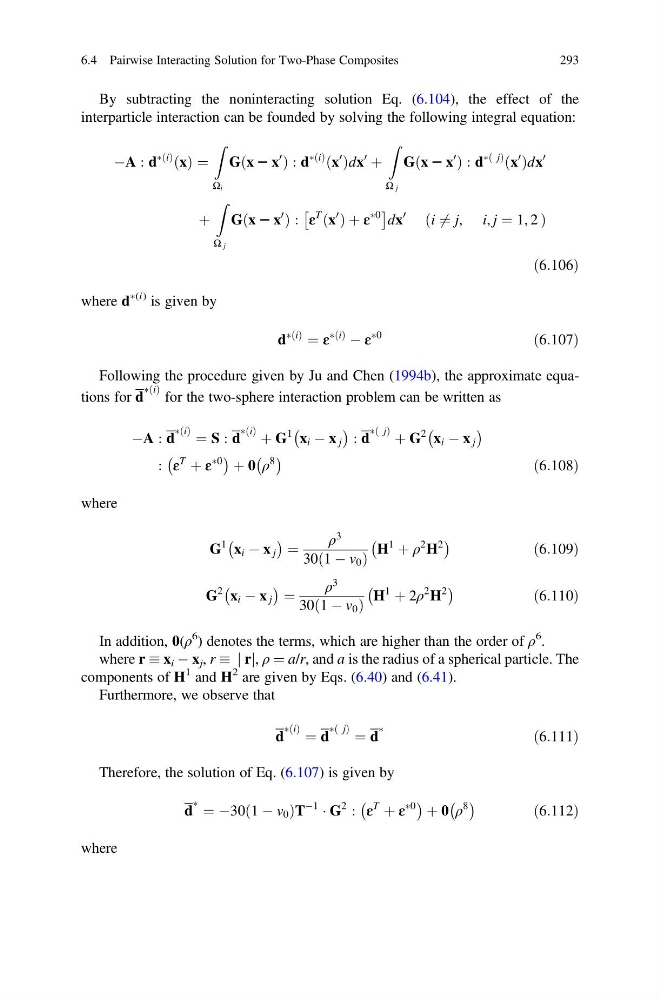
By subtracting the noninteracting solution Eq. (6.104), the effect of the
interparticle interaction can be founded by solving the following integral equation:
ÀA : d
à i
ð Þ x
ð Þ ¼
Z
Ω i
G x 2 x
0
ð
Þ: d
à i
ð Þ x
0
ð Þdx
0
þ
Z
Ω j
G x 2 x
0
ð
Þ: d
à j
ð Þ x
0
ð Þdx
0
þ
Z
Ω j
G x 2 x
0
ð
Þ: ε
T x
0
ð Þ þ ε
Ã0
Â
Ã
dx
0
i 6 ¼ j, i, j ¼ 1, 2
ð
Þ
ð6:106Þ
where d
Ã(i) is given by
d
à i
ð Þ
¼ ε
à i
ð Þ
À ε
Ã0
ð6:107Þ
Following the procedure given by Ju and Chen (1994b), the approximate equations for d
à i
ð Þ for the two-sphere interaction problem can be written as
ÀA : d
à i
ð Þ ¼ S : d
à i
ð Þ þ G
1 x i À x j
À
Á : d
à j
ð Þ þ G
2 x i À x j
À
Á
: ε
T
þ ε
Ã0
À
Á þ 0 ρ
8
À Á
ð6:108Þ
where
G
1 x i À x j
À
Á ¼
ρ
3
30 1 À v 0
ð
Þ
H
1
þ ρ
2 H
2
À
Á
ð6:109Þ
G
2 x i À x j
À
Á ¼
ρ
3
30 1 À v 0
ð
Þ
H
1
þ 2ρ
2 H
2
À
Á
ð6:110Þ
In addition, 0(ρ
6 ) denotes the terms, which are higher than the order of ρ
6 .
where r x i À x j , r j rj, ρ ¼ a/r, and a is the radius of a spherical particle. The
components of H
1 and H
2 are given by Eqs. (6.40) and (6.41).
Furthermore, we observe that
d
à i
ð Þ ¼ d
à j
ð Þ ¼ d
Ã
ð6:111Þ
Therefore, the solution of Eq. (6.107) is given by
d
à ¼ À30 1 À v 0
ð
ÞT
À1
Á G
2
: ε
T
þ ε
Ã0
À
Á þ 0 ρ
8
À Á
ð6:112Þ
where
6.4 Pairwise Interacting Solution for Two-Phase Composites
293
interparticle interaction can be founded by solving the following integral equation:
ÀA : d
à i
ð Þ x
ð Þ ¼
Z
Ω i
G x 2 x
0
ð
Þ: d
à i
ð Þ x
0
ð Þdx
0
þ
Z
Ω j
G x 2 x
0
ð
Þ: d
à j
ð Þ x
0
ð Þdx
0
þ
Z
Ω j
G x 2 x
0
ð
Þ: ε
T x
0
ð Þ þ ε
Ã0
Â
Ã
dx
0
i 6 ¼ j, i, j ¼ 1, 2
ð
Þ
ð6:106Þ
where d
Ã(i) is given by
d
à i
ð Þ
¼ ε
à i
ð Þ
À ε
Ã0
ð6:107Þ
Following the procedure given by Ju and Chen (1994b), the approximate equations for d
à i
ð Þ for the two-sphere interaction problem can be written as
ÀA : d
à i
ð Þ ¼ S : d
à i
ð Þ þ G
1 x i À x j
À
Á : d
à j
ð Þ þ G
2 x i À x j
À
Á
: ε
T
þ ε
Ã0
À
Á þ 0 ρ
8
À Á
ð6:108Þ
where
G
1 x i À x j
À
Á ¼
ρ
3
30 1 À v 0
ð
Þ
H
1
þ ρ
2 H
2
À
Á
ð6:109Þ
G
2 x i À x j
À
Á ¼
ρ
3
30 1 À v 0
ð
Þ
H
1
þ 2ρ
2 H
2
À
Á
ð6:110Þ
In addition, 0(ρ
6 ) denotes the terms, which are higher than the order of ρ
6 .
where r x i À x j , r j rj, ρ ¼ a/r, and a is the radius of a spherical particle. The
components of H
1 and H
2 are given by Eqs. (6.40) and (6.41).
Furthermore, we observe that
d
à i
ð Þ ¼ d
à j
ð Þ ¼ d
Ã
ð6:111Þ
Therefore, the solution of Eq. (6.107) is given by
d
à ¼ À30 1 À v 0
ð
ÞT
À1
Á G
2
: ε
T
þ ε
Ã0
À
Á þ 0 ρ
8
À Á
ð6:112Þ
where
6.4 Pairwise Interacting Solution for Two-Phase Composites
293