

3T 1
à þ 2T 2
à ¼ À
3T 1 þ 2T 2
aφ þ 1
ð
Þ
2
ð6:85Þ
T 2
à ¼ À
T 2
bφ þ 1
ð
Þ
2
þ
1
2 bφ þ 1
ð
Þ
ð6:86Þ
3T 1
ÃÃ þ 2T 2
ÃÃ ¼
3T 1 þ 2T 2
aφ þ 1
ð
Þ
2
ð6:87Þ
T 2
ÃÃ ¼
T 2
bφ þ 1
ð
Þ
2
þ
bφ À 1
2 bφ þ 1
ð
Þ
ð6:88Þ
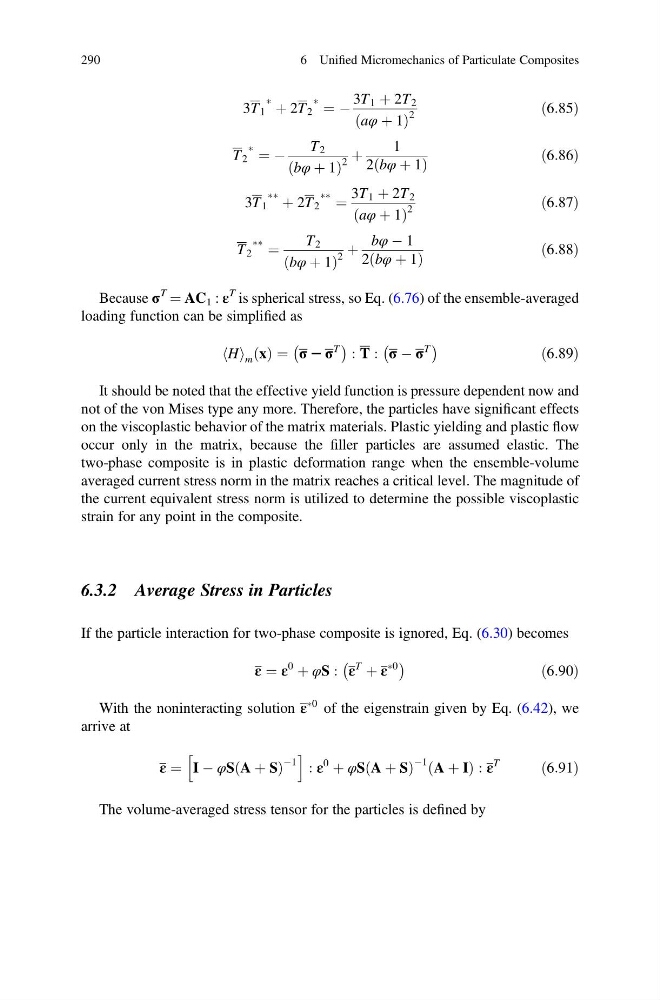
Because σ
T
¼ AC 1 : ε
T is spherical stress, so Eq. (6.76) of the ensemble-averaged
loading function can be simplified as
H
h i m x
ð Þ ¼ σ 2 σ
T
À
Á : T : σ À σ
T
À
Á
ð6:89Þ
It should be noted that the effective yield function is pressure dependent now and
not of the von Mises type any more. Therefore, the particles have significant effects
on the viscoplastic behavior of the matrix materials. Plastic yielding and plastic flow
occur only in the matrix, because the filler particles are assumed elastic. The
two-phase composite is in plastic deformation range when the ensemble-volume
averaged current stress norm in the matrix reaches a critical level. The magnitude of
the current equivalent stress norm is utilized to determine the possible viscoplastic
strain for any point in the composite.
6.3.2 Average Stress in Particles
If the particle interaction for two-phase composite is ignored, Eq. (6.30) becomes
ε ¼ ε
0
þ φS : ε
T
þ ε
Ã0
À
Á
ð6:90Þ
With the noninteracting solution ε
Ã0 of the eigenstrain given by Eq. (6.42), we
arrive at
ε ¼ I À φS A þ S
ð
Þ
À1
h
i
: ε
0
þ φS A þ S
ð
Þ
À1 A þ I
ð
Þ: ε
T
ð6:91Þ
The volume-averaged stress tensor for the particles is defined by
290
6 Unified Micromechanics of Particulate Composites
à þ 2T 2
à ¼ À
3T 1 þ 2T 2
aφ þ 1
ð
Þ
2
ð6:85Þ
T 2
à ¼ À
T 2
bφ þ 1
ð
Þ
2
þ
1
2 bφ þ 1
ð
Þ
ð6:86Þ
3T 1
ÃÃ þ 2T 2
ÃÃ ¼
3T 1 þ 2T 2
aφ þ 1
ð
Þ
2
ð6:87Þ
T 2
ÃÃ ¼
T 2
bφ þ 1
ð
Þ
2
þ
bφ À 1
2 bφ þ 1
ð
Þ
ð6:88Þ
Because σ
T
¼ AC 1 : ε
T is spherical stress, so Eq. (6.76) of the ensemble-averaged
loading function can be simplified as
H
h i m x
ð Þ ¼ σ 2 σ
T
À
Á : T : σ À σ
T
À
Á
ð6:89Þ
It should be noted that the effective yield function is pressure dependent now and
not of the von Mises type any more. Therefore, the particles have significant effects
on the viscoplastic behavior of the matrix materials. Plastic yielding and plastic flow
occur only in the matrix, because the filler particles are assumed elastic. The
two-phase composite is in plastic deformation range when the ensemble-volume
averaged current stress norm in the matrix reaches a critical level. The magnitude of
the current equivalent stress norm is utilized to determine the possible viscoplastic
strain for any point in the composite.
6.3.2 Average Stress in Particles
If the particle interaction for two-phase composite is ignored, Eq. (6.30) becomes
ε ¼ ε
0
þ φS : ε
T
þ ε
Ã0
À
Á
ð6:90Þ
With the noninteracting solution ε
Ã0 of the eigenstrain given by Eq. (6.42), we
arrive at
ε ¼ I À φS A þ S
ð
Þ
À1
h
i
: ε
0
þ φS A þ S
ð
Þ
À1 A þ I
ð
Þ: ε
T
ð6:91Þ
The volume-averaged stress tensor for the particles is defined by
290
6 Unified Micromechanics of Particulate Composites