

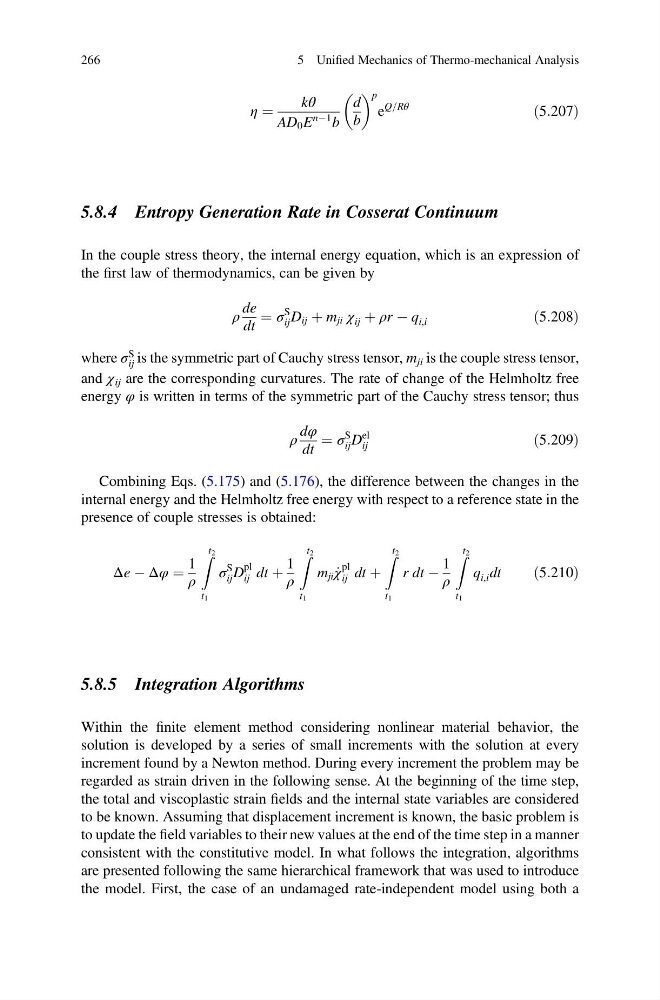
η ¼
kθ
AD 0 E
nÀ1 b
d
b
p
e
Q=Rθ
ð5:207Þ
5.8.4 Entropy Generation Rate in Cosserat Continuum
In the couple stress theory, the internal energy equation, which is an expression of
the first law of thermodynamics, can be given by
ρ
de
dt
¼ σ
S
ij D ij þ m ji χ ij þ ρr À q i,i
ð5:208Þ
where σ
S
ij is the symmetric part of Cauchy stress tensor, m ji is the couple stress tensor,
and χ ij are the corresponding curvatures. The rate of change of the Helmholtz free
energy φ is written in terms of the symmetric part of the Cauchy stress tensor; thus
ρ
dφ
dt
¼ σ
S
ij D
el
ij
ð5:209Þ
Combining Eqs. (5.175) and (5.176), the difference between the changes in the
internal energy and the Helmholtz free energy with respect to a reference state in the
presence of couple stresses is obtained:
Δe À Δφ ¼
1
ρ
Z t 2
t 1
σ
S
ij D
pl
ij dt þ
1
ρ
Z t 2
t 1
m ji _
χ
pl
ij dt þ
Z t 2
t 1
r dt À
1
ρ
Z t 2
t 1
q i,i dt
ð5:210Þ
5.8.5 Integration Algorithms
Within the finite element method considering nonlinear material behavior, the
solution is developed by a series of small increments with the solution at every
increment found by a Newton method. During every increment the problem may be
regarded as strain driven in the following sense. At the beginning of the time step,
the total and viscoplastic strain fields and the internal state variables are considered
to be known. Assuming that displacement increment is known, the basic problem is
to update the field variables to their new values at the end of the time step in a manner
consistent with the constitutive model. In what follows the integration, algorithms
are presented following the same hierarchical framework that was used to introduce
the model. First, the case of an undamaged rate-independent model using both a
266
5 Unified Mechanics of Thermo-mechanical Analysis
kθ
AD 0 E
nÀ1 b
d
b
p
e
Q=Rθ
ð5:207Þ
5.8.4 Entropy Generation Rate in Cosserat Continuum
In the couple stress theory, the internal energy equation, which is an expression of
the first law of thermodynamics, can be given by
ρ
de
dt
¼ σ
S
ij D ij þ m ji χ ij þ ρr À q i,i
ð5:208Þ
where σ
S
ij is the symmetric part of Cauchy stress tensor, m ji is the couple stress tensor,
and χ ij are the corresponding curvatures. The rate of change of the Helmholtz free
energy φ is written in terms of the symmetric part of the Cauchy stress tensor; thus
ρ
dφ
dt
¼ σ
S
ij D
el
ij
ð5:209Þ
Combining Eqs. (5.175) and (5.176), the difference between the changes in the
internal energy and the Helmholtz free energy with respect to a reference state in the
presence of couple stresses is obtained:
Δe À Δφ ¼
1
ρ
Z t 2
t 1
σ
S
ij D
pl
ij dt þ
1
ρ
Z t 2
t 1
m ji _
χ
pl
ij dt þ
Z t 2
t 1
r dt À
1
ρ
Z t 2
t 1
q i,i dt
ð5:210Þ
5.8.5 Integration Algorithms
Within the finite element method considering nonlinear material behavior, the
solution is developed by a series of small increments with the solution at every
increment found by a Newton method. During every increment the problem may be
regarded as strain driven in the following sense. At the beginning of the time step,
the total and viscoplastic strain fields and the internal state variables are considered
to be known. Assuming that displacement increment is known, the basic problem is
to update the field variables to their new values at the end of the time step in a manner
consistent with the constitutive model. In what follows the integration, algorithms
are presented following the same hierarchical framework that was used to introduce
the model. First, the case of an undamaged rate-independent model using both a
266
5 Unified Mechanics of Thermo-mechanical Analysis