

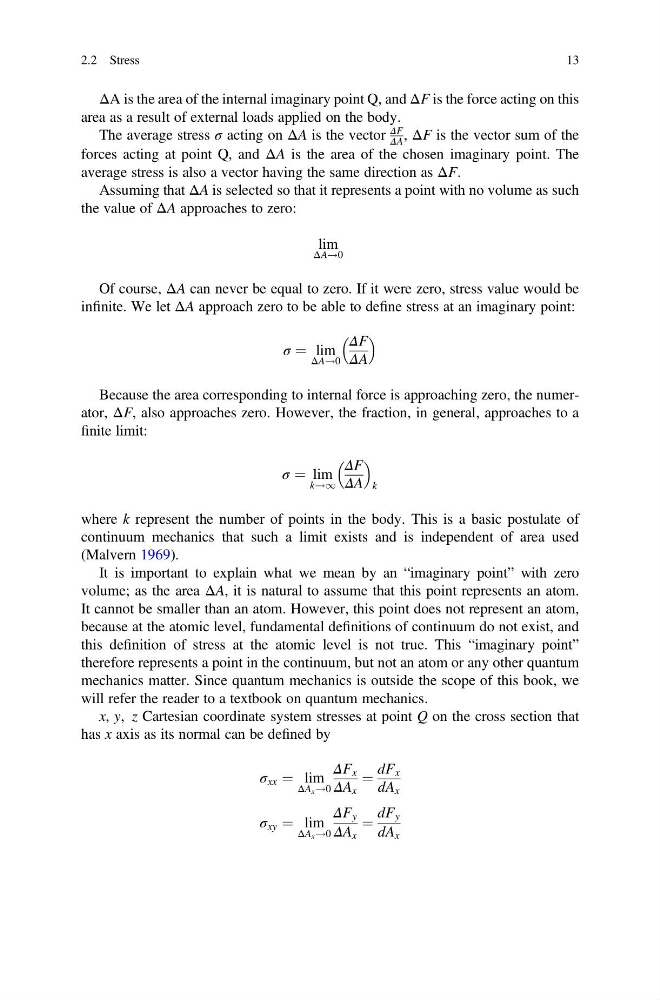
ΔA is the area of the internal imaginary point Q, and ΔF is the force acting on this
area as a result of external loads applied on the body.
The average stress σ acting on ΔA is the vector
ΔF
ΔA , ΔF is the vector sum of the
forces acting at point Q, and ΔA is the area of the chosen imaginary point. The
average stress is also a vector having the same direction as ΔF.
Assuming that ΔA is selected so that it represents a point with no volume as such
the value of ΔA approaches to zero:
lim
ΔA!0
Of course, ΔA can never be equal to zero. If it were zero, stress value would be
infinite. We let ΔA approach zero to be able to define stress at an imaginary point:
σ ¼ lim
ΔA!0
ΔF
ΔA
Because the area corresponding to internal force is approaching zero, the numerator, ΔF, also approaches zero. However, the fraction, in general, approaches to a
finite limit:
σ ¼ lim
k!1
ΔF
ΔA
k
where k represent the number of points in the body. This is a basic postulate of
continuum mechanics that such a limit exists and is independent of area used
(Malvern 1969).
It is important to explain what we mean by an “imaginary point” with zero
volume; as the area ΔA, it is natural to assume that this point represents an atom.
It cannot be smaller than an atom. However, this point does not represent an atom,
because at the atomic level, fundamental definitions of continuum do not exist, and
this definition of stress at the atomic level is not true. This “imaginary point”
therefore represents a point in the continuum, but not an atom or any other quantum
mechanics matter. Since quantum mechanics is outside the scope of this book, we
will refer the reader to a textbook on quantum mechanics.
x, y, z Cartesian coordinate system stresses at point Q on the cross section that
has x axis as its normal can be defined by
σ xx ¼ lim
ΔA x !0
ΔF x
ΔA x
¼
dF x
dA x
σ xy ¼ lim
ΔA x !0
ΔF y
ΔA x
¼
dF y
dA x
2.2 Stress
13
area as a result of external loads applied on the body.
The average stress σ acting on ΔA is the vector
ΔF
ΔA , ΔF is the vector sum of the
forces acting at point Q, and ΔA is the area of the chosen imaginary point. The
average stress is also a vector having the same direction as ΔF.
Assuming that ΔA is selected so that it represents a point with no volume as such
the value of ΔA approaches to zero:
lim
ΔA!0
Of course, ΔA can never be equal to zero. If it were zero, stress value would be
infinite. We let ΔA approach zero to be able to define stress at an imaginary point:
σ ¼ lim
ΔA!0
ΔF
ΔA
Because the area corresponding to internal force is approaching zero, the numerator, ΔF, also approaches zero. However, the fraction, in general, approaches to a
finite limit:
σ ¼ lim
k!1
ΔF
ΔA
k
where k represent the number of points in the body. This is a basic postulate of
continuum mechanics that such a limit exists and is independent of area used
(Malvern 1969).
It is important to explain what we mean by an “imaginary point” with zero
volume; as the area ΔA, it is natural to assume that this point represents an atom.
It cannot be smaller than an atom. However, this point does not represent an atom,
because at the atomic level, fundamental definitions of continuum do not exist, and
this definition of stress at the atomic level is not true. This “imaginary point”
therefore represents a point in the continuum, but not an atom or any other quantum
mechanics matter. Since quantum mechanics is outside the scope of this book, we
will refer the reader to a textbook on quantum mechanics.
x, y, z Cartesian coordinate system stresses at point Q on the cross section that
has x axis as its normal can be defined by
σ xx ¼ lim
ΔA x !0
ΔF x
ΔA x
¼
dF x
dA x
σ xy ¼ lim
ΔA x !0
ΔF y
ΔA x
¼
dF y
dA x
2.2 Stress
13